
Loading, please wait...
LOT 1086
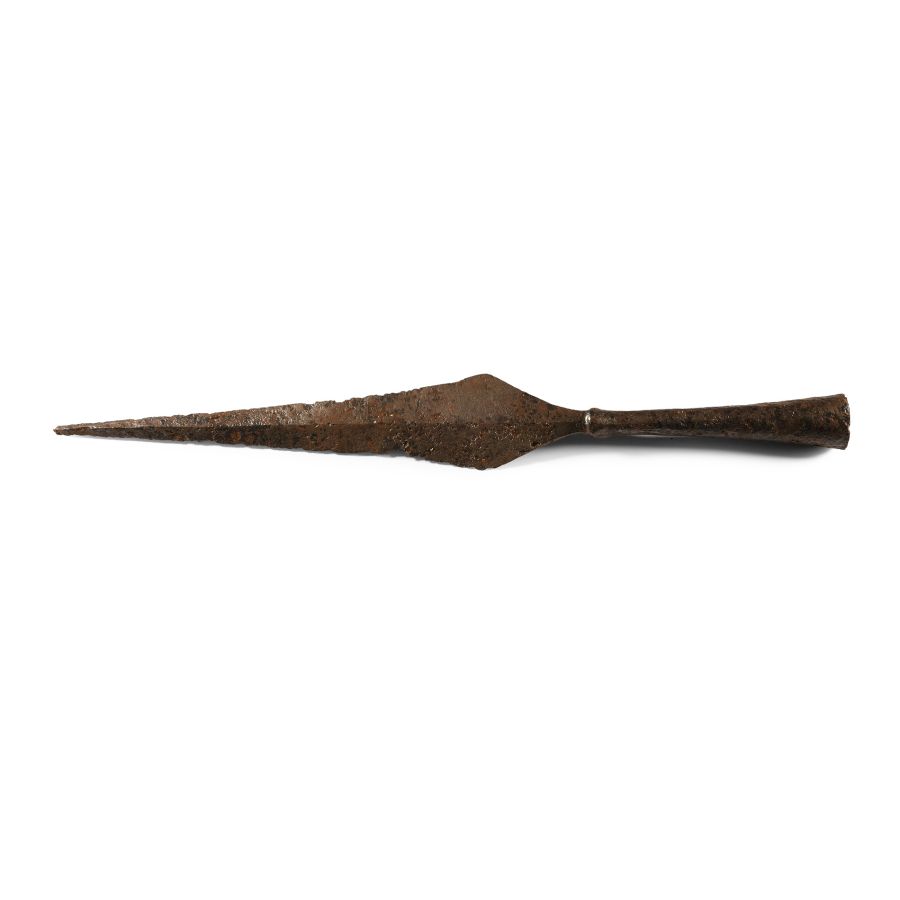
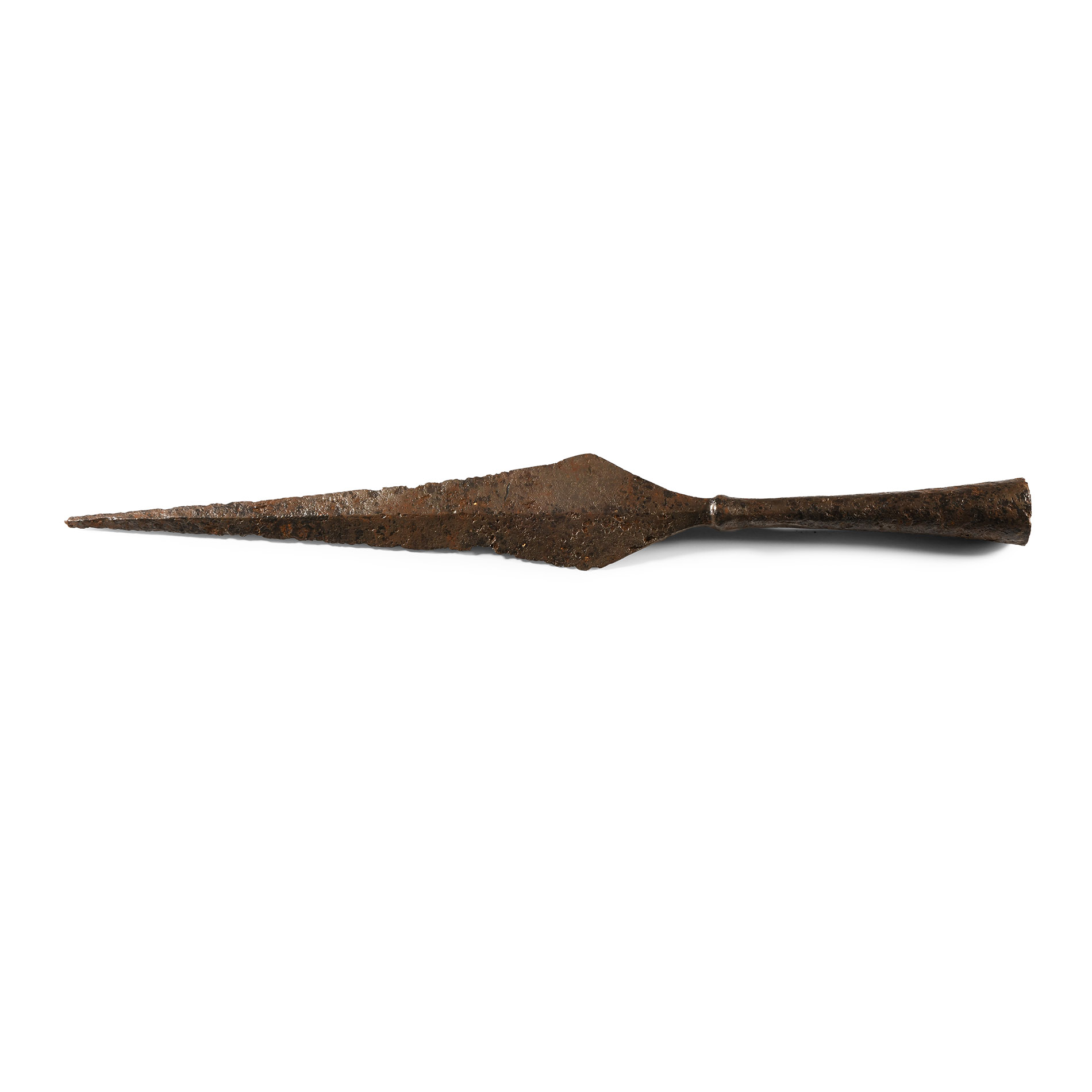
Viking Age Iron Socketted Spearhead
10-11TH CENTURY A.D.
16 in. (313 grams, 40.7 cm).
Type M with rhomboid blade with straight edges, ending in squared angles at the base and narrowing as it merges into the round cross-section socket.
ProvenanceEx private collection of Mr M.B., Mainz, Germany, since the 1980s.
Acquired from the above, 2004.
Cf. D'Amato, R., 'The Betrayal: military iconography and archaeology in the Byzantine paintings of XI-XV centuries AD representing the arrest of Our Lord' in Acts of the International conference ‘Weapons bring peace? Warfare in Medieval and Early Modern Europe’, Wroclaw, 2-4 December 2010, Wroclaw, 2012, pp.69-95, fig.18; Hjardar, K. and Vike, V., Vikings at war, Oxford-Philadelphia, 2016, pp.175-180.
FootnotesThis type of spears account for half of the found Viking spears, together with types I,K,G,F. Differently from the previous types of Viking spearheads, side wings do not feature commonly in these typologies. A Viking spear of M type, dated at end of 11th century A.D., was found on the Drastar battlefield, showing a cross intermediary between the blade and the shaft.
CONDITIONTimeLine Auctions follows a vetting process to ensure the authenticity and legality of all items, reinforcing our commitment to integrity and responsible trading. Each antiquity, antique, and coin lot undergoes thorough examination by a vetting committee of at least ten external specialists, professional trade association members, scientists, and archaeologists: Our Vetting Process
AUCTIONS:
TimeLine is a leading auction house specialising in antiquities, ancient art, collectables, natural history, coins, medals, and books. Our auctions offer museums, collectors, historians, and enthusiasts the opportunity to acquire unique and historically significant pieces.
-
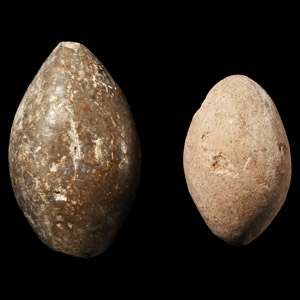
Roman Stone and Lead Sling Shot Group
2nd century A.D.Sold for (Inc. bp): £195
Comprising two lentoid-section, one a lead glans, and another in stone. 121 grams total, 47-58 mm
Ex Simmons Gallery, London E11, UK, in the 1990s. From a North London collection.
Both the missiles seem to be of ovoid type, type Ia of the Völling classification. The pair finds parallels with examples unearthed at Ham Hill, Somerset, UK. The sling (funda) with its lead missiles (plumbea pondera or glandae) and stone (lapides) was used by special funditores, illustrated on Trajan’s Column where they are simply dressed in broad tunics with no armour, but carry a shield. A fold in their cloak, or sagulum, acted as an ammunition bag. The effectiveness of the slingers was unquestionable and much appreciated, especially against elephants. Celsus, writing towards the end of the 2nd century A.D., described how a slingshot wound was more dangerous and harder to treat than one inflicted by an arrow. -
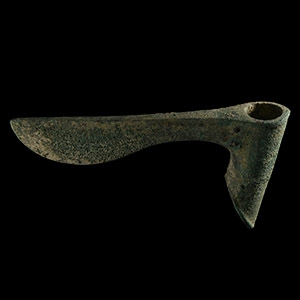
Luristan Sar-e Tabar Socketted Axehead
2nd millennium B.C.Sold for (Inc. bp): £208
With plain cylindrical socket and staff, off-set at the base, of simple undecorated shape with a long lentoid-section D-shaped blade with scooped profile. 465 grams, 18 cm
Earlier 20th century collection. Mayfair, London gallery, UK. Dr D.G. collection, 1990s-2019.
Many examples of bronze axeheads are attributed to the Luristan culture and various shapes have been discussed by different scholars. Moorey (1971, pp.39-41) shows similar axeheads, stating that the texts executed on some specimens have shown them made of arsenical bronze, and attributes them to the late 3rd millennium B.C. or 2nd millennium B.C., period in which this alloy was used abundantly. -
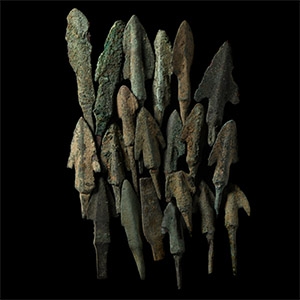
Western Asiatic Bronze Arrowhead Group
10th-9th century B.C.Sold for (Inc. bp): £117
Comprising mainly tanged arrowheads, the most of them having large elongated triangular blades and raised midrib, sharp central groove, cylindrical or squared stem for the shaft, barbed shoulders and convex sides; others with lanceolate head and rounded shoulders with long tang and foliate-section. 103 grams total, 29-68 mm
Acquired 1980-2015. Ex Abelita family collection.
The most of these arrowheads, having a lozenge-section midrib with thin blades filed sharp at the edges, are typical of the early Iron Age in Luristan. These arrowheads seem to belong to the type V, subcategory types A, C and D according to the classification of Khorasani and Negahban. In the four categories of triangular bronze arrowheads from Luristan, Marlik, and Northern Iran individuated by Negahban, subtypes C and D of type V are larger arrow or javelin heads, C with barbed shoulders and D with round shoulders. Subtype A is substantially similar to C, but smaller. Similar arrowheads are also visible in the Western Iberian and Balkan cultures in the Early Iron Age.
