
Loading, please wait...
LOT 1542
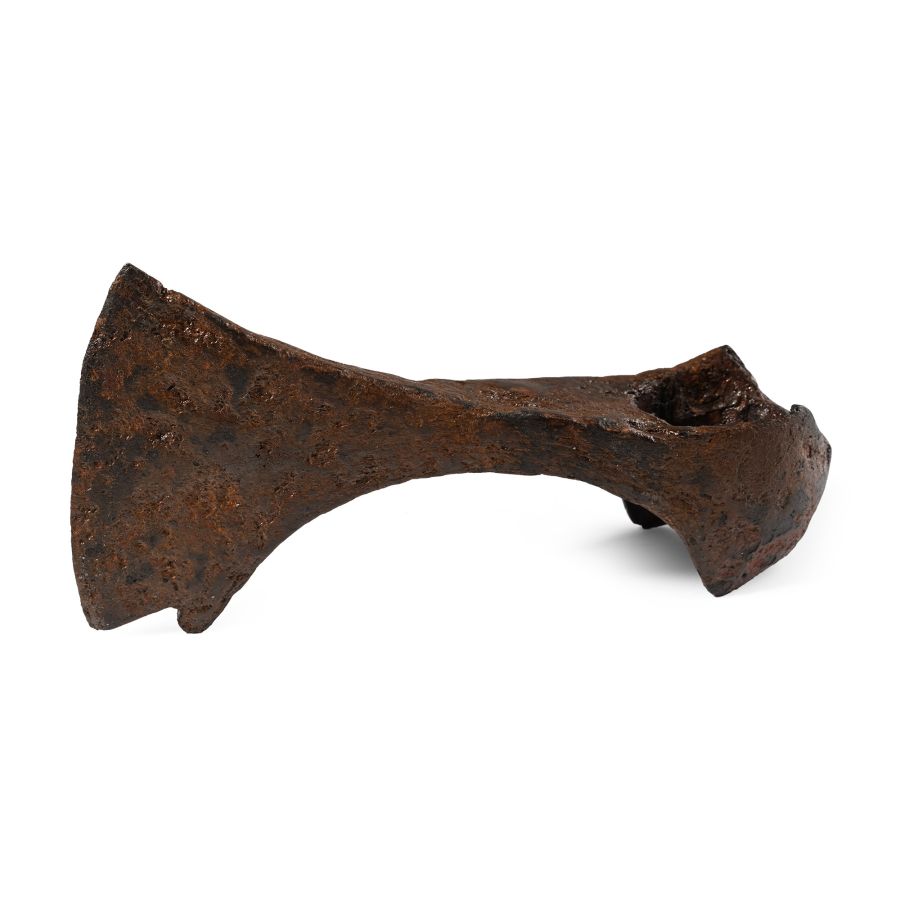
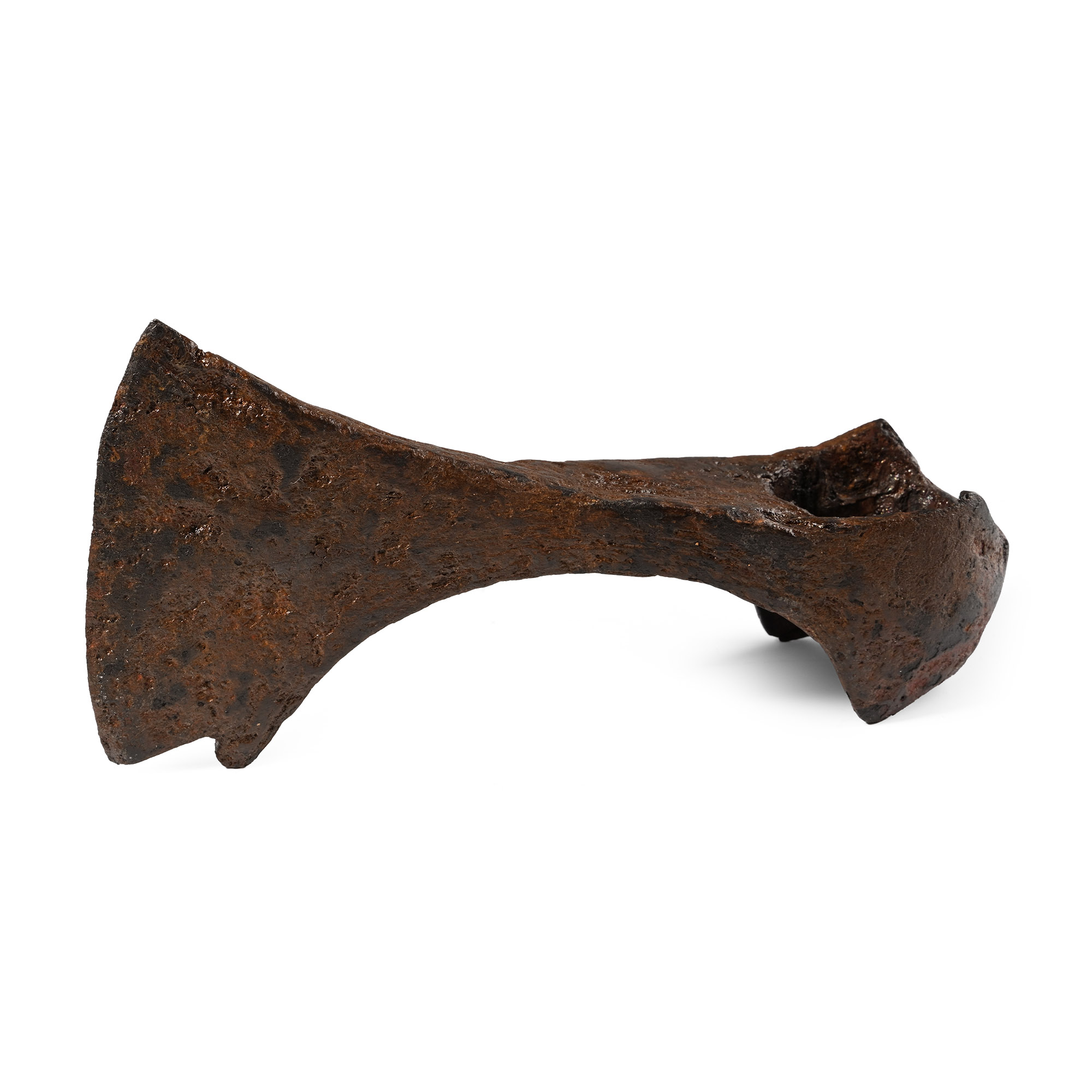
Viking Age Iron Shallow Bearded Axehead
9TH CENTURY A.D.
7 in. (579 grams, 18 cm).
A hand-forged axehead with triangular-section narrow blade widening to a broad bevelled edge with square chin, socket with lateral flanges and rounded panel to the rear. [No Reserve]
ProvenanceFrom the private collection of a London gentleman, from his grandfather's collection formed before the early 1970s.
This lot is accompanied by an illustrated lot declaration signed by the Head of the Antiquities Department, Dr Raffaele D'Amato.
Cf. Thunmark-Nylén, L., Die Wikingerzeit Gotlands I.: Abbildungen der Graubfunde, Stockholm, 1992, pl.13, item 14.
FootnotesThe axe seems to belong to the typology of Viking side axes of Wheeler type B (Wheeler III / Rygh 559). Usually these bearded axeheads (skeggöks) had a longer edge, designed to split tree trunks into planks and beams, or heads in two parts. Some of the bearded axes were known as halfÞynna öx, the neck on such 'half thin axe' was thinly forged, to make it lighter.
CONDITIONTimeLine Auctions follows a vetting process to ensure the authenticity and legality of all items, reinforcing our commitment to integrity and responsible trading. Each antiquity, antique, and coin lot undergoes thorough examination by a vetting committee of at least ten external specialists, professional trade association members, scientists, and archaeologists: Our Vetting Process
AUCTIONS:
TimeLine is a leading auction house specialising in antiquities, ancient art, collectables, natural history, coins, medals, and books. Our auctions offer museums, collectors, historians, and enthusiasts the opportunity to acquire unique and historically significant pieces.
-
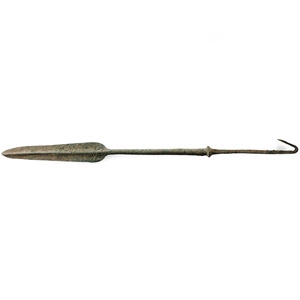
Mesopotamian Bronze Javelin Head
3rd-2nd millennium B.C.Sold for (Inc. bp): £182
With foliate blade, rhomboidal in section, raised mid-rib, medium length stem widening at its base and forming a small stop, rectangular-section tang with bent terminal. 206 grams, 45.4 cm
Acquired in the 1990s. Ex Abelita family collection. This lot is accompanied by an illustrated lot declaration signed by the Head of the Antiquities Department, Dr Raffaele D'Amato.
The specimen belongs to the category of tripartite spears with long pointed biconvex blade and single bevelled tang. They seem to be a Mesopotamian and Susian (Elamite) variant, and this type also includes decorated blades, like the spear from Tello with the inscription 'King of Kish'. -
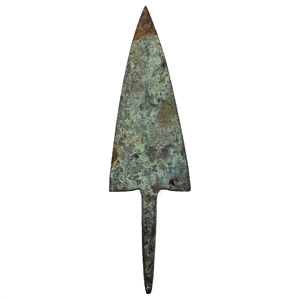
Large Luristan Bronze Arrowhead
2nd-1st millennium B.C.Sold for (Inc. bp): £85
Large triangular point with slightly raised midrib, long flat tang. 28.9 grams, 13.4 cm
Acquired on the UK art market before 2000. Property of an Essex, UK, gentleman. This lot is accompanied by an illustrated lot declaration signed by the Head of the Antiquities Department, Dr Raffaele D'Amato. -
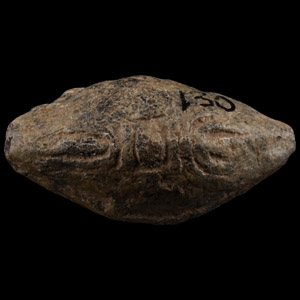
Romano-British 'Verulanium' Lead Slingshot
2nd century A.D.Sold for (Inc. bp): £169
Biconical in profile with reserved 'thunderbolt' motif to two faces; old inked collector's reference '130'. 59 grams, 37 mm
Found near St Albans (Verulamium), UK. From the private collection of Kenneth Machin (1936-2020), Buckinghamshire, UK; his collection of antiquities and natural history was formed since 1948; thence by descent. This lot is accompanied by an illustrated lot declaration signed by the Head of the Antiquities Department, Dr Raffaele D'Amato.
The missiles of ovoid shape belong to type Ia of the Völling classification. The sling (funda) with its lead missiles (plumbea pondera or glandae) and stone (lapides) was used by special funditores, illustrated on Trajan’s Column where they are simply dressed in broad tunics with no armour, but carry a shield. A fold in their cloak, or sagulum, acted as an ammunition bag. The effectiveness of the slingers was unquestionable and much appreciated, especially against elephants. Celsus, writing towards the end of the 2nd century A.D., described how a slingshot wound was more dangerous and harder to treat than one inflicted by an arrow.
