
Loading, please wait...
LOT 1061
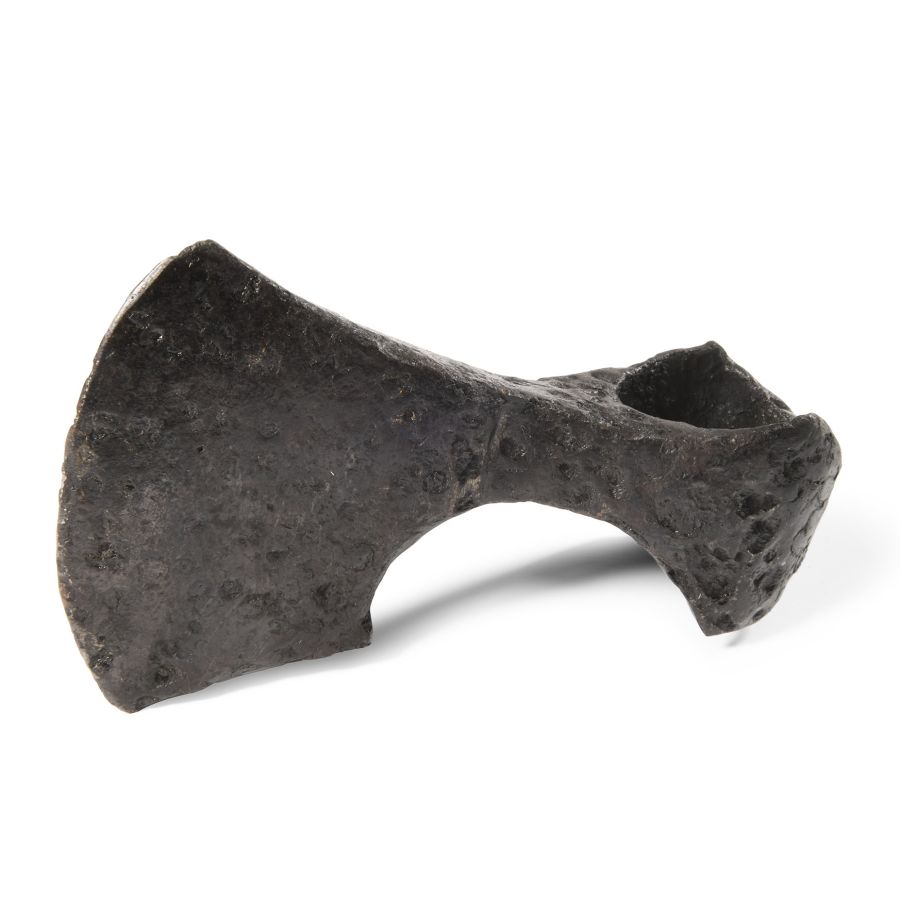
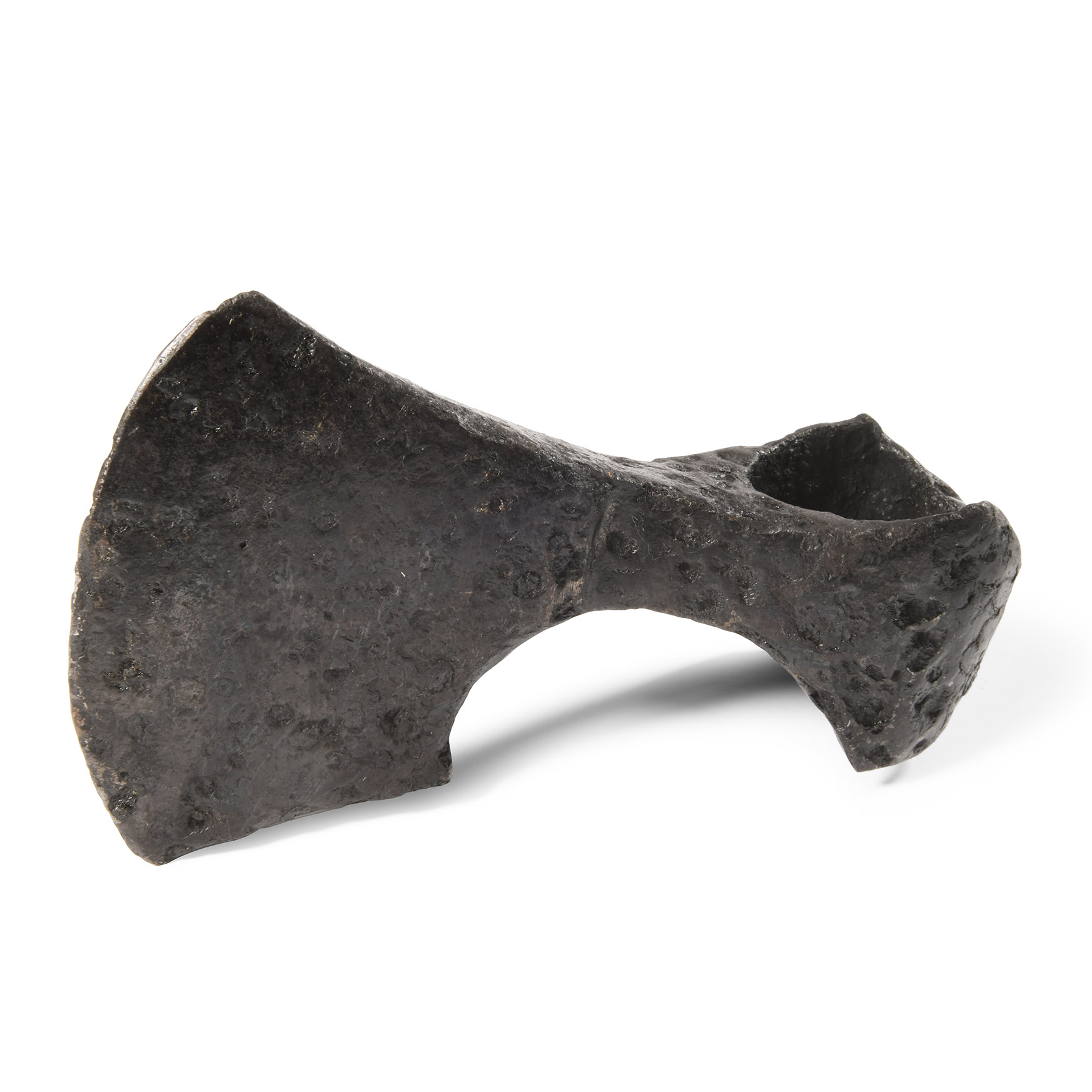
Viking Age Iron Bearded Axehead
9TH CENTURY A.D.
5 in. (359 grams, 12.4 cm).
Hand-forged with triangular-section narrow blade widening to a broad bevelled edge with square chin, socket with lateral flanges and rounded panel to the rear. [No Reserve]
ProvenanceFrom the private collection of a London gentleman, from his grandfather's collection formed before the early 1970s.
LiteratureCf. Thunmark-Nylén, L., Die Wikingerzeit Gotlands I.: Abbildungen der Graubfunde, Stockholm, 1992, pl.13, item 14.
FootnotesThe axe seems to belong to the typology of Viking side axes of Wheeler type B (Wheeler III / Rygh 559). Usually these bearded axeheads (skeggöks) had a longer edge, designed to split tree trunks into planks and beams, or heads in two parts. Some of the bearded axes were known as halfÞynna öx, the neck on such 'half thin axe' was thinly forged, to make it lighter.
CONDITIONTimeLine Auctions follows a vetting process to ensure the authenticity and legality of all items, reinforcing our commitment to integrity and responsible trading. Each antiquity, antique, and coin lot undergoes thorough examination by a vetting committee of at least ten external specialists, professional trade association members, scientists, and archaeologists: Our Vetting Process
AUCTIONS:
TimeLine is a leading auction house specialising in antiquities, ancient art, collectables, natural history, coins, medals, and books. Our auctions offer museums, collectors, historians, and enthusiasts the opportunity to acquire unique and historically significant pieces.
-
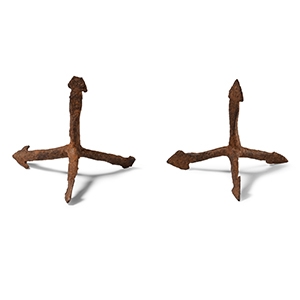
Medieval Iron Anti-Cavalry Caltrop Pair
11th-14th century A.D.Estimate: £100 - 140 (+bp*)
Opening Bid: £50
Each with four arms tipped with triangular spikes. 33 grams total, 62-64 mm
Acquired on the German art market before 2000. Property of a Surrey, UK, collector.
Caltrops were scattered on battlefields in an effort to stop or slow advancing enemy cavalry or foot soldiers; regardless of how a caltrop lands, one spike is always facing upwards. Caesar used widely them at Alesia (Caes., BG 7.73; 82): 'Stakes a foot long, with iron hooks attached to them, were entirely sunk in the ground before these, and were planted in every place at small intervals; these they called spurs'. -
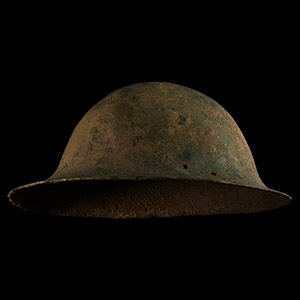
Villanovan Bronze Helmet
8th century B.C.Estimate: £10,000 - 14,000 (‡+bp*)
Opening Bid: £5,000
With rounded bowl and flared rim; three sets of paired piercings for attachment of leather cheek-flaps; cracked; accompanied by a custom-made display stand. 1.7 kg, 30.5 cm wide
Bowl pierced and cracked.
Acquired early 1990s. Ex private American collection; thence by descent. Private European collection since 1998. Accompanied by an academic report by Dr Raffaele D'Amato. This lot has been checked against the Interpol Database of stolen works of art and is accompanied by search certificate no.11573-199009.
The ‘pot’ or ‘bell’ helmet, found in contexts as early as the 8th century coffer grave (ad arca) from the Esquiline (Rome) and other graves (Coussin, 1926, p.88, fig.23; Sekunda, Northwood,1995, p.6, grave 94) was made from a single piece of bronze, while later Italic variants were fashioned from jointed plates (Connolly, 1981, p.102, figs.2-2a; Egg, 1988, p.223, variant Vetulonia). The skull was somewhat spherical, with a flared rim: in some Etruscan and Italic specimens, this was rivetted for strength. -
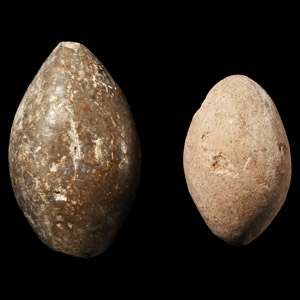
Roman Stone and Lead Sling Shot Group
2nd century A.D.Sold for (Inc. bp): £195
Comprising two lentoid-section, one a lead glans, and another in stone. 121 grams total, 47-58 mm
Ex Simmons Gallery, London E11, UK, in the 1990s. From a North London collection.
Both the missiles seem to be of ovoid type, type Ia of the Völling classification. The pair finds parallels with examples unearthed at Ham Hill, Somerset, UK. The sling (funda) with its lead missiles (plumbea pondera or glandae) and stone (lapides) was used by special funditores, illustrated on Trajan’s Column where they are simply dressed in broad tunics with no armour, but carry a shield. A fold in their cloak, or sagulum, acted as an ammunition bag. The effectiveness of the slingers was unquestionable and much appreciated, especially against elephants. Celsus, writing towards the end of the 2nd century A.D., described how a slingshot wound was more dangerous and harder to treat than one inflicted by an arrow.
