
Loading, please wait...
LOT 1427
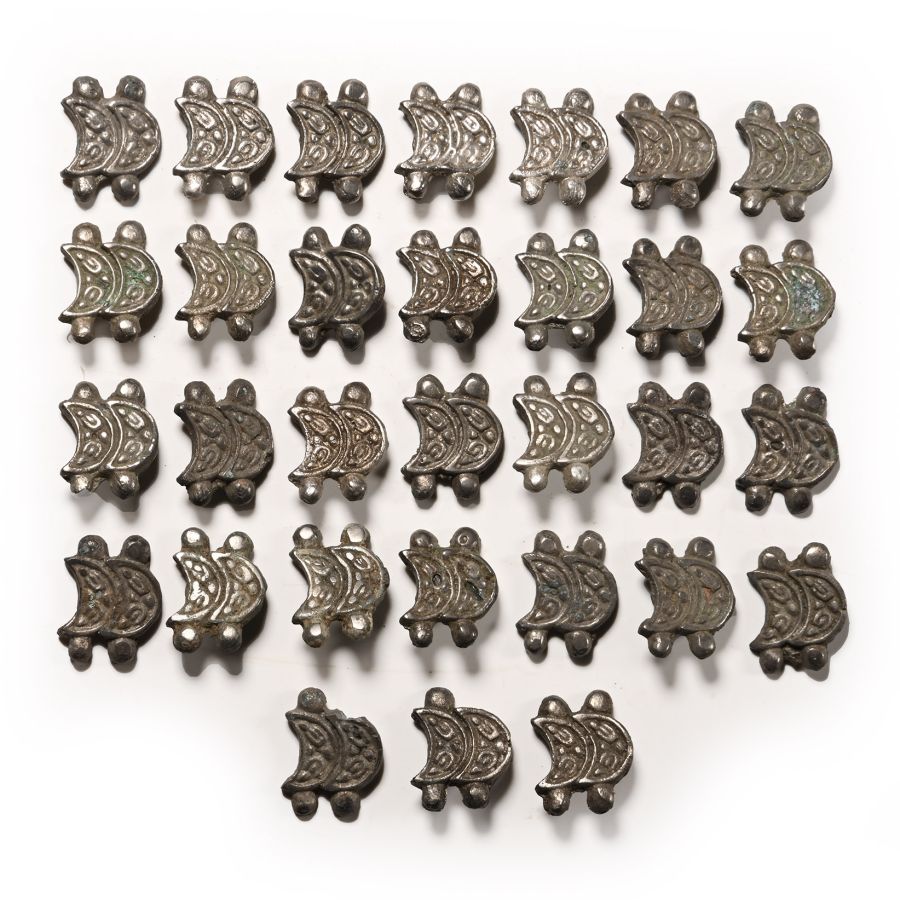
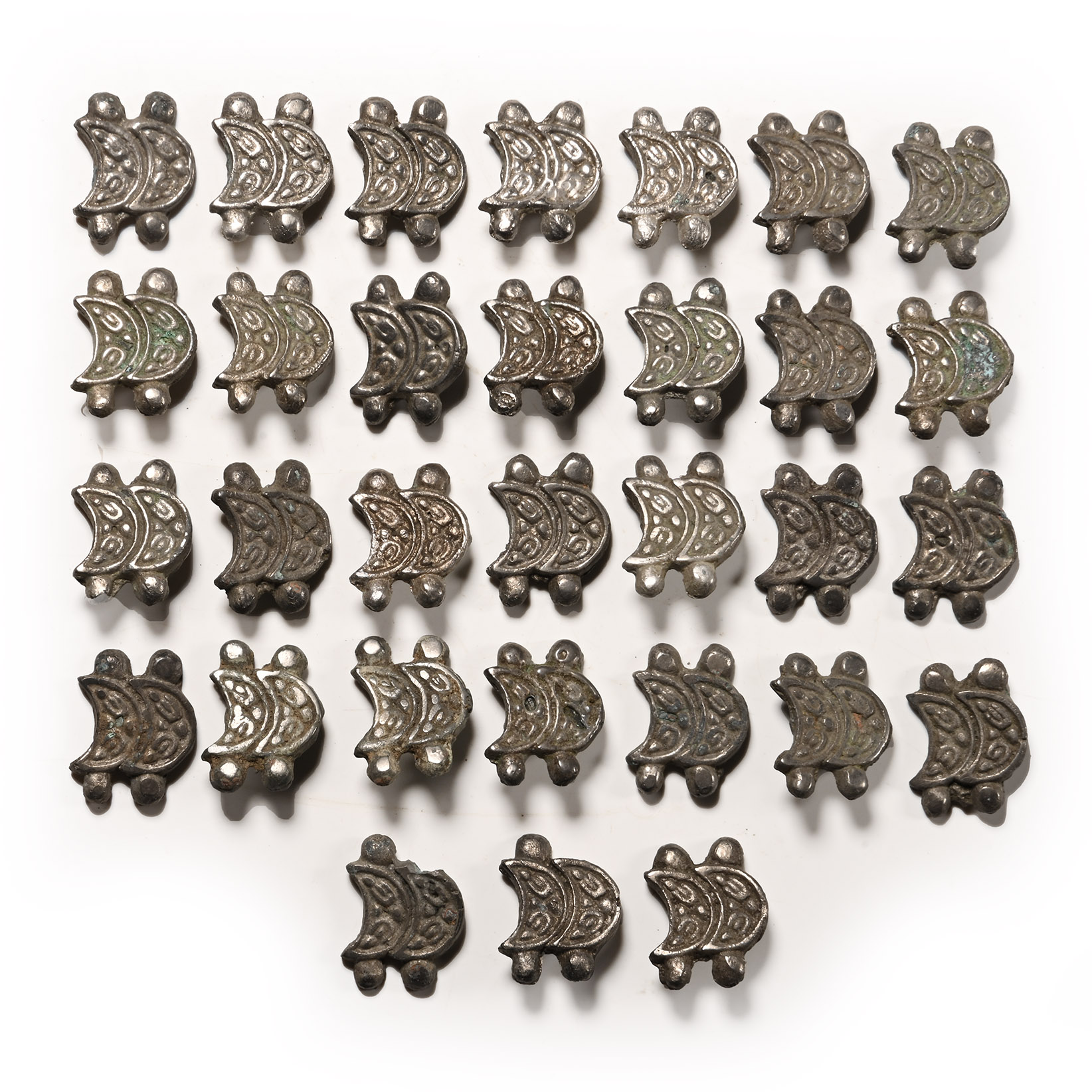
Viking Age High Tinned Bronze Horse Harness Rein Mount Group
KHAZAR, 9TH-10TH CENTURY A.D.
3/4 in. (66 grams total, 17-18 mm).
Mainly heater-shaped and crescentic plaque mounts with comma and pellet ornament, lateral lugs, mounting pins to reverse. [31, No Reserve]
ProvenanceAcquired on the European art market since the early 2000s.
From the private Northern Ireland collection of R.M.
TimeLine Auctions follows a vetting process to ensure the authenticity and legality of all items, reinforcing our commitment to integrity and responsible trading. Each antiquity, antique, and coin lot undergoes thorough examination by a vetting committee of at least ten external specialists, professional trade association members, scientists, and archaeologists: Our Vetting Process
AUCTIONS:
TimeLine is a leading auction house specialising in antiquities, ancient art, collectables, natural history, coins, medals, and books. Our auctions offer museums, collectors, historians, and enthusiasts the opportunity to acquire unique and historically significant pieces.
LOT 1427
Viking Age High Tinned Bronze Horse Harness Rein Mount Group
Sold for (Inc. bp): £624
-
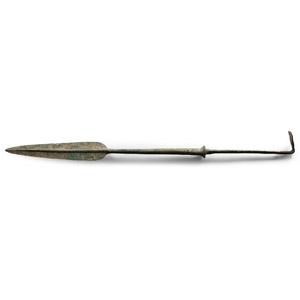
Mesopotamian Bronze Javelin Head
13th-7th century B.C.Sold for (Inc. bp): £124
With foliate blade, rhomboidal in section, raised mid-rib, medium length stem widening at its base and forming a small stop, quadrangular section tang with bent terminal. 191 grams, 45.5 cm
Acquired 1980-2015. Ex Abelita family collection.
The specimen belongs to the category of tripartite spears with long pointed biconvex blade and single bevelled tang. They seem to be a Mesopotamian and Susian (Elamite) variant, and this type also includes decorated blades, like the spear from Tello with the inscription 'King of Kish'. -
.jpg)
Mesopotamian Copper Double Rein Guide for a Chariot
Circa mid 3rd millennium B.C.Estimate: £6,000 - 8,000 (+bp*)
Opening Bid: £3,000
In the form of an advancing stallion on a plinth, holding its head high and gazing to the right; short standing mane with incised detailing, and a long tail extending to the plinth; recessed eyes, likely once inlaid, drilled nostrils and open mouth; the plinth joined at a right angle to two connected rings atop three parallel rods, the rods joined at the bottom to an arching bar with side lugs. 603 grams, 28.5 cm
Acquired from Toufic Arakji, Hamburg, Germany, 14 January 1997. with Mahboubian Gallery, London, UK. Property of a London gentleman. Accompanied by an academic academic report by Dr Raffaele D’Amato. This lot has been checked against the Interpol Database of stolen works of art and is accompanied by a search certificate number no.12160-218627.
This magnificent chariot fitting was cast in one piece, probably made in arsenical copper in Mesopotamia in the Early Dynastic Period (ED). The reins were connected to the head harness and then passed through the rein ring, that was connected to a yoke pole. The purpose of the rein ring was to prevent the multiple reins snarling and also added an element of control for the driver. The lower concave bar was tied onto the pole by rope or leather, while the hooks served to secure the ends. These rein rings were not only practical instruments, but also ornamental elements of royal vehicles. A well-known example of this type is a terret crowned by an equid figure that was associated with Pu-abi’s sledge in the Royal Cemetery at Ur, today at the British Museum, inv.121438. -
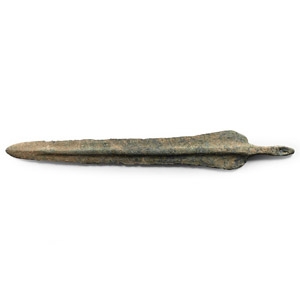
Western Asiatic Bronze Sword Blade
Circa 1000 B.C.Sold for (Inc. bp): £117
With rounded shoulders and square-sectioned mid-rib running to the blade tip; short tang with fastening hole. 254 grams, 34 cm
Acquired 1980-2015. Ex Abelita family collection.
The Luri people produced a quantity of fine metalwork, which according to Dr Khorasani, could be due to a settled period which arose as a result of the defeat of the Elamites by the Babylonians, leaving the Luristani people in relative peace for a period of time after 1200 BC. According to Khorasani 'A culture of innovation and experimentation flourished, and the repertoire of the Luristan smiths expanded in the period between 1150–1050 BC.'
