
Loading, please wait...
LOT 1171
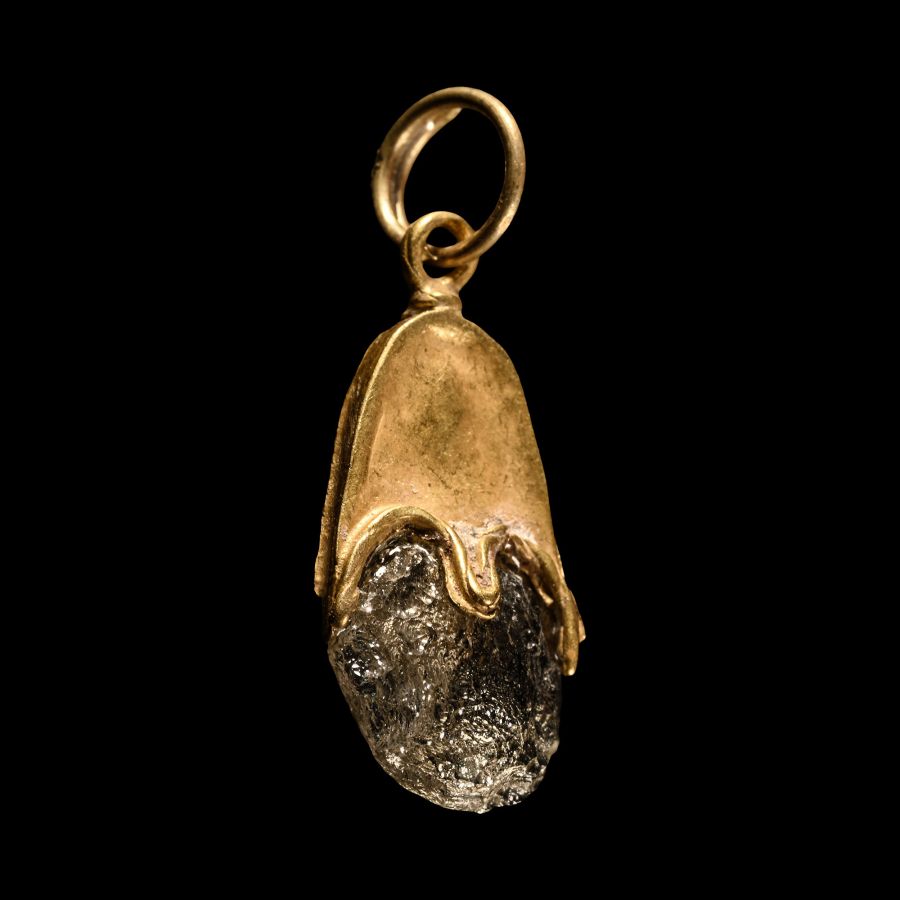
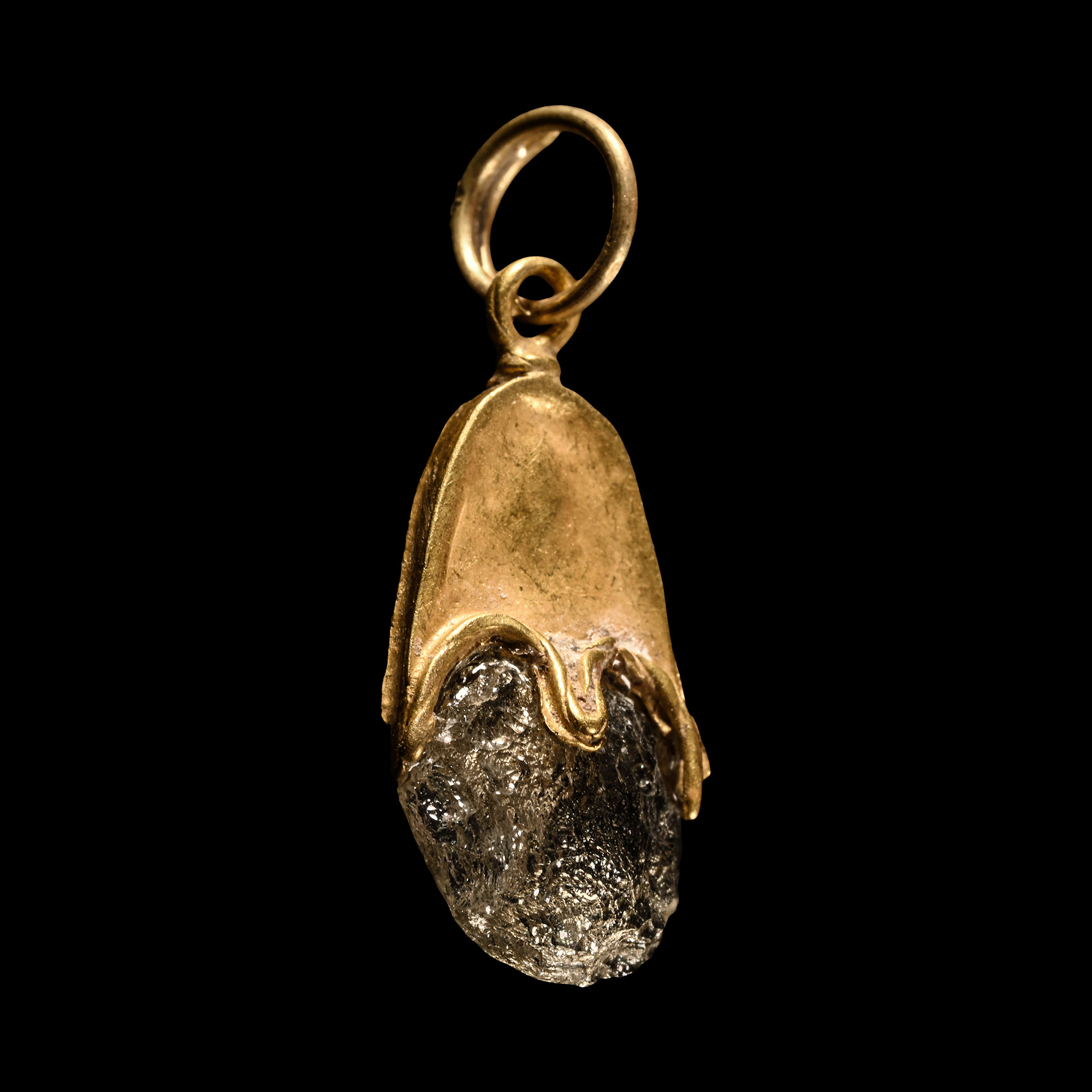
Viking Age Gold 'Elf Shot' Pendant
9TH-10TH CENTURY A.D. OR EARLIER
3/4 in. (0.64 grams, 21 mm).
Formed as a gold cap with rounded claws, set with polished glass gem; integral suspension loop with a later jump ring.
ProvenanceFrom a late Japanese specialist collector, 1970-2000s.
FootnotesThis amulet was believed to offer protection against 'Elfshot'. The attack of elves was believed responsible for mysterious suffering in men and livestock. 'Elfshot' described sudden shooting pains localised to a particular area of the body, such as in rheumatism, arthritis or muscle stitches or cramps. Elves were thought to shoot darts or arrows where such pains had no obvious external cause. Belief in elfshot persisted into the 20th century in rural areas, and as proof country folk would sometimes find small arrowheads (the remains of Neolithic or Mesolithic flints, or naturally-occurring spear-shaped stones) that were believed to be the magical weapons that caused the afflictions. Belief in elfshot began in the Pagan Germanic period.
CONDITIONTimeLine Auctions follows a vetting process to ensure the authenticity and legality of all items, reinforcing our commitment to integrity and responsible trading. Each antiquity, antique, and coin lot undergoes thorough examination by a vetting committee of at least ten external specialists, professional trade association members, scientists, and archaeologists: Our Vetting Process
AUCTIONS:
TimeLine is a leading auction house specialising in antiquities, ancient art, collectables, natural history, coins, medals, and books. Our auctions offer museums, collectors, historians, and enthusiasts the opportunity to acquire unique and historically significant pieces.
-
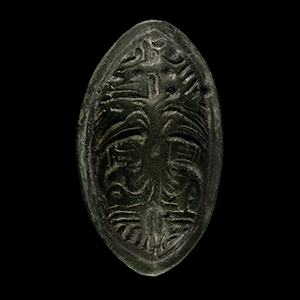
Viking Age Bronze Tortoise Brooch
9th-11th century A.D.Sold for (Inc. bp): £316
Comprising a domed elliptical body and plain flange, catch to the underside with T-bar mount for the ferrous pin; 66 grams, 81 mm
From the collection of a North American gentleman, formed in the 1990s. -
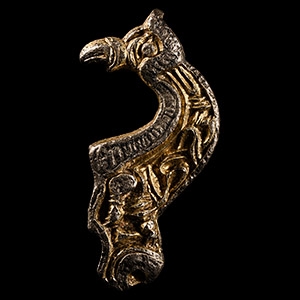
Pre-Viking Silver-Gilt Mythical Beast Helmet Mount
Circa 5th-6th century A.D.Estimate: £1,500 - 2,000 (+bp*)
Opening Bid: £700
In the form of an equine creature modelled in the round with long beak and arched neck; panels of gilded Style I ornament to each lateral face, stepped band with punched detailing extending from the ears to the chest; rounded rump with pointillé detailing; hollow mounting socket to the underside. 13.6 grams, 42 mm
Acquired early 1990s. From an East Anglian private collection. This lot has been checked against the Interpol Database of stolen works of art and is accompanied by search certificate no.11895-204402.
The socket on the underside suggests that the mount was placed prominently, perhaps on the crest of a helmet. Zoomorphic helmet mounts are known e.g. the boars on the Benty Grange and Wollaston examples, though these are not so detailed as the present example. The item is too small to be seen from afar but is ornate enough to attract attention at close quarters. Stylistically, the piece might have been made in southern Scandinavia or in an Anglian area of England in the later 5th or 6th century A.D. -
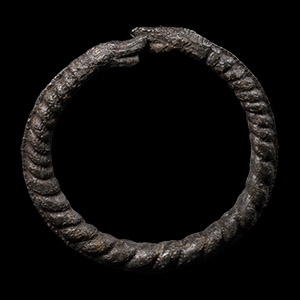
Viking Age Bronze Faux Twisted Beast Bracelet
9th-11th century A.D.Sold for (Inc. bp): £182
Of penannular form with lentoid-section body and opposed beast head terminals. 61 grams, 66 mm
From the collection of a North American gentleman, formed in the 1990s.
