
Loading, please wait...
_900x900.jpg "Viking Age Gold Chip-Carved Bronze 'Plunder' Pendant")
_200x200.jpg "Viking Age Gold Chip-Carved Bronze 'Plunder' Pendant")
.jpg "Viking Age Gold Chip-Carved Bronze 'Plunder' Pendant")
LOT 1187
Viking Age Gold Chip-Carved Bronze 'Plunder' Pendant
CIRCA 9TH-11TH CENTURY A.D.
1 in. (3.75 grams, 26 mm).
The majority of an early Saxon wrist clasp with style 1 ornament, later pierced for suspension as a pendant. [No Reserve]
ProvenanceAcquired in the 1980s.
Ex property of a Worcestershire gentleman.
Acquired on the UK art market in 2014.
Property of a Kent lady collector.
TimeLine Auctions follows a vetting process to ensure the authenticity and legality of all items, reinforcing our commitment to integrity and responsible trading. Each antiquity, antique, and coin lot undergoes thorough examination by a vetting committee of at least ten external specialists, professional trade association members, scientists, and archaeologists: Our Vetting Process
AUCTIONS:
TimeLine is a leading auction house specialising in antiquities, ancient art, collectables, natural history, coins, medals, and books. Our auctions offer museums, collectors, historians, and enthusiasts the opportunity to acquire unique and historically significant pieces.
-
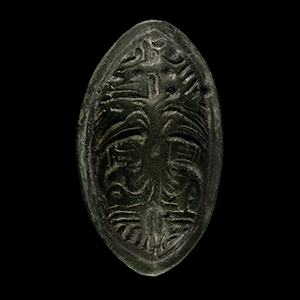
Viking Age Bronze Tortoise Brooch
9th-11th century A.D.Sold for (Inc. bp): £316
Comprising a domed elliptical body and plain flange, catch to the underside with T-bar mount for the ferrous pin; 66 grams, 81 mm
From the collection of a North American gentleman, formed in the 1990s. -
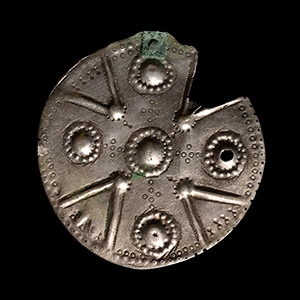
Viking Silver Pendant with Expanding Cross
9th-11th century A.D.Estimate: £250 - 350 (‡+bp*)
Opening Bid: £113
Executed in repoussé technique, a dome to each arm likely representing the Five Wounds of Christ, together with punched annulets and other details. 6.56 grams, 51 mm
From the collection of a North American gentleman, formed in the 1990s. -
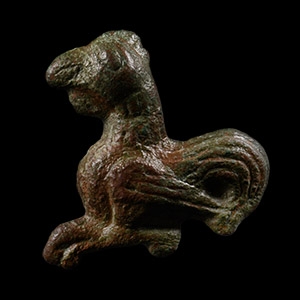
Viking Age Bronze Bird Brooch
9th-11th century A.D.Sold for (Inc. bp): £117
Modelled standing left with stylised detailing; likely a cockerel; pin lug and catchplate to reverse. 6.4 grams, 26 mm
From the collection of a North American gentleman, formed in the 1990s.
Similar brooches are known from Denmark and some examples show us a very similar form and decoration. So far England is the only area outside Scandinavia where bird brooches similar to those discovered in Denmark have been found. The archaeological finds indicate close contacts between England and Denmark in the first half of the 11th century. Anne Pedersen suggests that Byzantium art may be a source of inspiration for these specific type of brooches as is evident from the Danish coinage of the 11th century that direct or indirect influence from Constantinople played an important role, especially in connection with the presence of Danish mercenaries in the Varangian Guard of the Roman emperor.
