
Loading, please wait...
_900x900.jpg "Viking Age Gilt Bronze Openwork Roundel with Interlaced Snakes")
_200x200.jpg "Viking Age Gilt Bronze Openwork Roundel with Interlaced Snakes")
.jpg "Viking Age Gilt Bronze Openwork Roundel with Interlaced Snakes")
LOT 1510
Viking Age Gilt Bronze Openwork Roundel with Interlaced Snakes
10TH-12TH CENTURY A.D.
2 3/4 in. (48.9 grams, 70.7 mm).
With rilled edge and pierced hub, the field a network of dense interlaced tendrils.
ProvenanceAcquired 1971-1972.
From the collection of the vendor's father.
Ex property of a London, UK, collector.
TimeLine Auctions follows a vetting process to ensure the authenticity and legality of all items, reinforcing our commitment to integrity and responsible trading. Each antiquity, antique, and coin lot undergoes thorough examination by a vetting committee of at least ten external specialists, professional trade association members, scientists, and archaeologists: Our Vetting Process
AUCTIONS:
TimeLine is a leading auction house specialising in antiquities, ancient art, collectables, natural history, coins, medals, and books. Our auctions offer museums, collectors, historians, and enthusiasts the opportunity to acquire unique and historically significant pieces.
LOT 1510
Viking Age Gilt Bronze Openwork Roundel with Interlaced Snakes
Estimate £300 - 400€350 - 460 (for guidance only)$410 - 540 (for guidance only)
-
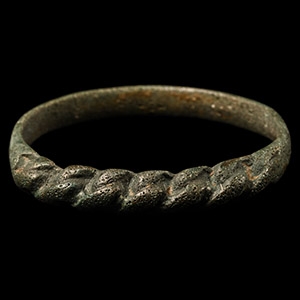
Viking Age Bronze Faux Plaited Ring
Circa 9th-11th century A.D.Sold for (Inc. bp): £33
The slender hoop slightly expanded at the bezel, displaying a faux plaited design. 1.63 grams, 22.56 mm overall, 19.87 mm internal diameter (approximate size British O, USA 7, Europe 14.98, Japan 14)
Private collection formed since the 1940s. UK art market. Property of an Essex gentleman. -
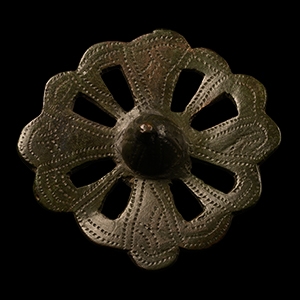
Viking Bronze Cross Brooch with Central Turret
Circa 9th century A.D.Sold for (Inc. bp): £234
Discoid in plan with scalloped circumference, cross at centre with central dome and apex pellet, openwork 'petals' in each quarter between the arms of the cross, the upper face decorated with pricked dots; catchplate to reverse. 26 grams, 55 mm
Acquired 1990s. From an East Anglian private collection. -
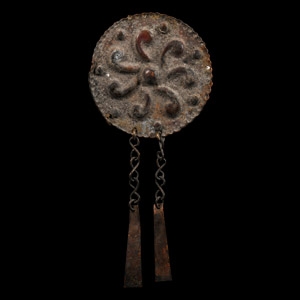
Viking Age Bronze Sun Wheel Plaque with Pendants
10th-12th century A.D.Sold for (Inc. bp): £104
Scalloped circumference and repoussé central design, two remaining dangles. 8.67 grams, 90 mm
From the collection of a North American gentleman, formed in the 1990s.
