
Loading, please wait...
LOT 1076
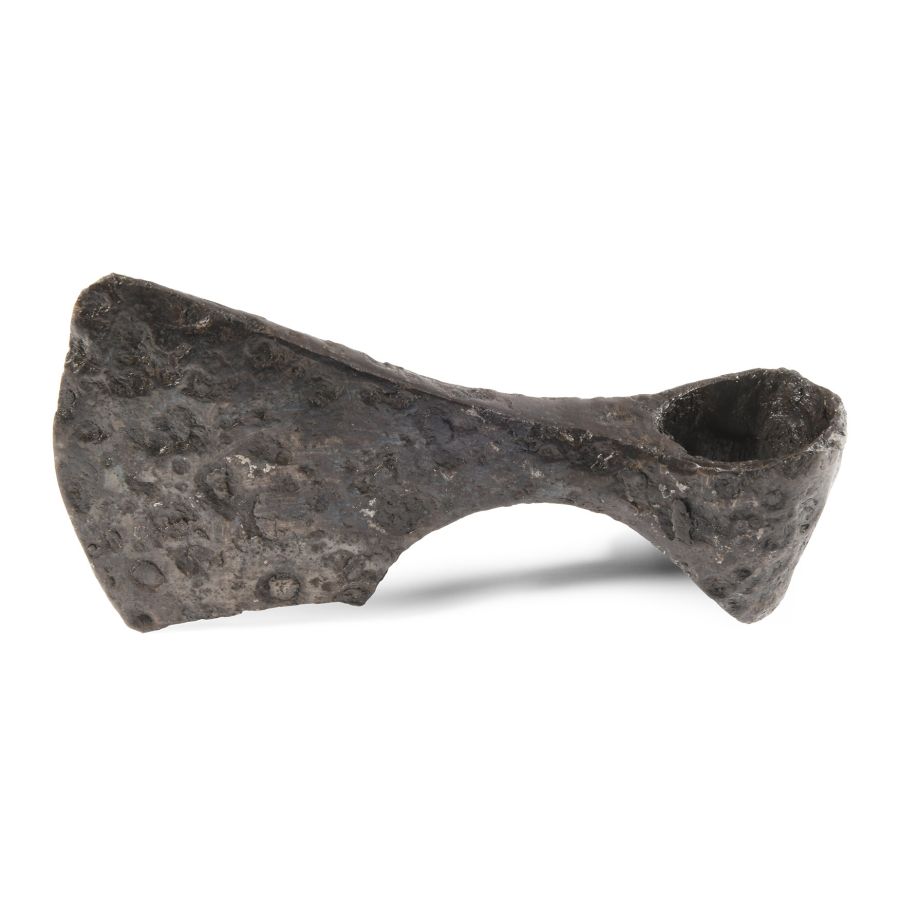
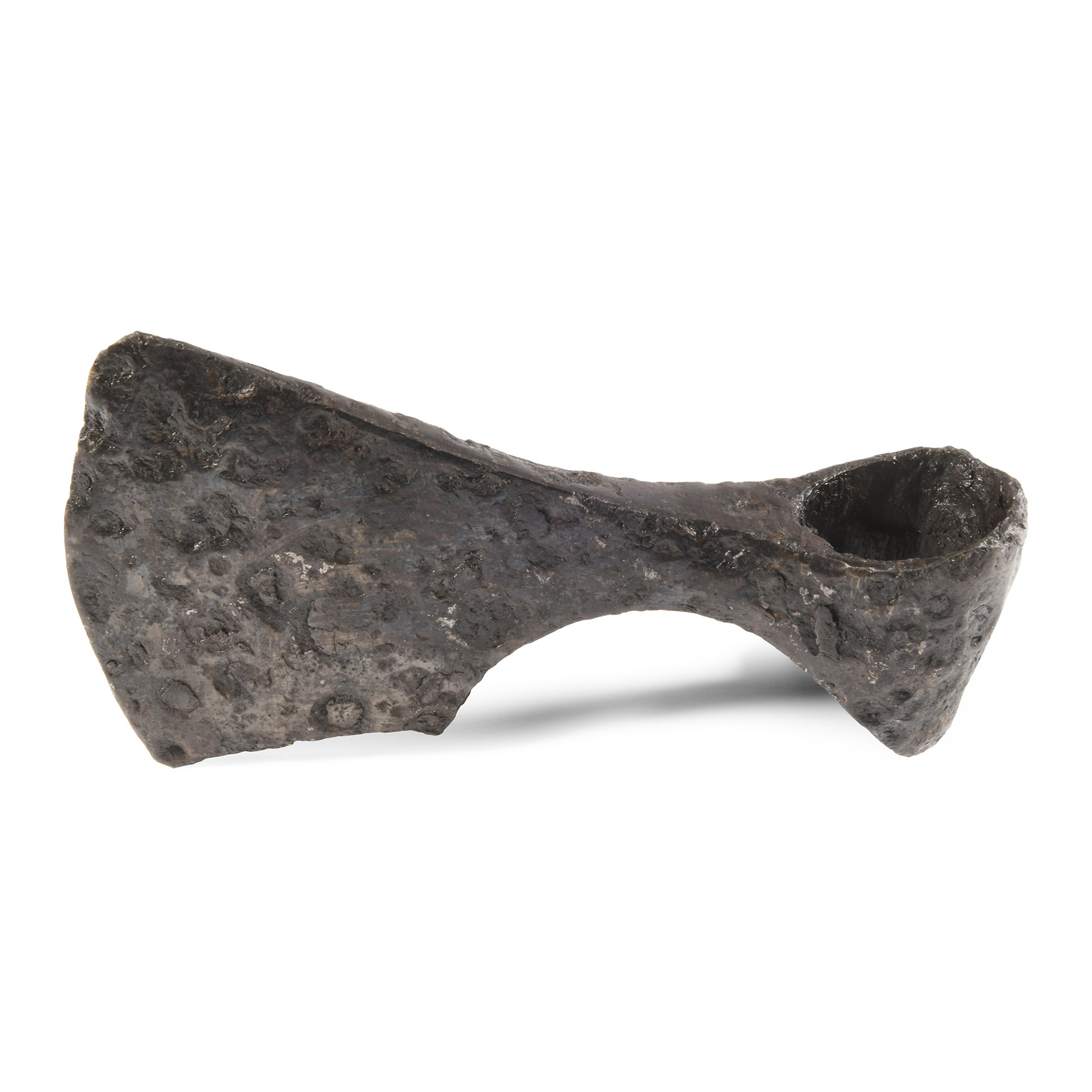
Viking Age Finno-Ugrian Socketted Axehead
10TH-13TH CENTURY A.D.
6 3/4 in. (548 grams, 17 cm).
Hand-forged with triangular-section narrow blade widening to a broad bevelled edge with square chin and spur to the rear, socket with flanges to the rear. [No Reserve]
ProvenanceFrom the private collection of a London gentleman, from his grandfather's collection formed before the early 1970s.
LiteratureSee for similar axes Nicolle, D., 'Raiders of the Ice War' in Military Illustrated, March 1996, no.94, pp.26-29, fig.p.28; Sedov, B.B., 'Finno-Ugri i Balti v Epokhi Srednevekovija,' Moscow, 1987, pl.CX, item 44.
FootnotesDuring the mid 13th century, the axes were favourite weapons among Baltic people. For instance the Curonian army included lightly armed soldiers who fought with spears, shields, fighting knives and axes. A heavily armed soldier could also carry a sword, a helmet, a shield and a wide-bladed axe.
CONDITIONTimeLine Auctions follows a vetting process to ensure the authenticity and legality of all items, reinforcing our commitment to integrity and responsible trading. Each antiquity, antique, and coin lot undergoes thorough examination by a vetting committee of at least ten external specialists, professional trade association members, scientists, and archaeologists: Our Vetting Process
AUCTIONS:
TimeLine is a leading auction house specialising in antiquities, ancient art, collectables, natural history, coins, medals, and books. Our auctions offer museums, collectors, historians, and enthusiasts the opportunity to acquire unique and historically significant pieces.
-
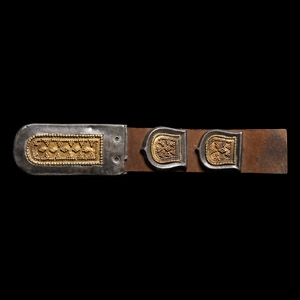
Avar-Byzantine Silver-Gilt Sword Belt Mount Group
7th-9th century A.D.Sold for (Inc. bp): £156
Comprising three belt mounts later remounted onto brown leather comprising: a rectangular strap end with rounded terminal, decorated with granulated borders, lozenges and chevrons; two roughly D-shaped mounts with apex flourish and waisted sides, also decorated with granulated lozenges and chevrons. 26.5 grams, 12.2 cm long
Fine condition.
Acquired in the 1980s-1990s. Ex an important central London gallery, London W1.
This type of belt element, decorated with granulation, is present in the Avar graves of the second half of the 7th century, and was most likely produced in the workshops of the Eastern Roman Empire, from where they reached the Avar lands as imperial gifts (tomb of Kunbàboni) or spoils of war. They were part of multiple belts, to which sabres and knives were attached, commonly used among Avars, Bulgars and Romans during the 7th and 8th centuries A.D. -
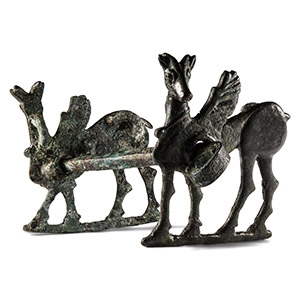
Luristan Bronze Horse Bit
9th-8th century B.C.Sold for (Inc. bp): £910
The cheekpieces formed as winged deer with horns and small ears, a circular opening to the body for the bar to pass through, two loops and studs to the reverse; the bar with looped circular terminals. 543 grams, 17.5 cm
Ex old English collection. London art market, pre 2000. Property of a Lonodon, UK, gentleman.
The most admirable horse bits ever created by man are undoubtedly those from Luristan, a province which extended along the valleys that make up the central part of the Zagros mountains. Worked in cast bronze with the lost wax process, they almost always had a rigid cannon in round or square bars which were flattened and rolled up around themselves at the ends, but their exceptional feature were the figural side bars. The local metalsmiths, in a period of time between 1200 and 700 B.C. managed to create an infinite number of typologies: horses, oxen, ibex, roosters and various mythological animals. -
.jpg)
Hellenistic Bronze Armour Section with Herakles Fighting Hydra
Circa 4th-3rd century B.C.Sold for (Inc. bp): £3,120
Comprising an embossed fragment of a breast-plate from muscle-type armour (thorax statos) representing Herakles fighting against the Hydra of Lerna; three-quarters of the hero's body preserved showing him naked in a dynamic position, wearing a fluttering short cloak (chlamys), overlooking the body of the monster of which the long tail covered with scales and fins is visible; fragment of cloak preserved separately. 122 grams total, 3.4-17.5 cm
Good portion of armour, extremely rare
Acquired on the French art market before 2000. From an EU collection before 2020.
This kind of armour is very rare, especially for this period, when most of the attested armour is plain or only slightly decorated. The young Herakles appears in heroic nudity running to the right, but, as on the cheek-piece from Gurlo, his head was probably turned in the opposite direction. The plasticism of the scene finds a good match in the Thracian tradition of the representation of weapons and armour, and the embossed elements with the highly prized work of the Panagyurishte treasure. The warrior-theme and the representation of Herakles or other fighting scenes on the Thracian and Hellenistic armours was a reference to the spirit of the immortal fighter.
