
Loading, please wait...
LOT 1351
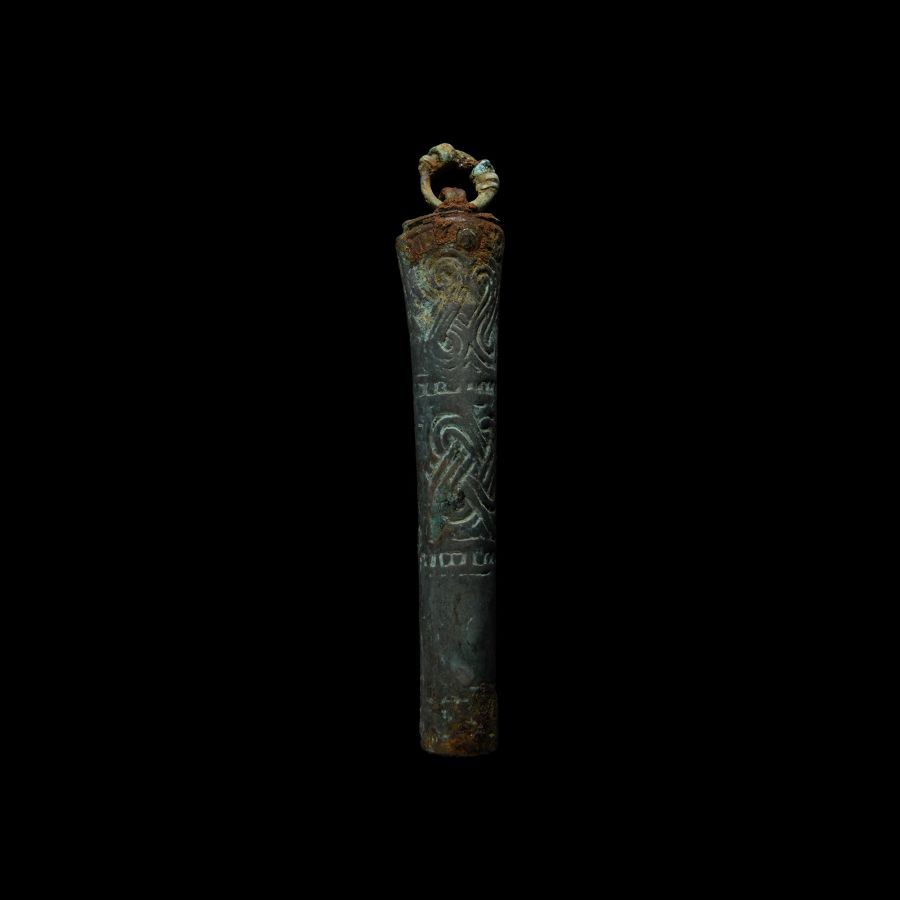
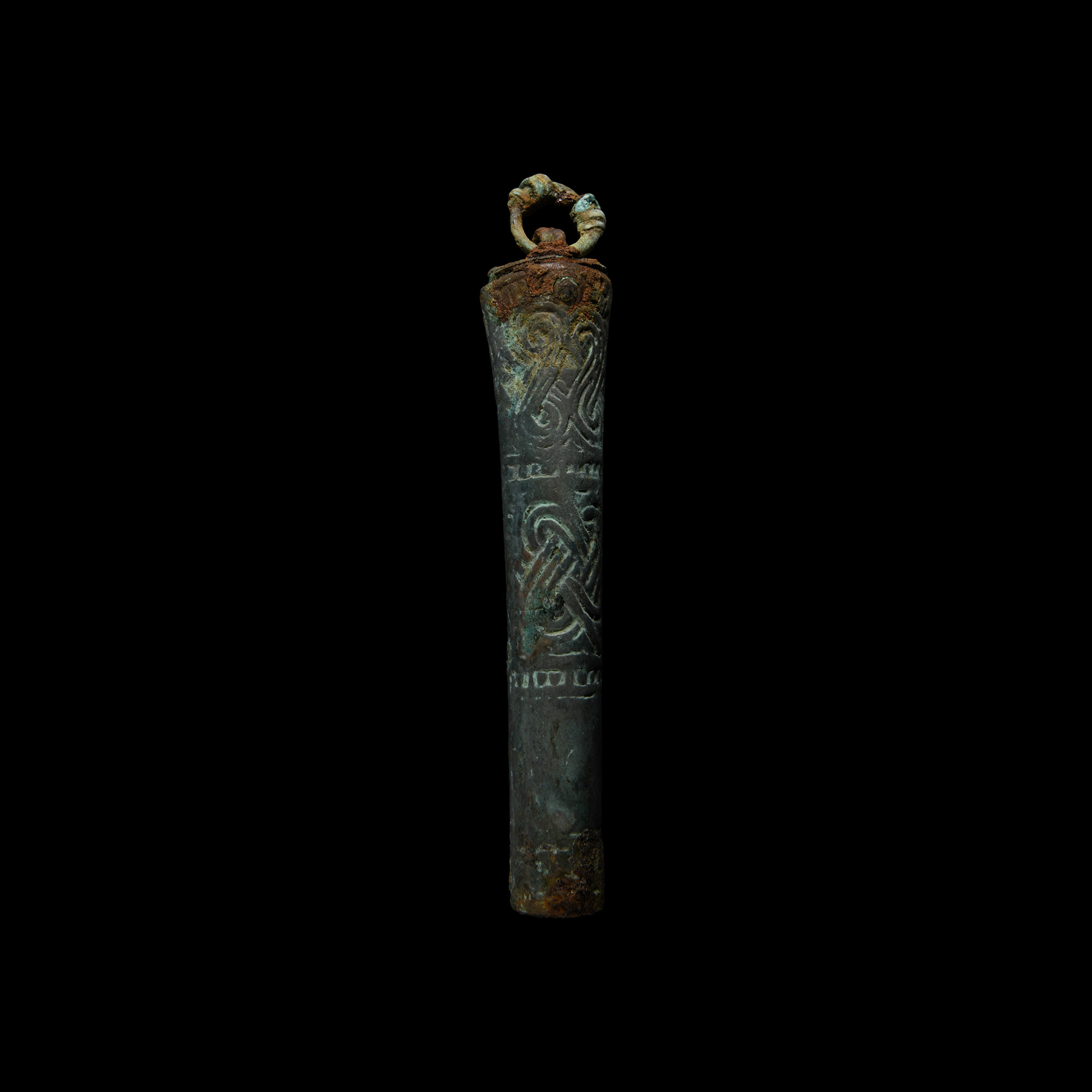
Viking Age Bronze Knife Handle
10TH-11TH CENTURY A.D.
4 in. (58 grams, 10.3 cm).
With tubular bronze handle and low-relief interlaced geometric designs. [No Reserve]
ProvenanceFrom the collection of a North American gentleman, formed in the 1990s.
LiteratureCf. Sedov, B.B., Finno-Ugri i Balti v Epokhi Srednevekovija, Moscow, 1987, pl.XII, item 11.
FootnotesOrnamented bronze knife handles became an integral part of medieval culture also in Finno-Ugric lands. The blades of the knives were in iron, with bronze handles, and had an oval cross-section slightly expanding upwards. In a certain number of female burials, knives were found in sheaths with a bronze lamellar lining, decorated with complex floral ornamentation.
CONDITIONTimeLine Auctions follows a vetting process to ensure the authenticity and legality of all items, reinforcing our commitment to integrity and responsible trading. Each antiquity, antique, and coin lot undergoes thorough examination by a vetting committee of at least ten external specialists, professional trade association members, scientists, and archaeologists: Our Vetting Process
AUCTIONS:
TimeLine is a leading auction house specialising in antiquities, ancient art, collectables, natural history, coins, medals, and books. Our auctions offer museums, collectors, historians, and enthusiasts the opportunity to acquire unique and historically significant pieces.
-

Viking Age Bronze Contorted Gripping Beast Pendant
Late 10th-early 11th century A.D.Sold for (Inc. bp): £390
Scandinavian pendant of Norelund type with integral suspension loop; the openwork plaque with three-band border and four panels, internal stylised zoomorph with hatched panel to the hip, gripping hands to the body and border, facing mask below the loop. 6.22 grams, 34 mm
Acquired on the German art market before 2000. From an old Munich collection.
There is a class of discoid pendants with banded borders and contorted figures found in the hinterland of the Baltic region, associated with the influence of Scandinavian settlers. The design of these items recalls specific elements of Scandinavian art - for example, the 'gripping hands' motif is a feature of the Oseberg Style named after the famous Norwegian ship-burial. Oseberg Style is associated with the beginnings of the Viking age, and was current in the 9th century when Scandinavian settlers began to establish centres of trade and political control in the area of the rivers Dnieper and Volga. The motif has been interpreted as a horse and linked with various legends and mythic figures, including Sigurð's fight with the dragon Fafnir. -
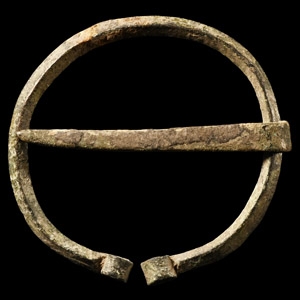
Viking Age Bronze Penannular Brooch
9th-11th century A.D.Sold for (Inc. bp): £39
The body with lozenge-shaped cross-section and coiled terminals, free-running and tapering tongue. 9.36 grams, 46 mm
Private collection formed in Europe in the 1980s. Westminster collection, central London, UK. -

Viking Age Bronze Implement Pendant
9th-11th century A.D.Sold for (Inc. bp): £65
With tear-drop plaque, pierced lug and scoop finial, low-relief geometric ornament. 10.9 grams, 93 mm
From the collection of a North American gentleman, formed in the 1990s.
In the Finno-Ugrian and Eastern Viking societies the status that an individual might achieve through personal qualities, social position and wealth was enhanced by valuable clothing, finely worked jewellery made of precious metal (like chatelaine chains for women) and, for the men, weapons and horse furnishing of exceptional quality. Families and individuals visually expressed the elements of other societies and cultures that they thought were desirable through the deliberate use of foreign objects.
