Loading, please wait...
Details
LOT 1394
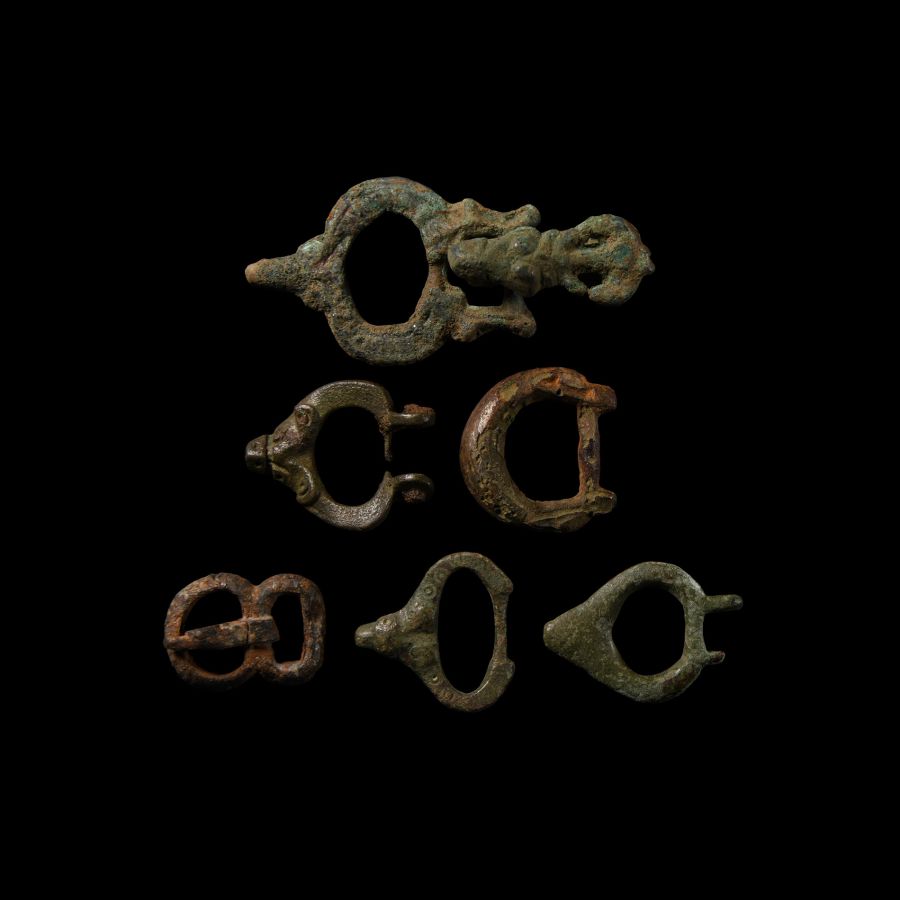
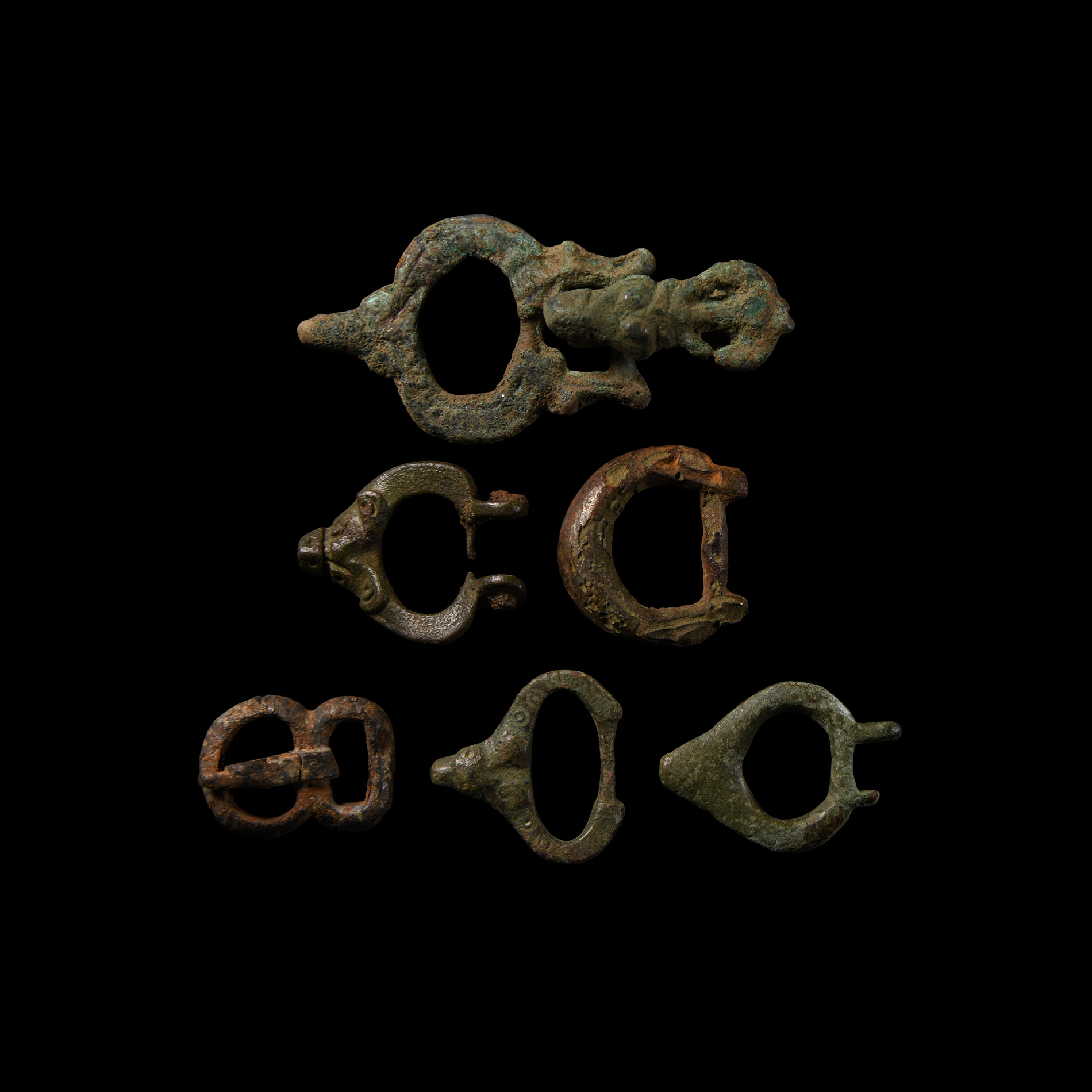
Viking Age Bronze Buckle Collection
MAINLY 8TH-9TH CENTURY A.D.
1 - 2 1/2 in. (53.6 grams total, 23-64 mm).
Four flat in profile with mask detailing to the tongue-rest; one a substantial D-shaped loop; one similar with keeper to the rear, inlaid silver banding. [6, No Reserve]
Provenance
From the collection of a North American gentleman, formed in the 1990s.
Literature
Cf. Sedov, B.B., Finno-Ugri i Balti v Epokhi Srednevekovija, Moscow, 1987, pl.LXXVIII (23, 54), for types.
CONDITIONVETTING:
TimeLine Auctions follows a vetting process to ensure the authenticity and legality of all items, reinforcing our commitment to integrity and responsible trading. Each antiquity, antique, and coin lot undergoes thorough examination by a vetting committee of at least ten external specialists, professional trade association members, scientists, and archaeologists: Our Vetting Process
AUCTIONS:
TimeLine is a leading auction house specialising in antiquities, ancient art, collectables, natural history, coins, medals, and books. Our auctions offer museums, collectors, historians, and enthusiasts the opportunity to acquire unique and historically significant pieces.
RELATED LOTS
-
Viking Bronze Tortoise Brooch Set
10th-11th century A.D.Sold for (Inc. bp): £1,820
Comprising a pair of domed brooches with low-relief zoomorphic decoration in bands, pin to the reverse on a transverse bar, reinforced catchplate; attached to a loop on the reverse of each brooch, a spacer formed as a lobed plaque with double rosette detailing and loops below, two chains connecting to the matched brooch; from the rosette spacers hang two more chains, one with a needle case with openwork knotwork plaque handle above, the other with a decorated lunate pendant. 334 grams, hangs 53 cm
Fine condition. Rare.
Property of a professional collector; acquired before 1990. Ex London collection since 2016. Accompanied by an academic report by Dr Raffaele D’Amato. This lot has been checked against the Interpol Database of stolen works of art and is accompanied by search certificate number no.11736-201216.
The most characteristic items of Viking women's jewellery are oval brooch pairs, sometimes called 'tortoise brooches' due to their shape, which are found in many female graves of the period. As in this example, the brooches themselves were usually connected by swags of chains, suspended from the pair of brooches and supporting utilitarian objects such as tweezers, an ear spoon, shears or a small knife, as well as amulets. In addition the wearer displayed strands of beads of glass, silver, amber or jet. -
Pre-Viking Gold Aroma Bucket Pendant
4th-7th century A.D.Sold for (Inc. bp): £650
Adorned with filigree to the sidewall and handle, a polished red glass gem to the base held in a toothed setting. 2.24 grams, 21 mm
Private collection formed in Europe in the 1980s. Westminster collection, central London, UK.
Pendants in the form of miniature buckets have been found in a number of pagan Anglo-Saxon and Viking contexts and are generally made of bronze or iron, with gold examples being rare; three gold examples were found with the hoard from Hoen, Norway. Bronze bucket amulets have been found at Driffield in Yorkshire, and Vimose bog in Denmark, among other places. In form they represent wooden buckets bound with bronze or iron bands which have been found in Anglo-Saxon and Viking graves and are believed to have held mead or ale and were used to replenish the cups from which warriors drank. As amulets they probably represent the ecstatic power of alcoholic drink and the role of women as the dispensers of these precious beverages. -
Anglo-Scandinavian Viking Bronze Stirrup Mount with Interlaced Serpents
10th-11th century A.D.Estimate: £400 - 600 (+bp*)
Opening Bid: £160
Squat-bodied and triangular in form; short tab with rivet hole to apex, ledge with rivet to reverse of the lower edge, displaying high-relief interlaced serpent design with head above the lower edge. 22.3 grams, 32 mm
Acquired early 1990s. From an East Anglian private collection.
The mount is not included in Williams's study of Anglo-Scandinavian stirrup mounts, which is now more than twenty years old. However, it is evidently an example of Class B, while lacking the bear-mask and openwork features. Its design appears to derive from a Class A type (Williams's nos.380, 383) which shares the feature of the facing serpent-head placed centrally on the lower edge.