
Loading, please wait...
LOT 1265
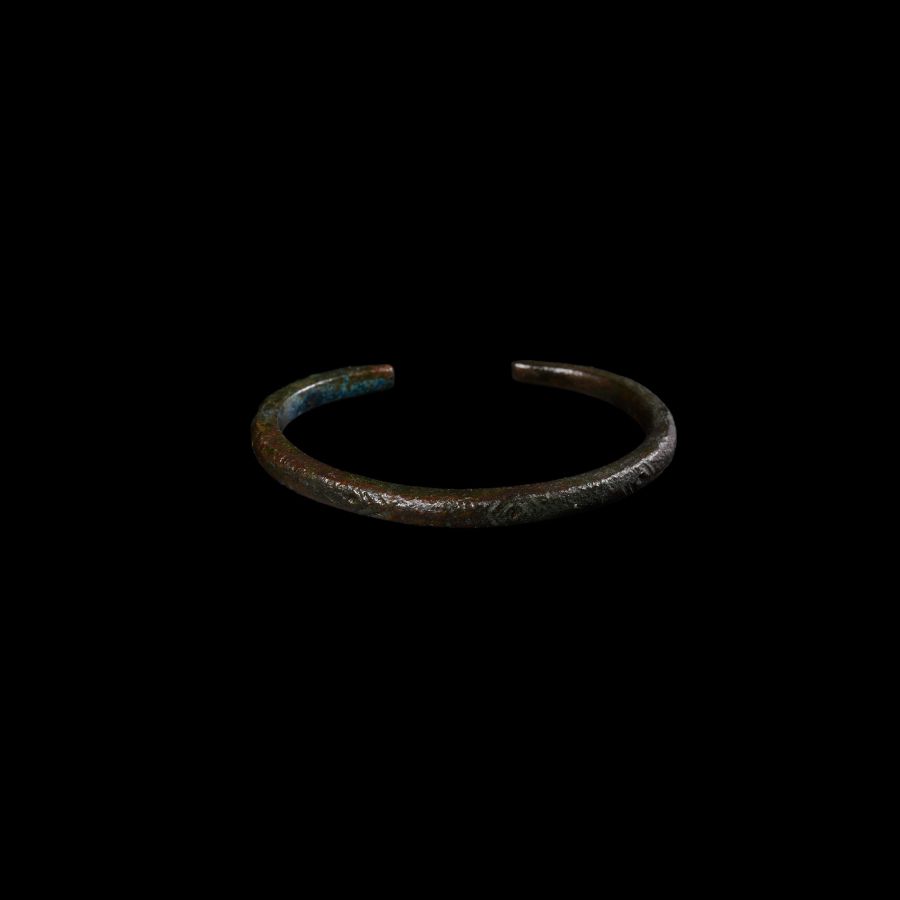
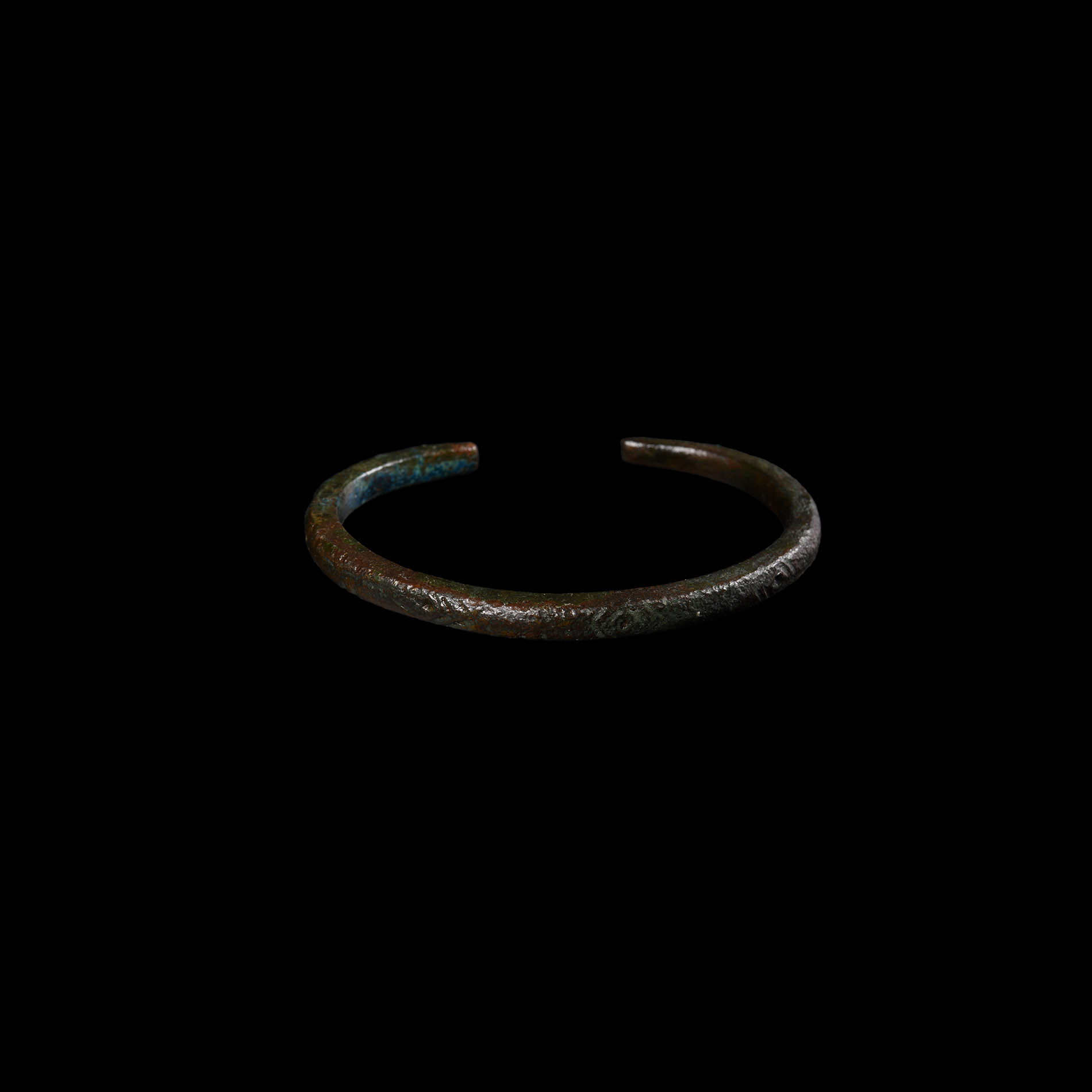
Viking Age Bronze Bracelet
9TH-11TH CENTURY A.D.
2 3/4 in. (28.3 grams, 71 mm).
Composed of a penannular hoop with convex outer face, tapering towards the terminals; decorative notching and lozenges. [No Reserve]
ProvenanceFrom the collection of a North American gentleman, formed in the 1990s.
CONDITIONTimeLine Auctions follows a vetting process to ensure the authenticity and legality of all items, reinforcing our commitment to integrity and responsible trading. Each antiquity, antique, and coin lot undergoes thorough examination by a vetting committee of at least ten external specialists, professional trade association members, scientists, and archaeologists: Our Vetting Process
AUCTIONS:
TimeLine is a leading auction house specialising in antiquities, ancient art, collectables, natural history, coins, medals, and books. Our auctions offer museums, collectors, historians, and enthusiasts the opportunity to acquire unique and historically significant pieces.
-
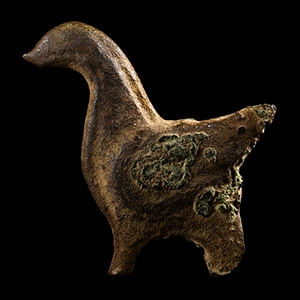
Viking Age Bronze Bird Brooch
10th-11th century A.D.Sold for (Inc. bp): £104
Modelled facing left, stylised wing and body detailing; remains of a fitting element to reverse. 6.06 grams, 30 mm
From the collection of a North American gentleman, formed in the 1990s.
Bird brooches from the late(r) Viking era have been found in Scandinavia as well in areas occupied and inhabited by the Vikings and Norsemen within England, in Anglo-Scandinavian and Anglo-Saxon contexts. These so-called bird shaped brooches can be dated to the 11th and even early 12th century. Stylistically the brooch here cannot be categorised as a distinct 'Viking style' such as the late Urnes style, although some types of other bird shaped brooches shows us connections to the Ringerike and Urnes style. The decoration and form of the bird on the brooch here is more influenced by the development of Romanesque styles spreading from the Continent into Scandinavian art, like the style of a bird, depicted on the right corner next to the door portal of Rimsø Kirke, Jylland, completed in 1150 A.D. -

Scandinavian Viking Bronze Drum Brooch with Interlaced Panels
8th-9th century A.D.Estimate: £1,500 - 2,000 (+bp*)
Opening Bid: £833
With four raised arms and central knop to the upper face, all with punched ring-and-dot detailing; the outer sidewall with four panels of knotwork, dividing vertical stems with ring-and-dot motif, each with a D-shaped protrusion; the upper face with dense zoomorphic ornament; pin and separate catchplate to the underside with central hole, five studs retaining it to the upper. 71.6 grams total, 45 mm
Fine condition, pin intact, backplate slightly cracked.
UK gallery, acquired in the 2000s. Property of an English gentleman. This lot has been checked against the Interpol Database of stolen works of art and is accompanied by search certificate no.11406-192532.
The type is known as a 'drum' brooch or 'box' brooch. They were apparently manufactured on the island of Gotland and all known examples probably have their origin there. Over time, the refinement of the earlier types (such as the present example) is superseded by cruder decoration consisting of dimples or simple dots. -

Viking Age Gold 'Elf Shot' Pendant
9th-10th century A.D. or earlierSold for (Inc. bp): £624
Formed as a gold cap with rounded claws, set with polished glass gem; integral suspension loop with a later jump ring. 0.64 grams, 21 mm
From a late Japanese specialist collector, 1970-2000s.
This amulet was believed to offer protection against 'Elfshot'. The attack of elves was believed responsible for mysterious suffering in men and livestock. 'Elfshot' described sudden shooting pains localised to a particular area of the body, such as in rheumatism, arthritis or muscle stitches or cramps. Elves were thought to shoot darts or arrows where such pains had no obvious external cause. Belief in elfshot persisted into the 20th century in rural areas, and as proof country folk would sometimes find small arrowheads (the remains of Neolithic or Mesolithic flints, or naturally-occurring spear-shaped stones) that were believed to be the magical weapons that caused the afflictions. Belief in elfshot began in the Pagan Germanic period.
