
Loading, please wait...
LOT 1052
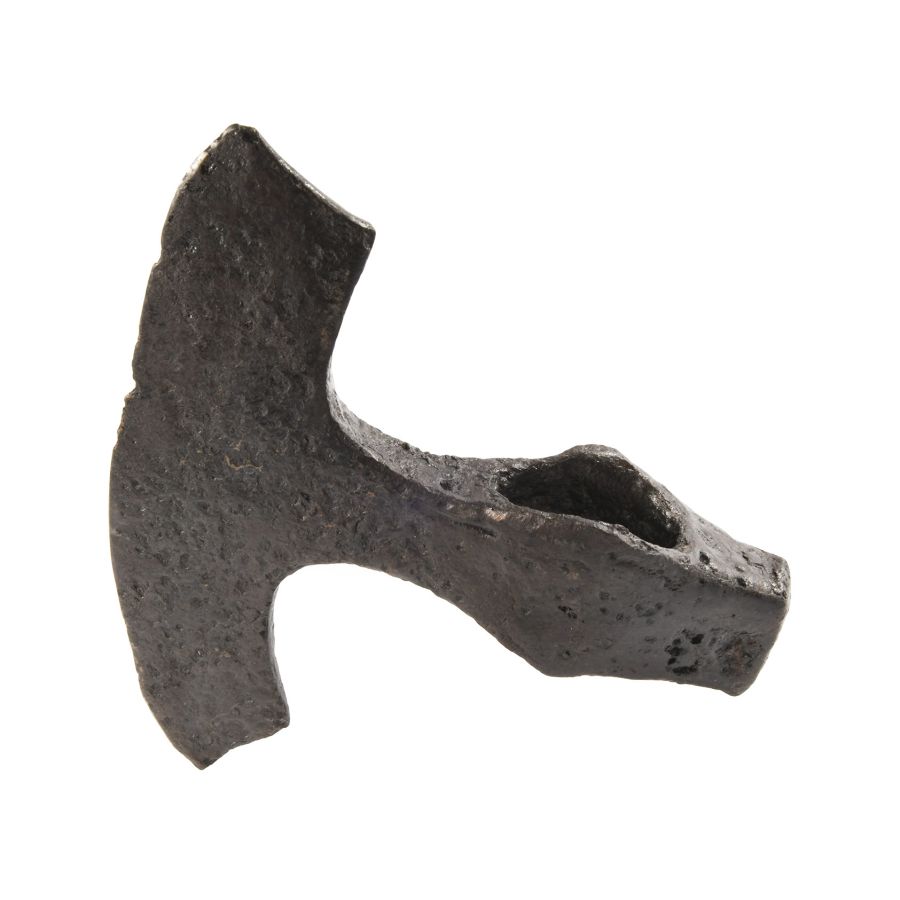
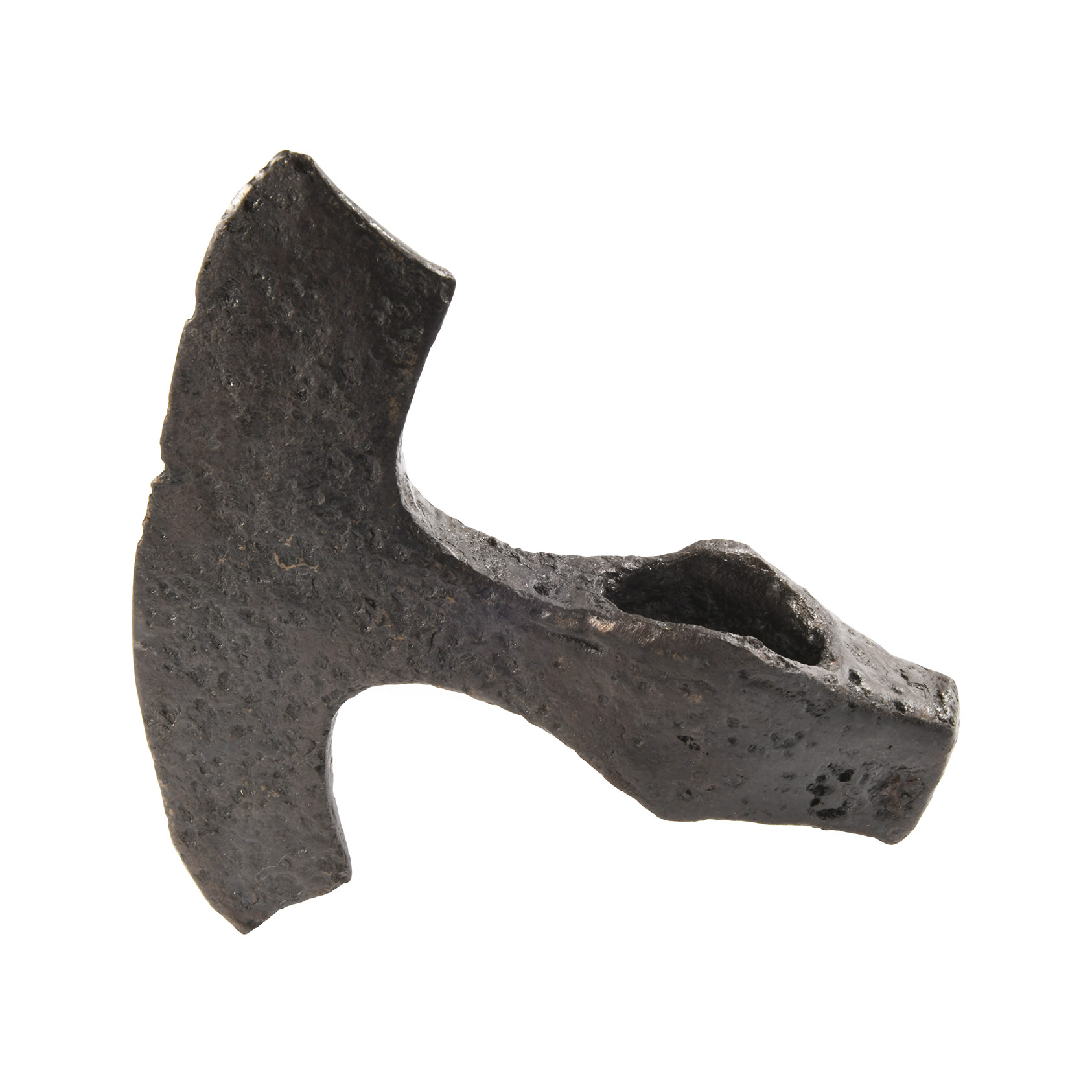
Viking Age Baltic Iron Wide-Bladed Axehead
11TH-13TH CENTURY A.D.
7 in. (785 grams, 18 cm).
With narrow T-shaped blade with curved edge, large round socket with lateral triangular flanges and rectangular extension to the rear. [No Reserve]
ProvenanceFrom the private collection of a London gentleman, from his grandfather's collection formed before the early 1970s.
LiteratureCf. Sedov, B.B., Finno-Ugri i Balti v Epokhi Srednevekovija, Moscow, 1987, pl.CX, item 41, for the type.
FootnotesThe Curonians were known as fierce warriors and sailors who were involved in several wars and alliances with the Swedish, Danish and Icelandic Vikings. Baltic tribes created an original and impressive set of weaponry. They included battle knives, battle axes and spears and javelins with medium sized heads of a characteristic shape.
CONDITIONTimeLine Auctions follows a vetting process to ensure the authenticity and legality of all items, reinforcing our commitment to integrity and responsible trading. Each antiquity, antique, and coin lot undergoes thorough examination by a vetting committee of at least ten external specialists, professional trade association members, scientists, and archaeologists: Our Vetting Process
AUCTIONS:
TimeLine is a leading auction house specialising in antiquities, ancient art, collectables, natural history, coins, medals, and books. Our auctions offer museums, collectors, historians, and enthusiasts the opportunity to acquire unique and historically significant pieces.
-
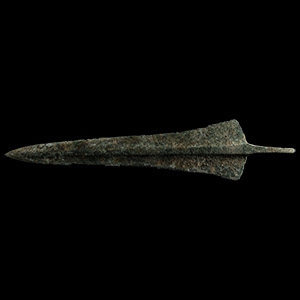
Western Asiatic Bronze Tanged Spearhead
Circa 13th-6th century B.C.Estimate: £100 - 140 (+bp*)
Opening Bid: £50
With leaf-shaped blade and rounded tip, pronounced medial rib and shoulder flanges, short flat-section tang. 255 grams, 31 cm
Acquired 1980-2015. Ex Abelita family collection.
The spearhead belongs to type 2 of spearheads according to the classification of Khorasani. A similar specimen was excavated by Negahban in Marlik. -
.jpg)
Viking Age Iron Sword with Seven-Lobed Pommel
11th-13th century A.D.Estimate: £5,000 - 7,000 (+bp*)
Opening Bid: £2,500
Couronian sword of Petersen Type K with double-edged tapering blade and tapering fullers; bronze cross-guard extending at each end to serpent- or horse-heads, wheeled ornament to both faces; the lower guard with similar motifs; seven-lobed pommel with annulets and pellets. 1.02 kg, 86.5 cm
From the private collection of a London gentleman, from his grandfather's collection formed before the early 1970s. Accompanied by an academic report by Dr Raffaele D’Amato. This lot has been checked against the Interpol Database of stolen works of art and is accompanied by search certificate no.11925-209658.
Couronian swords of this type, with animal-head decoration on the lower guard, were widespread and used in the Eastern Baltic lands from the 10th to 13th century. Such zoomorphic detailing was a clear influence from Germanic art. Regular geometric ornamentation, derived from Romanesque art, was also widespread, with one of the most common ornaments being a cross-in-circle. -
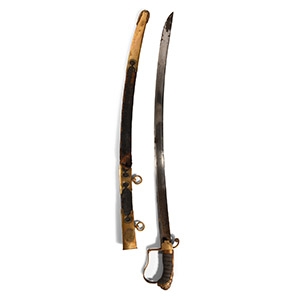
Officer's Presentation Sword with Islamic Script
Circa 1798 A.D.Sold for (Inc. bp): £780
British infantry officer's sword - 1796 pattern with lion-head pommel and knuckle-guard, short curved quillon to the rear; leather scabbard with brass fittings and escutcheon below the frog with the legend 'R. Johnston / late / Bland & Foster / Sword Cutler / & Belt Maker to his / Majesty / -68- / St. James's St/ London'; guilloche detailing to the border and to the langets; hollow-ground blade with inlaid brass Arabic script to both faces, possibly a trophy from the Battle of the Nile in August, 1798. 1.23 kg, 95 cm total
From a Suffolk, UK, private collection.
Richard Johnston took over the sword- and belt-making business from John Bland, who died in 1791, and his surviving partner, Robert Foster, who died in 1798. After Bland's death, Foster and Johnston moved their premises from 70 St. James's Street to number 68 in the same street, and continued the business until Foster's death in 1798, after which Johnston took on another shop, then displaying the address as '38 & 68 St. James's Street'. The cartouche gives the address as '68 St. James's Street', which shows that the sword was produced, finished and sold in 1798.
