
Loading, please wait...
LOT 1093
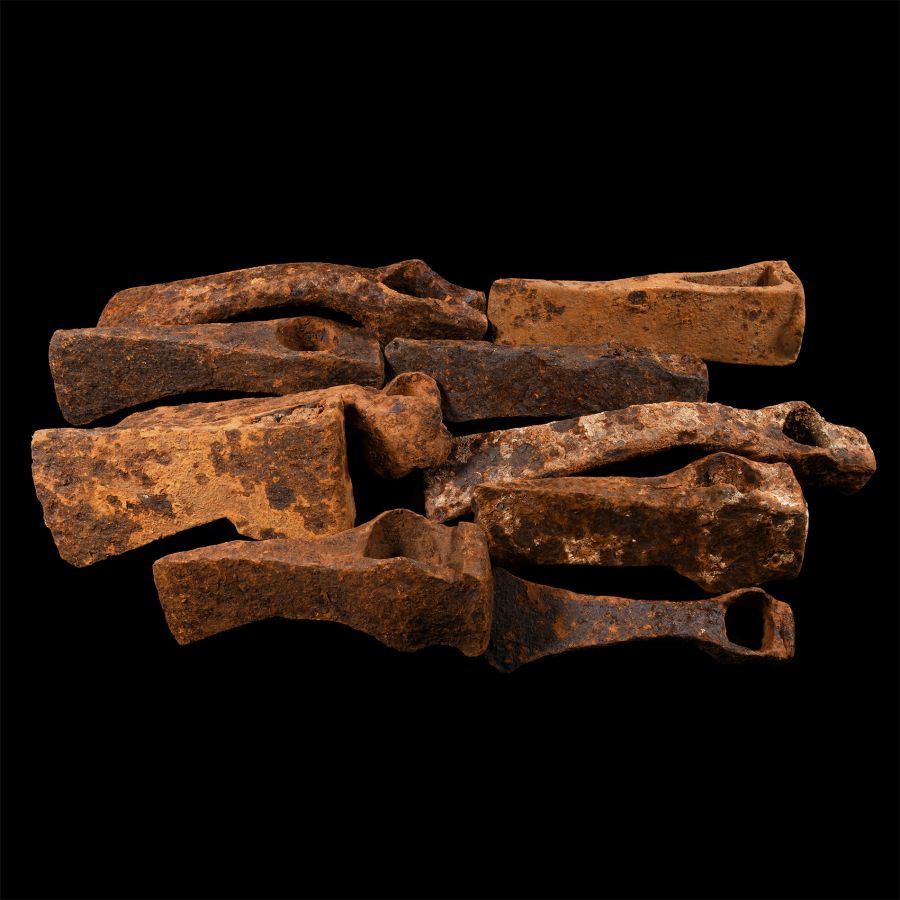
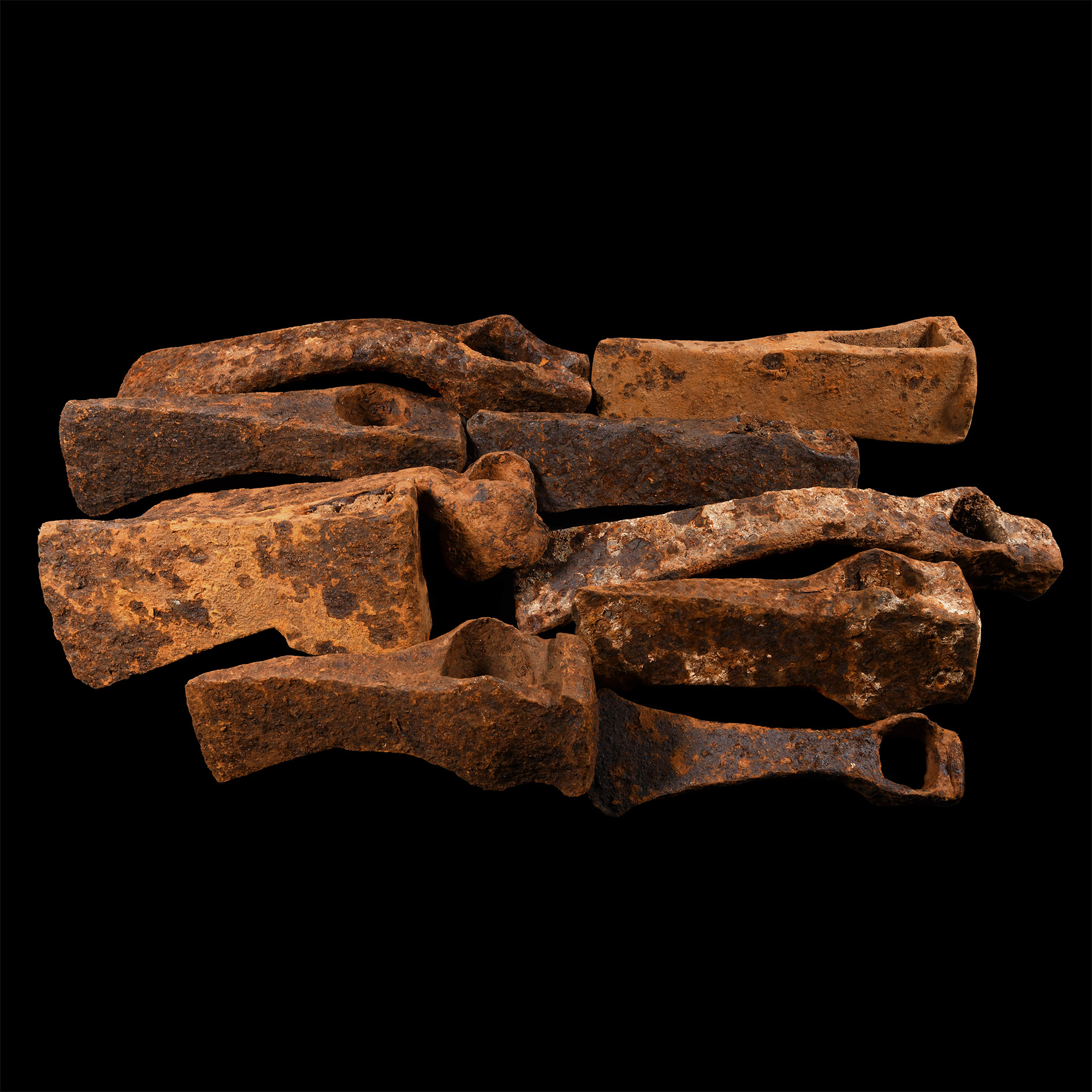
Viking Age and Later Axehead Group
CIRCA 11TH-18TH CENTURY A.D.
6 1/4 - 9 1/2 in. (7 kg total, 16-24.5 cm).
Comprising socketted axeheads of various types; some possibly stamped with maker's marks. [10]
ProvenanceAcquired 1990s-early 2000s.
East Anglian private collection.
TimeLine Auctions follows a vetting process to ensure the authenticity and legality of all items, reinforcing our commitment to integrity and responsible trading. Each antiquity, antique, and coin lot undergoes thorough examination by a vetting committee of at least ten external specialists, professional trade association members, scientists, and archaeologists: Our Vetting Process
AUCTIONS:
TimeLine is a leading auction house specialising in antiquities, ancient art, collectables, natural history, coins, medals, and books. Our auctions offer museums, collectors, historians, and enthusiasts the opportunity to acquire unique and historically significant pieces.
LOT 1093
Viking Age and Later Axehead Group
Estimate £100 - 140€120 - 160 (for guidance only)$140 - 190 (for guidance only)
-
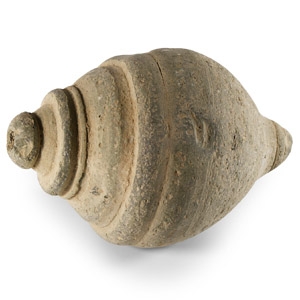
Turco-Mongol Ceramic Fire Bomb or Hand Grenade
14th-15th century A.D.Sold for (Inc. bp): £117
Piriform body with domed filler-hole, raised horizontal flanges to the shoulders; intended to be filled with explosive liquid and wick, used as a hand grenade. 409 grams, 11.7 cm
Acquired 1980-2015. Ex Abelita family collection. Accompanied by an academic paper by military specialist Dr Raffaele D'Amato, dated 15 July 2019 and titled 'Eastern Roman Empire - Greek Fire Bomb or Hand Grenade (μεσαίον kακάβιον) 9th-11th century AD'.
This piece was a sort of ceramic fire grenade, similar to the ones used by the Eastern Romans but of Turco-Mongol type. Apart from the use of manual flame-throwers, special corps of soldiers employed terracotta grenades, in the form of small jars, abundantly evidenced in archaeological excavations. -
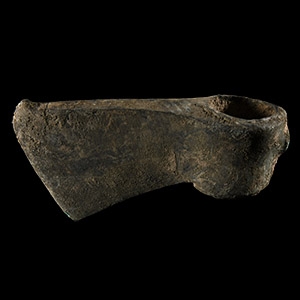
Heavy Western Asiatic Bronze Axehead
Late 3rd millennium B.C.Estimate: £100 - 140 (+bp*)
Opening Bid: £50
With swept blade, large socket with shallow raised circumferential rib and a vertical rib to the rear. 741 grams, 14.5 cm
Acquired 1980-2015. Ex Abelita family collection.
In the middle of the 3rd millennium B.C., the most widespread types of axes were those made for splitting and those for cutting. In the last third of this millennium there emerged a sharp differentiation between such axes. Such a sharp division by function should be associated with the influence of the Syro-Palestinian tradition. Such differentiation, in the absence of some multifunctional forms can be observed from the end of the 4th millennium B.C. and during the 3rd millennium B.C. -
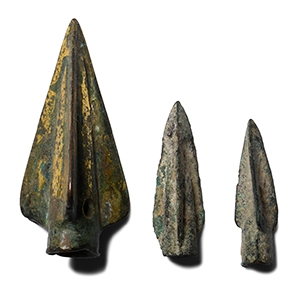
Chinese and Greek Bronze Arrowhead Group
Circa 3rd century B.C.-3rd century A.D.Sold for (Inc. bp): £26
Comprising two triangular-section Greek arrowheads; a gilt triangular-section arrowhead with short tubular socket. 18.9 grams total, 24-40 mm
Acquired in the 1980s-1990s. Property of a Nottinghamshire gentleman.
