
Loading, please wait...


LOT 2037
Victorian Marble and Lava Cameo Collection
19TH CENTURY A.D.
7/8 - 1 in. (5.68 grams total, 21-24 mm).
Comprising: a grey cameo with a low-relief profile bust of a bearded man with a wreath on his head; an orange mottled stone cameo with a youthful male bust in three-quarter view, resembling the portraits of Alexander the Great. [2, No Reserve]
ProvenanceAcquired on the European art market.
CONDITIONTimeLine Auctions follows a vetting process to ensure the authenticity and legality of all items, reinforcing our commitment to integrity and responsible trading. Each antiquity, antique, and coin lot undergoes thorough examination by a vetting committee of at least ten external specialists, professional trade association members, scientists, and archaeologists: Our Vetting Process
AUCTIONS:
TimeLine is a leading auction house specialising in antiquities, ancient art, collectables, natural history, coins, medals, and books. Our auctions offer museums, collectors, historians, and enthusiasts the opportunity to acquire unique and historically significant pieces.
-
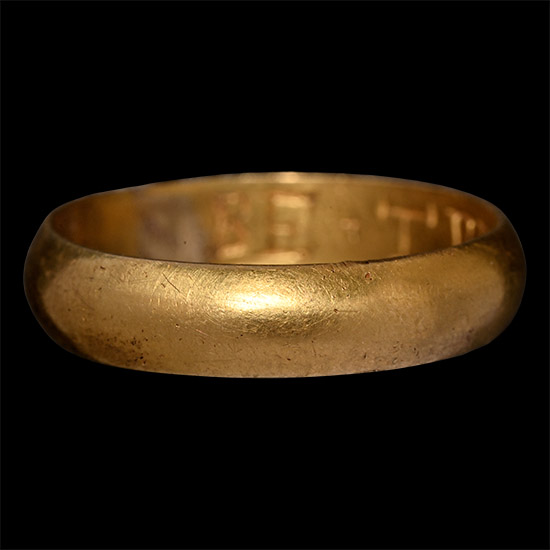
Tudor Gold 'BE . TRVE . IN . HART' Posy Ring
Circa 16th century A.D.Sold for (Inc. bp): £2,470
Featuring a smooth exterior and D-shaped in cross-section, a flat internal face with an inscription in upper case Roman letters, reading 'BE . TRVE . IN . HART' for 'Be true in heart' with the stops formed as small crosses and the N reversed. 4.25 grams, 20.66 mm overall, 18.06 mm internal diameter (approximate size British P, USA 7 1/2, Europe 16.23, Japan 15)
Found whilst searching with a metal detector near Edgmond, Telford & Wrekin, UK, by George Elymn, on 27 October 2024. Recorded with the British Museum's Portable Antiquities Scheme (PAS) with reference no.HESH-B237EA; handed in as Treasure under the Treasure Act, and subsequently disclaimed and returned to the finder. Accompanied by a copy of the Report for H M Coroner on finding of Potential Treasure, with reference no.2025T1645. Accompanied by a copy of a letter from the British Museum explaining that the Crown's interest in this find has been disclaimed.
The 'posy' name is derived from the 'poesy' (motto) engraved around the hoop. In medieval examples, the posy is usually found around the hoop exterior, although on later examples, inscriptions were more usually engraved on the interior. Rings with amatory inscriptions can be found from the 14th century AD onwards, when they served as love gifts, betrothal and wedding rings. Posy rings were also given to friends or used to mark significant occasions. Posies were composed by the giver, kept in stock by goldsmiths, or could be selected from published compendiums or commonplace books such as 'The Mysteries of Love or the Arts of Wooing' (1658 AD), or 'Love's Garland or Posies for Rings, Hand-kerchers and Gloves and such pretty tokens that Lovers send their Loves' (1674 AD). Rings were one genre of personal item amongst many to be adorned with posies at this time. -
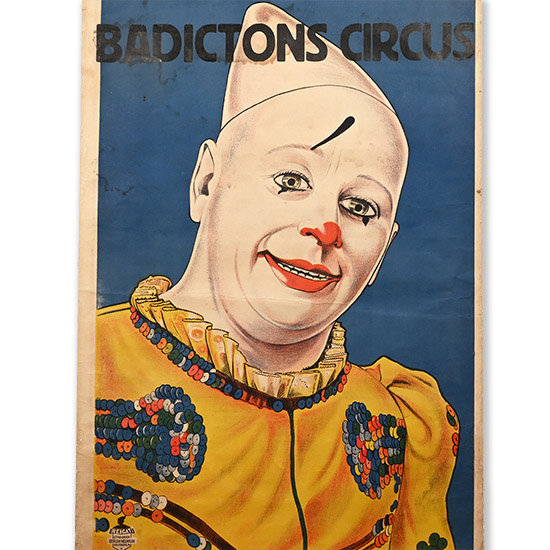
Badictons Circus Original Advertising Poster
1920s A.D.Sold for (Inc. bp): £364
Off-white ground with overprinted pierrot image, 'Badictons Circus' title; printer's logo bottom left 'Beigat Litho-Druck / Berlin-NeuKolln / Reuterstr.34' and reference 'No.109'. 22 grams, 70.5 x 46.5 cm
Acquired on the UK art market. Property of a Harwich, UK, collector. -
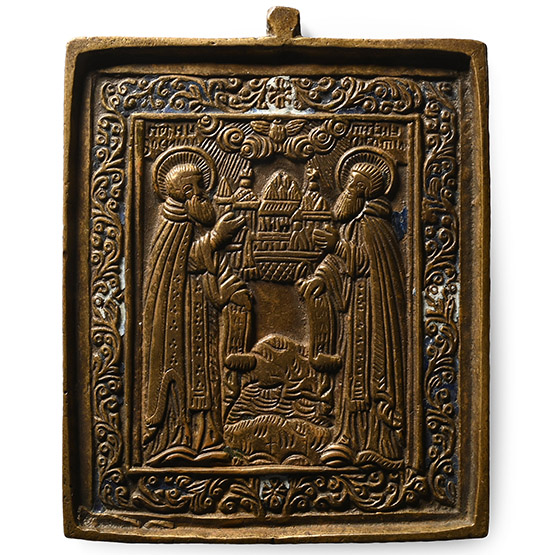
Russian Orthodox Enamelled Bronze Travel Icon with Saints Zosima and Sabbas
Circa 1820 A.D.Sold for (Inc. bp): £975
Depicting Saint Zosima and Saint Sabbas in front of the Solovetsky Monastery, both nimbate and dressed in the Abbot’s garments, holding the model of the monastery offered to God, represented in the sky as a dove upon a cloud; arabesque frame; inscriptions in Old Slavonic with the names of the saints. 108 grams, 88 mm
Acquired from Chris Martin-Zakheim, Iconastas, 5 Piccadilly Arcade, London SW1. From the private collection of a West London, UK, gentleman, formed since the early 2000s.
Saints Zosima and Sabbas or Sabbatius were highly venerated Orthodox saints, founders of the Solovetsky Monastery, a fortified monastery located in the White Sea in Northern Russia. This double portrait shows Zosima and Sabbas holding up a model of their religious institution, which resembles a small medieval city. Solovetsky Monastery obtained big investments from the city of Novgorod and established itself as one of the richest monasteries in Russia.
