
Loading, please wait...
LOT 1428
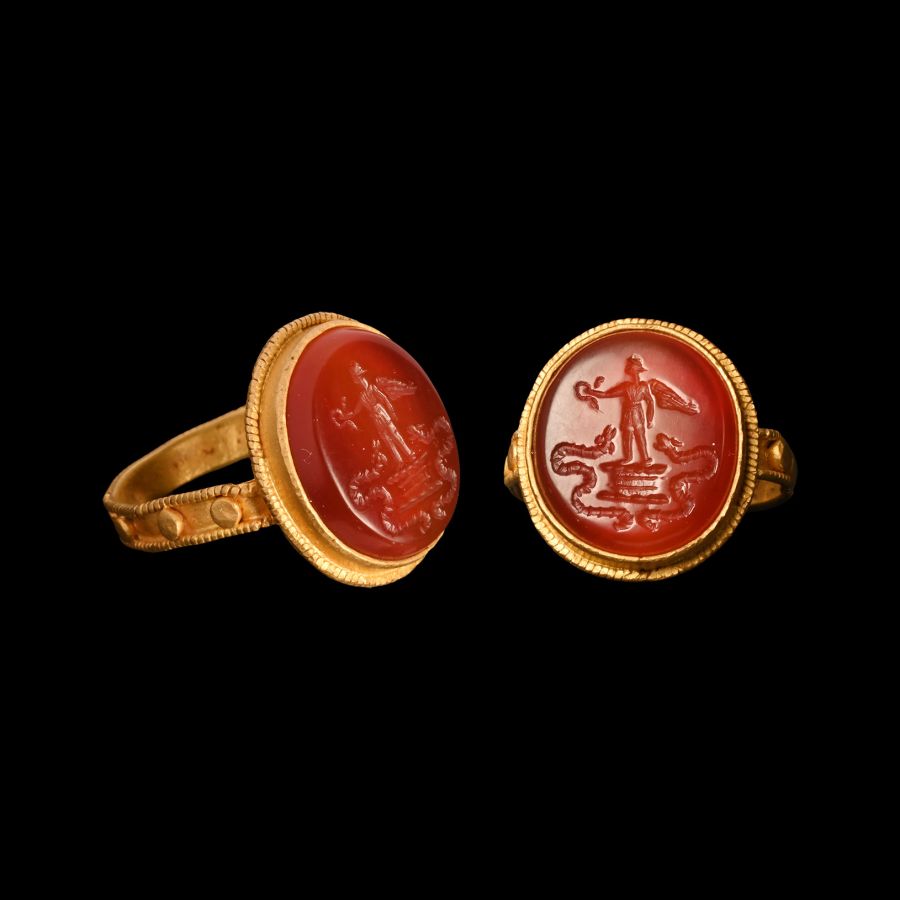
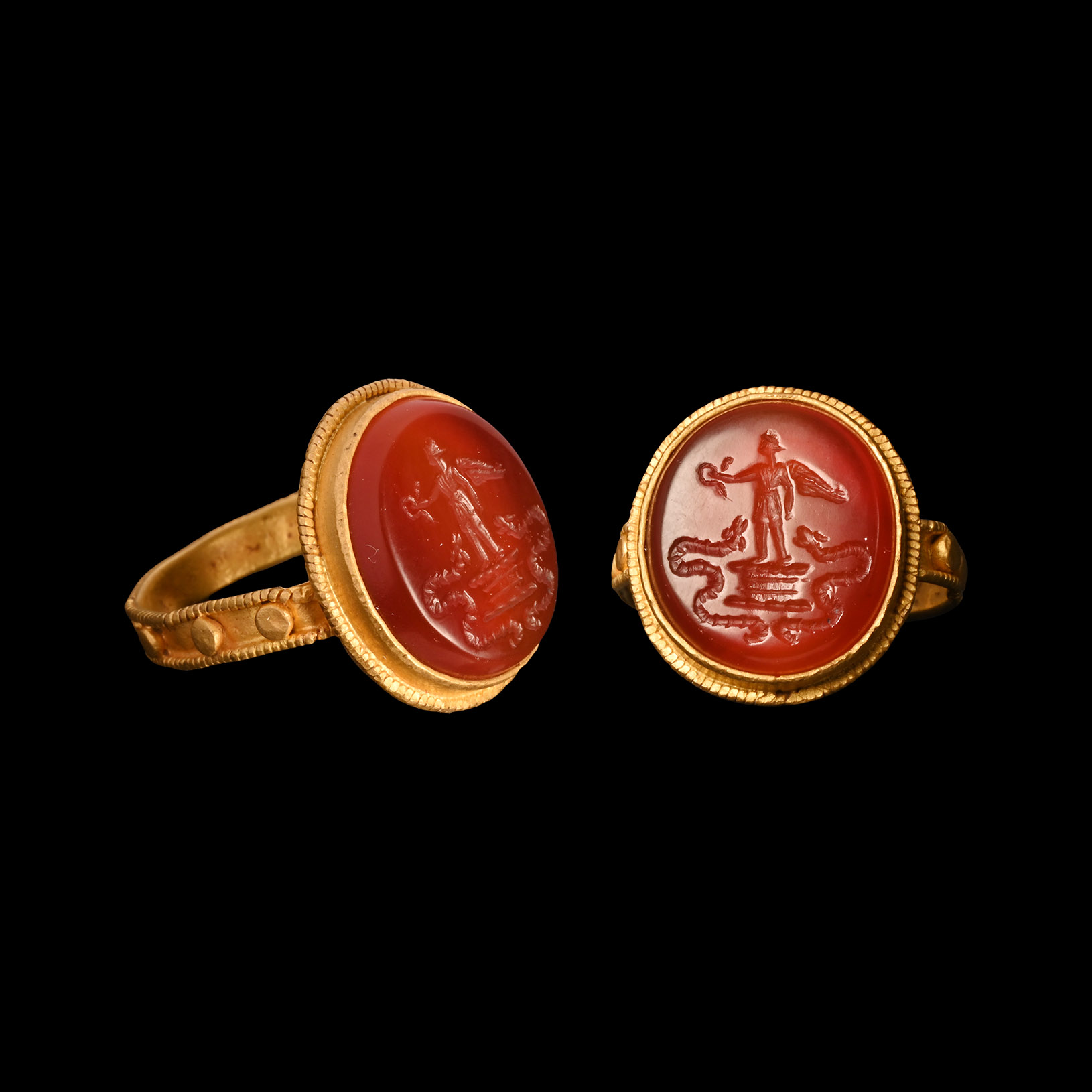
Victorian Gold Ring with Victory Gemstone
19TH-20TH CENTURY A.D. OR EARLIER
3/4 in. (3.54 grams, 20.07 mm overall, 15.50 mm internal diameter (approximate size British I, USA 4 1/4, Europe 7.44, Japan 7)).
A gold finger ring with beaded wire to the rim of the hoop and applied pellets, ellipsoid bezel with beaded wire border, inset carnelian cloison with figure of Victory on a plinth between rearing snakes.
ProvenanceEnglish private collection.
CONDITIONTimeLine Auctions follows a vetting process to ensure the authenticity and legality of all items, reinforcing our commitment to integrity and responsible trading. Each antiquity, antique, and coin lot undergoes thorough examination by a vetting committee of at least ten external specialists, professional trade association members, scientists, and archaeologists: Our Vetting Process
AUCTIONS:
TimeLine is a leading auction house specialising in antiquities, ancient art, collectables, natural history, coins, medals, and books. Our auctions offer museums, collectors, historians, and enthusiasts the opportunity to acquire unique and historically significant pieces.
LOT 1428
Victorian Gold Ring with Victory Gemstone
Estimate £600 - 800€700 - 930 (for guidance only)$810 - 1,080 (for guidance only)
-
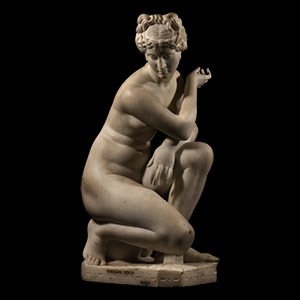
Marble Statue of Kneeling Venus
20th century A.D.Sold for (Inc. bp): £14,950
A marble copy of the kneeling Venus (original in the Vatican Museums), crouching on an octagonal base; the arms raised in expressive pose, head tilted, hair drawn up in a chignon; lettering to base 'KNEELING VENUS' and 'ROME'. 135 kg, 88.5 cm high
French collection, 1960s-early 2000s. From an important Paris gallery, France. with Auktionshaus Kaupp GmbH, Salzburg, Germany, 25 September 2016. This lot has been checked against the Interpol Database of stolen works of art and is accompanied by search certificate number no.11688-199351.
The statue is modelled on an ancient original, commonly thought to represent Aphrodite. The original statue of the Crouching Venus was excavated in Salona (modern Solin near Split, Croatia). It was purchased for the Vatican Museums from where it was confiscated by the French under Napoleon, and subsequently returned to the Vatican in 1816. -
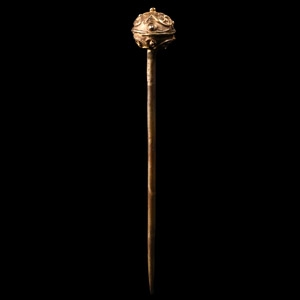
Tudor Gilt Silver Dress Pin
Circa 16th century A.D.Sold for (Inc. bp): £46
A gilt-silver dress pin composed of a round-section body and roughly spherical head, decorated with granules and filigree trefoils and roundels above and below a medial band. 2.8 grams, 62 mm
Acquired on the UK antiques market between 1974-1985. Albert Ward collection, Essex, UK. -
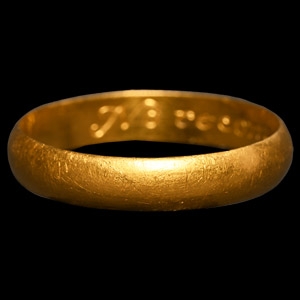
Post Medieval Gold 'No Recompence But Love' Posy Ring
Circa 18th century A.D.Sold for (Inc. bp): £845
A large gold posy ring with D-section hoop and inscribed internally 'No recompence but love' in lower case with 'ML' maker's punch. 3.08 grams, 20.33 mm overall, 18.20 mm internal diameter (approximate size British P 1/2, USA 7 3/4, Europe 16.86, Japan 16)
Acquired on the UK antiques market between 1974-1985. Albert Ward collection, Essex, UK.
