Loading, please wait...

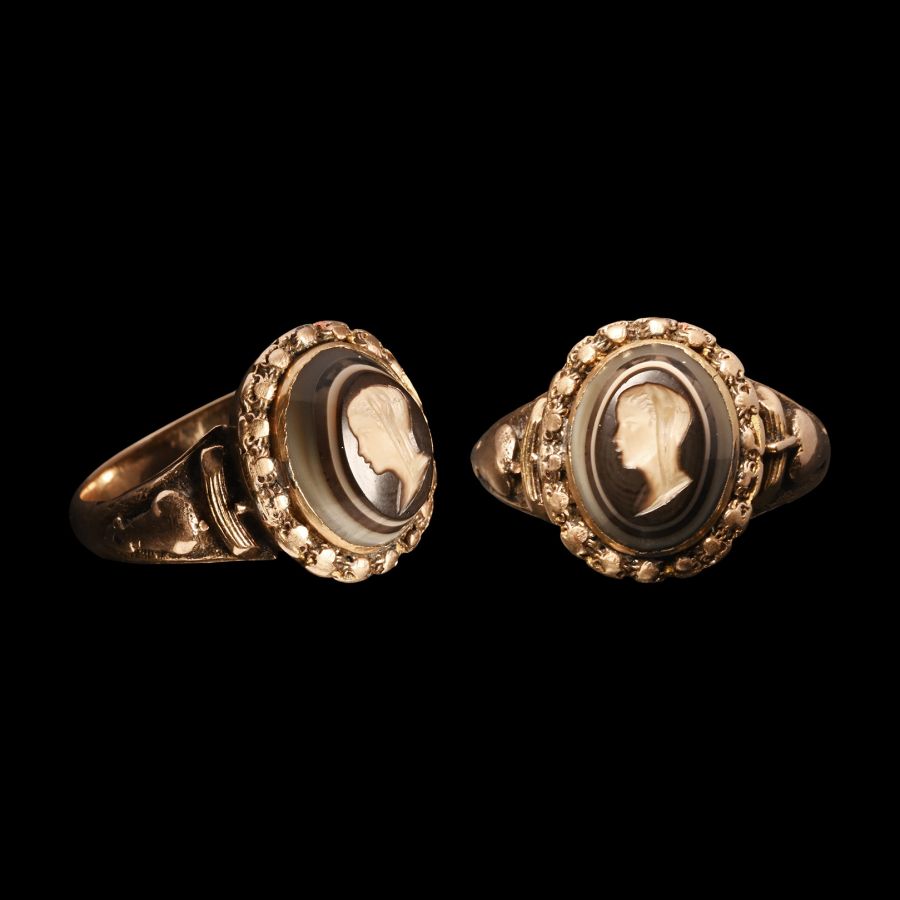
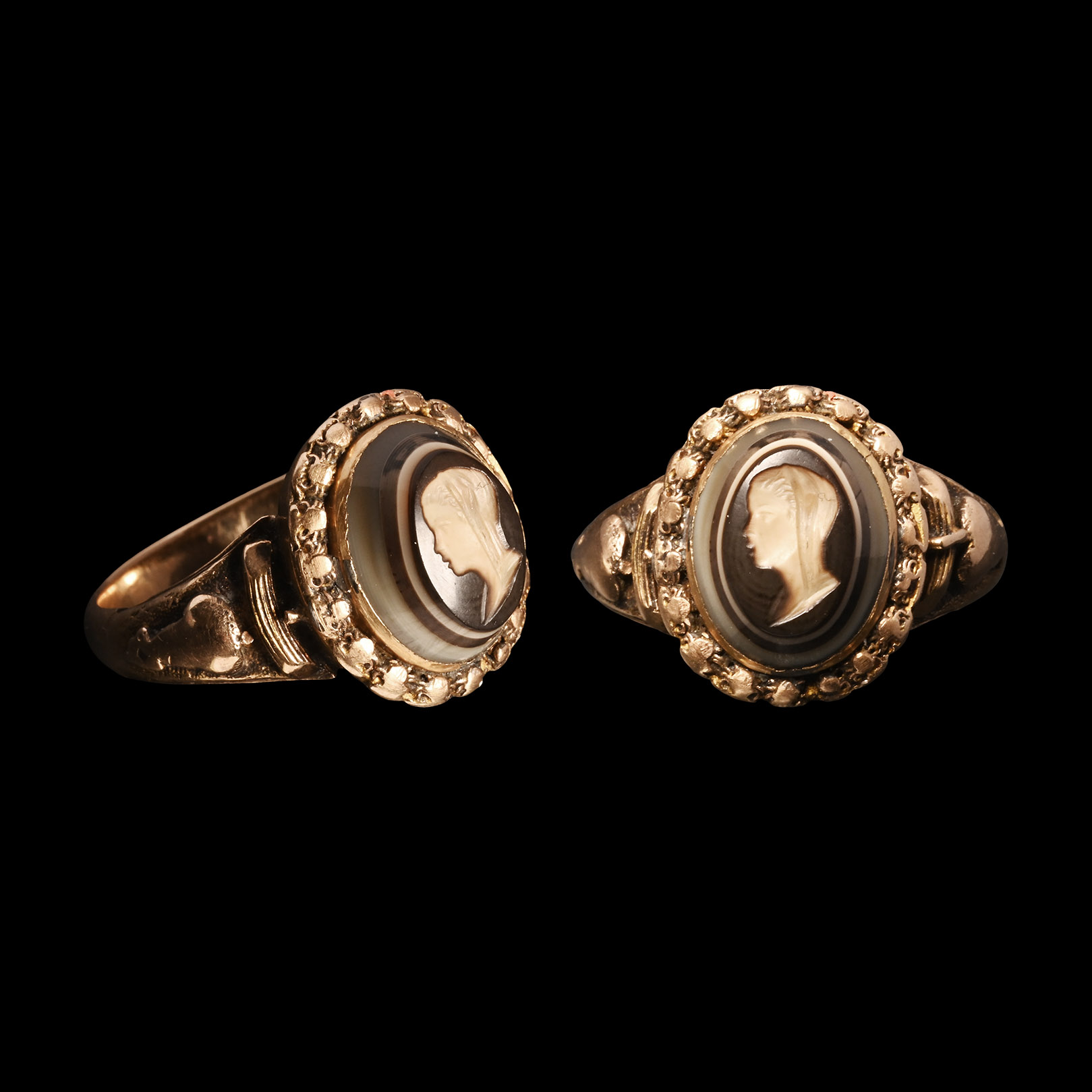
Victorian Gold Ring with Portrait Gemstone Victorian Gold Ring with Portrait Gemstone Victorian Gold Ring with Portrait Gemstone
Use mousewheel to zoom in and out, click to enlarge
Details

LOT 1444

Victorian Gold Ring with Portrait Gemstone

19TH CENTURY A.D.

1 in. (5.75 grams, 26.60 mm overall, 17.78 mm internal diameter (approximate size British O 1/2, USA 7 1/4, Europe 15.61, Japan 15)).

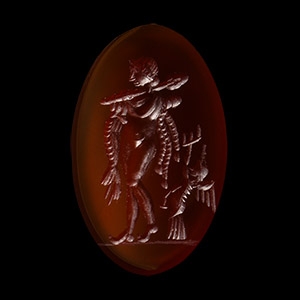
A gold finger ring with pie-dish bezel and pellets to the rim, inset sardonyx with intaglio female bust.

Provenance

English private collection.

CONDITION
VETTING:

TimeLine Auctions follows a vetting process to ensure the authenticity and legality of all items, reinforcing our commitment to integrity and responsible trading. Each antiquity, antique, and coin lot undergoes thorough examination by a vetting committee of at least ten external specialists, professional trade association members, scientists, and archaeologists: Our Vetting Process


AUCTIONS:

TimeLine is a leading auction house specialising in antiquities, ancient art, collectables, natural history, coins, medals, and books. Our auctions offer museums, collectors, historians, and enthusiasts the opportunity to acquire unique and historically significant pieces.

LOT 1444

Victorian Gold Ring with Portrait Gemstone

Estimate £400 - 600€460 - 700 (for guidance only)$540 - 810 (for guidance only)

Print page

RELATED LOTS
  • The Hursley Tudor Gold Hope Is Mi Holde Till Hap Shall Helpe Buckle Posy Ring
    'The Hursley' Tudor Gold 'Hope Is Mi Holde Till Hap Shall Helpe' Buckle Posy Ring
    Circa 16th century A.D.

    Estimate: £15,000 - 20,000 (+bp*)

    Opening Bid: £5,556

    A gold posy ring with rectangular-section hoop in the form of a buckled belt with looped end tie and chape with double-bowed and pinned buckle, the outer face inscribed '+HOPE * IS * MI HOLDE' in Roman capitals, continuing 'TILL * HAP * SHALL * HELPE' around the interior; accompanied by a vintage ring box. 2.76 grams, 19.17 mm overall, 16.63 mm internal diameter (approximate size British M, USA 6 1/4, Europe 12.34, Japan 12)


    Found whilst searching with a metal detector near Hursley, Hampshire, UK, on Sunday 26th August 2012. Acquired from Berganza, Hatton Garden, London, 2017. Property of an East Sussex collector. Disclaimed under the Treasure Act with reference no.2012 T805. Accompanied by a copy of the British Museum's Portable Antiquities Scheme report no.HAMP-62C152. Accompanied by a copy of the Berganza invoice. This lot has been checked against the Interpol Database of stolen works of art and is accompanied by search certificate no.11667-197581.

    The inscription is somewhat enigmatic and does not seem to have been previously recorded for a posy ring; the form of the buckle and the knopped chape are typical of examples seen, often in base metal, from the late medieval period to the 16th century A.D. The name of this genre of ring is derived from the 'poesy' or motto usually engraved around the hoop. In medieval examples the posy is mostly engraved around the outside of the hoop but later examples find it on the inner surface. Rings with amatory inscriptions have their origins in the 14th century A.D., when they served as love gifts, betrothal and wedding rings, as attested by surviving documentary evidence. Posy rings were also given to friends or used to mark significant occasions.

    Lot Details

  • Renaissance Painted Child
    Renaissance Painted Child
    16th-17th century A.D.

    Estimate: £2,000 - 3,000 (+bp*)

    Opening Bid: £1,000

    A child carved naturalistically in relief in wood, enveloped in the folds of a woman's garment and cradled in her right arm and hand; remains of gesso, gilding and polychrome pigmentation; mounted on a custom-made display stand. 3.2 kg total, 42 cm high including stand


    English private collection. This lot has been checked against the Interpol Database of stolen works of art and is accompanied by searcher certificate number no.11674-199841.

    Lot Details

  • Ethiopian Processional Cross
    Ethiopian Processional Cross
    17th-18th century A.D.

    Sold for (Inc. bp): £715

    A bifacial wooden Qäqwami Mäsqäl processional cross, three-lobed extremities on three sides, decorated with geometric motifs representing crosses of different types, supported by a lanceolate shaft with two round openwork openings; socketted shaft with vertical grooves and fitted with a double horizontal groove; inscriptions on two of the lobed sides of the cross; accompanied by a custom-made display stand. 600 grams, 42 cm high (49cm high including stand)


    Acquired on the London art market, 2003. UK private collection.

    The large wooden crosses are often used by ddbtdras, who are unordained members of the Orthodox Ethiopian clergy, for their liturgical dance. In the countryside, one or two of these crosses are kept on the church window-sills close to the area where the dance is performed, instead of being kept in the church storehouse. Sometimes they are mounted upon a shaft and worn in procession. The characteristic feature of a processional cross is a socketted shaft which serves for mounting them on a strong pole known as masor or handle. Although technically the shaft serves to support the cross, according to the interpretation of Ethiopian church scholars, its real function is to protect the cross from being touched.

    Lot Details

Stay up-to-date with the latest from TimeLine Auctions by joining our mailing list