
Loading, please wait...
_900x900.jpg "Victorian 'Freaks Fair' Model of a Shrunken Head")
_200x200.jpg "Victorian 'Freaks Fair' Model of a Shrunken Head")
_900x900.jpg "Victorian 'Freaks Fair' Model of a Shrunken Head")
_200x200.jpg "Victorian 'Freaks Fair' Model of a Shrunken Head")
.jpg "Victorian 'Freaks Fair' Model of a Shrunken Head")
.jpg "Victorian 'Freaks Fair' Model of a Shrunken Head")
LOT 2178
Victorian 'Freaks Fair' Model of a Shrunken Head
19TH CENTURY A.D.
8 in. (810 grams total, 20.5 cm including stand).
A tribal head modelled from leather with applied hair, moustache, eyebrows and eyelashes; pierced through the lips and ears; set in a later glass dome with base. [No Reserve]
ProvenanceAcquired Mellors & Kirk, circa 2019.
Ian Wilkinson collection, Nottinghamshire, UK, formed since 1985.
This lot is accompanied by an illustrated lot declaration signed by the Head of the Antiquities Department, Dr Raffaele D’Amato.
This lot is accompanied by an illustrated lot declaration signed by the Head of the Antiquities Department, Dr Raffaele D'Amato.
The freak show was the archetypal expression of popular culture, enjoyed by everyone regardless of their class. The freak show was presented to the public as entertaining and educational, offering the opportunity to learn about anatomy and the ‘realities’ of people from foreign lands. The real 'shrunken heads' known as tsantsas were severed human heads that were used by tribal cultures as war trophies or for ceremonial purposes. They were also used to scare off an enemy, using the heads as a threat, or also in religious rituals.
CONDITIONTimeLine Auctions follows a vetting process to ensure the authenticity and legality of all items, reinforcing our commitment to integrity and responsible trading. Each antiquity, antique, and coin lot undergoes thorough examination by a vetting committee of at least ten external specialists, professional trade association members, scientists, and archaeologists: Our Vetting Process
AUCTIONS:
TimeLine is a leading auction house specialising in antiquities, ancient art, collectables, natural history, coins, medals, and books. Our auctions offer museums, collectors, historians, and enthusiasts the opportunity to acquire unique and historically significant pieces.
-
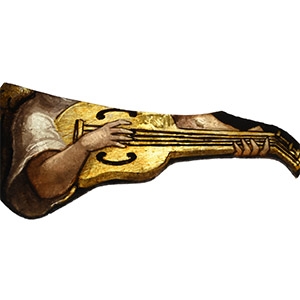
Medieval Stained Glass Panel with Two Hands Playing a Vihuela
Northern France, circa 1520 A.D.Sold for (Inc. bp): £338
Irregular panel with a pair of youthful hands playing a vihuela (?) with four strings. 66 grams, 25 cm
Ex Galerie de Chartres, 8 March 2009, no.93. Ex central London gallery. This lot is accompanied by an illustrated lot declaration signed by the Head of the Antiquities Department, Dr Raffaele D'Amato. -
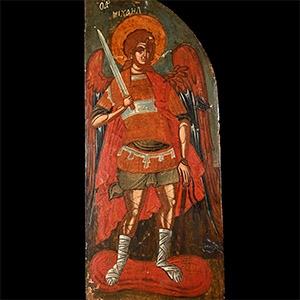
Large Wing of a Triptych Showing the Archangel Michael
Greek, 17th century A.D.Sold for (Inc. bp): £1,560
Tempera on wood panel depicting the Archangel Michael standing on a red cushion in the guise of a guardian angel, holding a drawn sword in his right hand and a scabbard in his other hand; the face with a brown base, features formed in shades of tan and beige with white highlights on a terracotta and deep green background. 3.5 kg, 70 x 38 cm with frame
Acquired on the European art market. Private collection, London, UK. Accompanied by an academic report by Dr Raffaele D'Amato. This lot has been checked against the Interpol Database of stolen works of art and is accompanied by a search certificate number no.12844-240885. This lot is accompanied by an illustrated lot declaration signed by the Head of the Antiquities Department, Dr Raffaele D'Amato.
Even after the fall of Constantinople, icons painted on wood remained the principal object of devotion for Orthodox Christians both within the former borders of Byzantium and wherever the commonwealth of the Eastern Roman Empire left its traces. The painted icons are still today used by the Orthodox for personal devotion, for display in churches on feast days, and to decorate the iconostasis (partition) of the church, i.e. the dividing wall erected in front of the Bema, where the sacred altar of the Apse is collocated. The Archangel Michael was the commander of the Heavenly Host, and venerated by military men and the common people as one of the most powerful protector saints. -
.jpg)
Post Medieval Bronze Fire Strikers
17th-18th century A.D.Estimate: £700 - 900 (‡+bp*)
Opening Bid: £150
Both with two large arched loops for fingers; one with a triangular, the other with a rectangular striking peen; profile formed as a ship with pointed stern and the bow ending in a volute, engraved wave pattern along the hull; mounted on a custom-made display stand. 190 grams total, 18.5 cm wide including stand
German art market, before 2008. Accompanied by a copy of an Art Loss Register certificate no.S00014409. This lot is accompanied by an illustrated lot declaration signed by the Head of the Antiquities Department, Dr Raffaele D’Amato. This lot is accompanied by an illustrated lot declaration signed by the Head of the Antiquities Department, Dr Raffaele D'Amato.
These fire strikers represent one of the typical shape during the 17th and 18th centuries. They were shaped with two bows, and were often decorated with a series of ornamental strokes on the side.
