
Loading, please wait...

LOT 2197
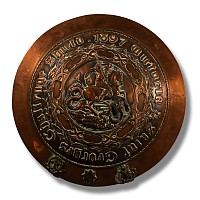
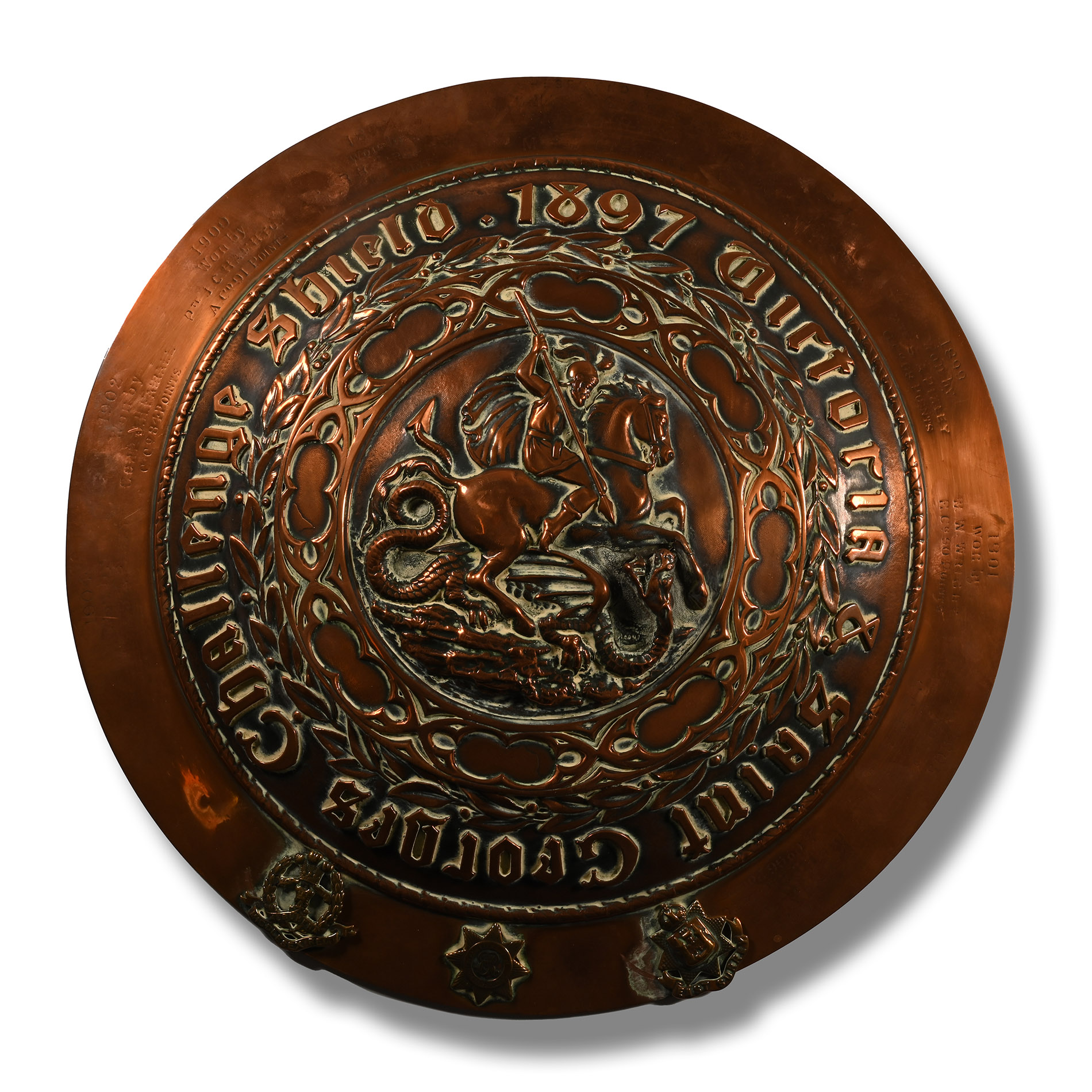
Victoria and St George's Rifles Challenge Shield
1897 A.D.
15 1/2 in. (1.04 kg, 39.5 cm).
With embossed St. George and the Dragon, surrounded by '1897, Victoria & Saint Georges Challenge Shield', presented by Mrs. W. Clemence, with nine winners noted around the outer edge. [No Reserve]
ProvenancePresented by Mrs W. Clemence in 1897.
Property of a Stockport, UK, collector.
This lot is accompanied by an illustrated lot declaration signed by the Head of the Antiquities Department, Dr Raffaele D’Amato.
The regiment was raised as the 1st (Victoria Rifle Club) Middlesex Rifle Volunteer Corps and became the 1st Middlesex Rifle Volunteer Corps on the formation of the Volunteer Force in 1860. By 1892 the 1st Middlesex and 6th (St George's) Rifle Volunteer Corps were joined together.
CONDITIONTimeLine Auctions follows a vetting process to ensure the authenticity and legality of all items, reinforcing our commitment to integrity and responsible trading. Each antiquity, antique, and coin lot undergoes thorough examination by a vetting committee of at least ten external specialists, professional trade association members, scientists, and archaeologists: Our Vetting Process
AUCTIONS:
TimeLine is a leading auction house specialising in antiquities, ancient art, collectables, natural history, coins, medals, and books. Our auctions offer museums, collectors, historians, and enthusiasts the opportunity to acquire unique and historically significant pieces.
-
.jpg)
Greek Style Stone Recumbent Ram Statue
19th-20th century A.D.Sold for (Inc. bp): £13
Modelled in the round on a rectangular base, the legs folded beneath the body; after the antique. 10.3 kg, 25.5 cm wide
From a collection acquired on the UK art market from various auction houses and collections mostly before 2000. From an important Cambridgeshire estate; thence by descent. This lot is accompanied by an illustrated lot declaration signed by the Head of the Antiquities Department, Dr Raffaele D’Amato. -
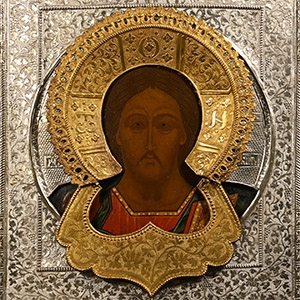
Russian Icon with Bust of Christ Pantokrator
17th century A.D.Estimate: £3,000 - 4,000 (+bp*)
Opening Bid: £1,350
Rectangular wooden board with mounting bars to reverse, silver-coloured metal riza with reserved epigraphic panels and circular void to reveal painted icon beneath; separate two-piece gilt revetment, the upper with pierced edge and reserved capitals, the scooped lower panel bearing reserved tendril ornament. 1.53 kg. 30.5 x 26 cm
Acquired on the UK art market. Private collection, London, UK. Accompanied by an academic report by Dr Raffaele D'Amato. This lot has been checked against the Interpol Database of stolen works of art and is accompanied by a search certificate number no.12553-231940. This lot has been cleared against the Art Loss Register database, and is accompanied by an illustrated lot declaration signed by the Head of the Antiquities Department, Dr Raffaele D’Amato. -
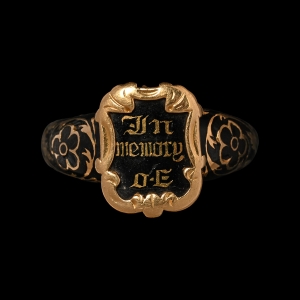
Engraved Gold and Black Enamel Memento Mori Ring
19th century A.D.Estimate: £1,000 - 1,400 (+bp*)
Opening Bid: £500
With D-section tapering hoop, black enamel finish with reserved rosettes and tendrils, the bezel an ornate heater shield with reserved text 'In memory OE' and copperplate engraving to the inner face '1852 / obt.63', 'Mrs.Sarah Hems, obt.26 May' and stamped assay marks: crown, '18', leopard's head, gothic 'k' in octagonal panel (dated to 1845). 4.14 grams, 22.74 mm overall, 17.43 mm internal diameter (approximate size British O, USA 7, Europe 14.98, Japan 14)
Acquired on the UK art market. Property of an East Sussex collector. This lot is accompanied by an illustrated lot declaration signed by the Head of the Antiquities Department, Dr Raffaele D’Amato.
