
Loading, please wait...
LOT 0015
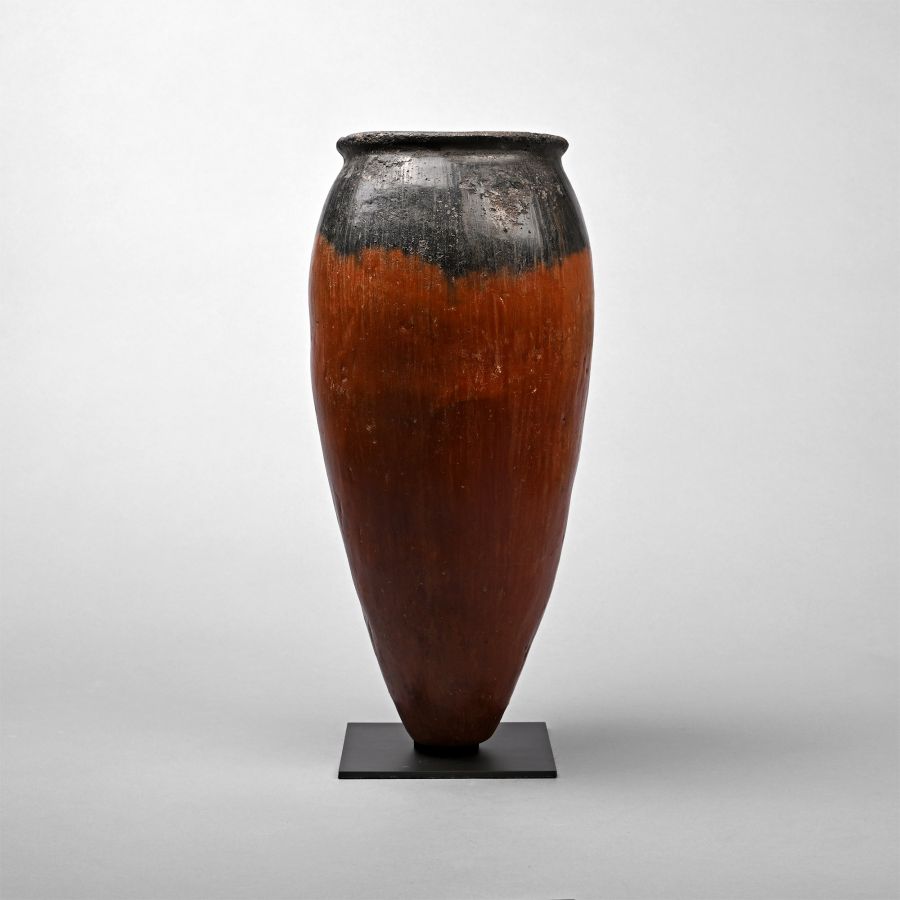
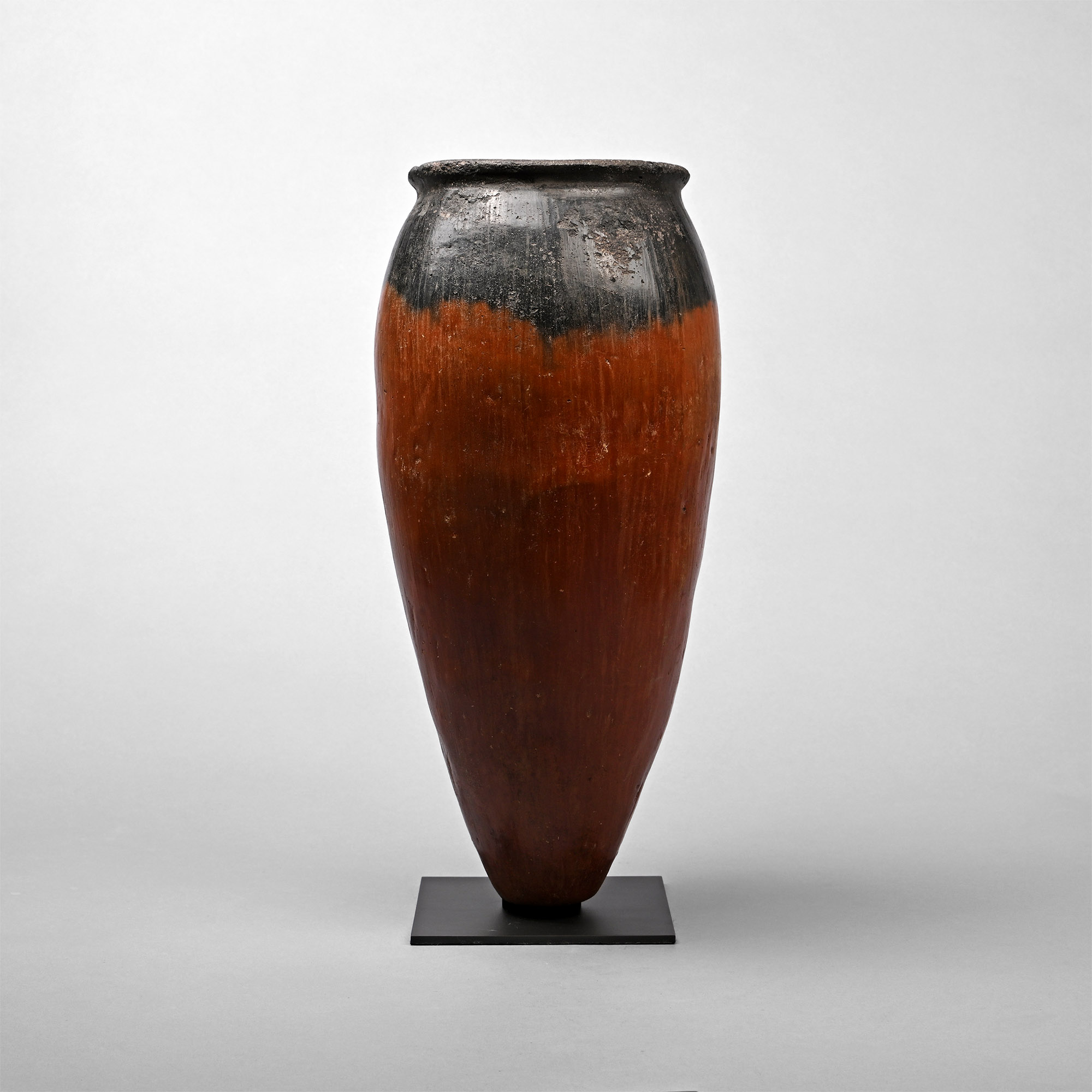
Very Tall Egyptian Black-Topped Vase
PREDYNASTIC PERIOD, NAQADA II, CIRCA 3900–3400 B.C.
15 3/4 in. (16 in.) (3.67 kg total, 40 cm (40.5 cm high including stand)).
A finely made, coil-formed Nile silt clay, red-polished pottery vessel with elongated ovoid body, pointed base, rounded shoulder, and narrowing neck widening to a slightly everted rim; the upper section blackened through inverted firing, creating the characteristic black-topped finish of Upper Egyptian Predynastic ceramic production; the surface retaining a lustrous burnish with visible vertical polishing marks; accompanied by a display stand.
Provenancewith Joe Gerena Fine Arts, New York, USA.
Collection of Erich Spangenberg, Texas, 1980s.
Fortuna Fine Arts Ltd, New York, USA.
Wyvern Collection, acquired from the above on 20 March 2018.
This lot has been checked against the Interpol Database of stolen works of art and is accompanied by search certificate number no.13349-256959.
Cf. Petrie, W.M.F., Corpus of Prehistoric Pottery and Palettes, London, 1917, pl. VI, no. 53a, for the vessel type.
FootnotesThis is an exceptionally large Naqada II black-topped vessel; comparable large examples generally measure approximately 33–37 cm (e.g., Aberdeen Museums ABDMS003532, 36.5 cm; British Museum EA30966, 33.6 cm; National Museum of Ireland 1899:311, 36 cm; Metropolitan Museum of Art 36.1.2, 35 cm), although most examples are significantly smaller.
Black-topped vessels were hand-made from finely prepared Nile silt clay, often tempered and coated with a red hematite slip. Larger examples frequently took the form of hes-jars with tapered or pointed bases and narrowing necks and vases with rather more torpedo-like bodies, like this example, while others were made as beakers or wide bowls. Experimental studies suggest that the vessels were fired inverted, with their openings buried in sawdust or other organic material, producing the characteristic blackened rim and interior. After firing, their surfaces were carefully burnished to a high polish, leaving visible polishing marks. These vessels were used mainly in ritual and funerary contexts for the presentation and pouring of liquid offerings. Found chiefly in higher-status burials and cultic deposits, their distinctive red-and-black colour scheme was probably associated with Egyptian concepts of death, regeneration, and cyclical renewal, making them especially appropriate for funerary ceremonies and ritual activities.
TimeLine Auctions follows a vetting process to ensure the authenticity and legality of all items, reinforcing our commitment to integrity and responsible trading. Each antiquity, antique, and coin lot undergoes thorough examination by a vetting committee of at least ten external specialists, professional trade association members, scientists, and archaeologists: Our Vetting Process
AUCTIONS:
TimeLine is a leading auction house specialising in antiquities, ancient art, collectables, natural history, coins, medals, and books. Our auctions offer museums, collectors, historians, and enthusiasts the opportunity to acquire unique and historically significant pieces.
-
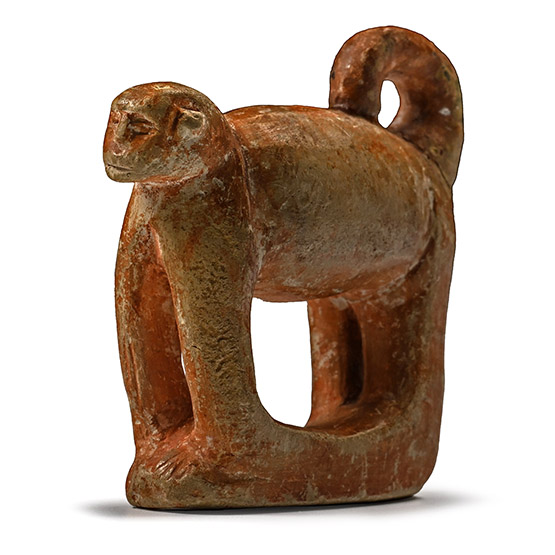
Egyptian Statuette of a Monkey
Ptolemaic Period, 4th-1st century B.C.Estimate: £600 - 800 (‡+bp*)
Current Winning Bid: £400
Standing on a rectangular plinth with head raised and tail curled above the hindquarters, barrel-shaped body with incised detailing at the shoulders and hips, traces of a white and reddish brown coating; partially restored; old collector's labels to underside '51' and 'N13234'. 42.8 grams, 60 mm
Ex Baden-Württemberg, Germany, formed since ca.1930. Private collection, Saarland, Germany. Thereafter, Michael Schrôder, Germany. Consigned to DAWO Auktion, 18 February 2017, no.824. Accompanied by a copy of an Art Loss Register certificate no.S00123279.
The ancient Egyptians kept pet monkeys (baboons as well as the more slender guenons) for amusement and as status symbols. These animals played around the house and accompanied the master on outings. -
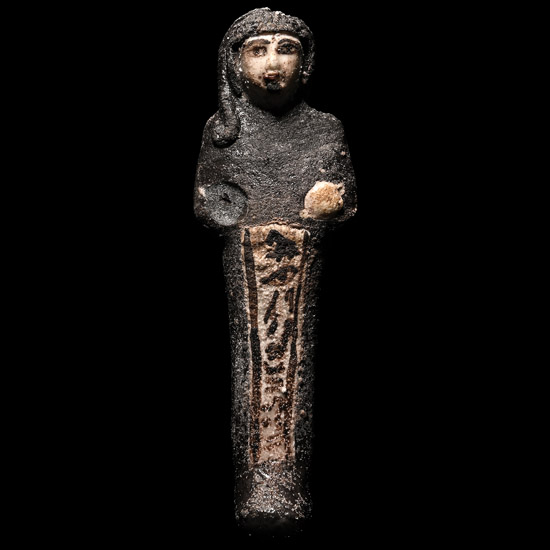
Egyptian Faience Shabti for the Fourth Son of Ramesses II, Prince Khaemwaset
New Kingdom, 19th Dynasty, 1279-1213 B.C.Sold for (Inc. bp): £1,950
In brownish-black and white faience with black detailing, depicted wearing a round wig featuring a side-lock, the white face displaying eyes, eyebrows, nostrils, and a short beard in black; the arms crossed, and the white-glazed hands (one missing) holding hoes; a slightly raised white-glazed frontal panel containing a column of hieroglyphic text reading: 'The Osiris, the sem (priest), the King's Son, Khaemwaset, True of Voice'. 103 grams, 12.7 cm
Acquired on the UK art market, 1990s. Private collection, New York, USA. This lot has been checked against the Interpol Database of stolen works of art and is accompanied by search certificate no.13431-225468.
Khaemwaset was the fourth son of Ramesses II, born to Queen Iset-Nofret. In addition to serving as the Sem-priest of Ptah at Memphis from an early age, he held various titles related to the Memphite cult, including High Priest of Ptah. The side-lock featured on all of Khaemwaset's shabtis is associated with his priestly role. Many shabtis of the prince are known, with the largest single group coming from the Serapeum at Saqqara; however, others have been found in numerous other locations. Since Khaemwaset's tomb has yet to be discovered, it appears that most of the known shabtis may have served as votive offerings in the sacred areas of the Memphite necropolis. His faience shabtis come in various colours, including green, blue, white, and black, and range in size from just under 10 cm to 15 cm in height. The distinctive glaze combination of this example, featuring a raised white-glazed panel contrasting with the darker body colour, is also found on some other 19th Dynasty shabtis (Cf. Janes, G., The Shabti Collections 3: Rochdale Arts & Heritage Service, Cheshire, 2011, pp.1-5, for those of Userhat from Sedment). -
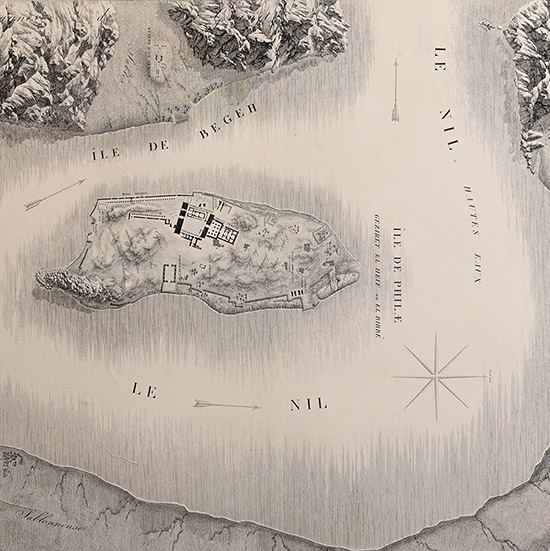
Very Large Egyptian Expedition Lithograph of the Isle of Philae
Early 19th century A.D.Sold for (Inc. bp): £98
Proof etching on laid paper of plate 1 from Île de Philae entitled Plan Général de l'île et de ses environs. 255 grams, 104 x 69 cm
From the collection of a North American priest. Acquired between 1981-1996. Property of a North American collector.
Produced between February 1802 and 1830 on the orders of Napoleon Bonaparte; published between 1809 and 1828. Just 1,000 copies were distributed to various institutions, printed on laid paper with an 'Égypte ancienne et moderne' watermark. The book is subtitled Recueil des observations et des recherches qui ont été faites en Égypte pendant l’expédition de l’Armée française, publié par les ordres de Sa Majesté l’Empereur Napoléon le Grand (Gathering of observations and discoveries which were made in Egypt during the expedition of the French army, published on the orders of His Majesty the Emperor Napoleon the Great). It was the world's first encyclopedia devoted exclusively to the remains of ancient Egypt. The plates of this book are the first to present the archaeological sites of Thebes (Luxor). The Philae temple complex was one of the monuments moved during the construction of the Aswan High Dam. It was carefully dismantled piece by piece and reassembled on the island of Agilkia.
