
Loading, please wait...
LOT 0433
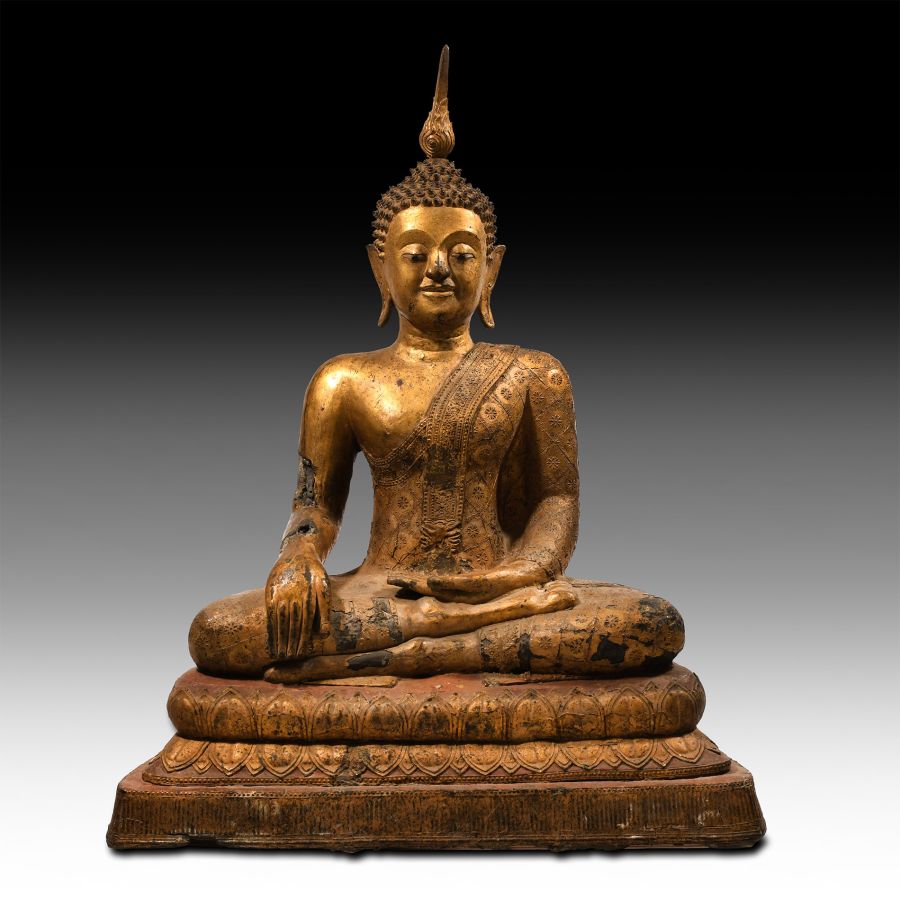
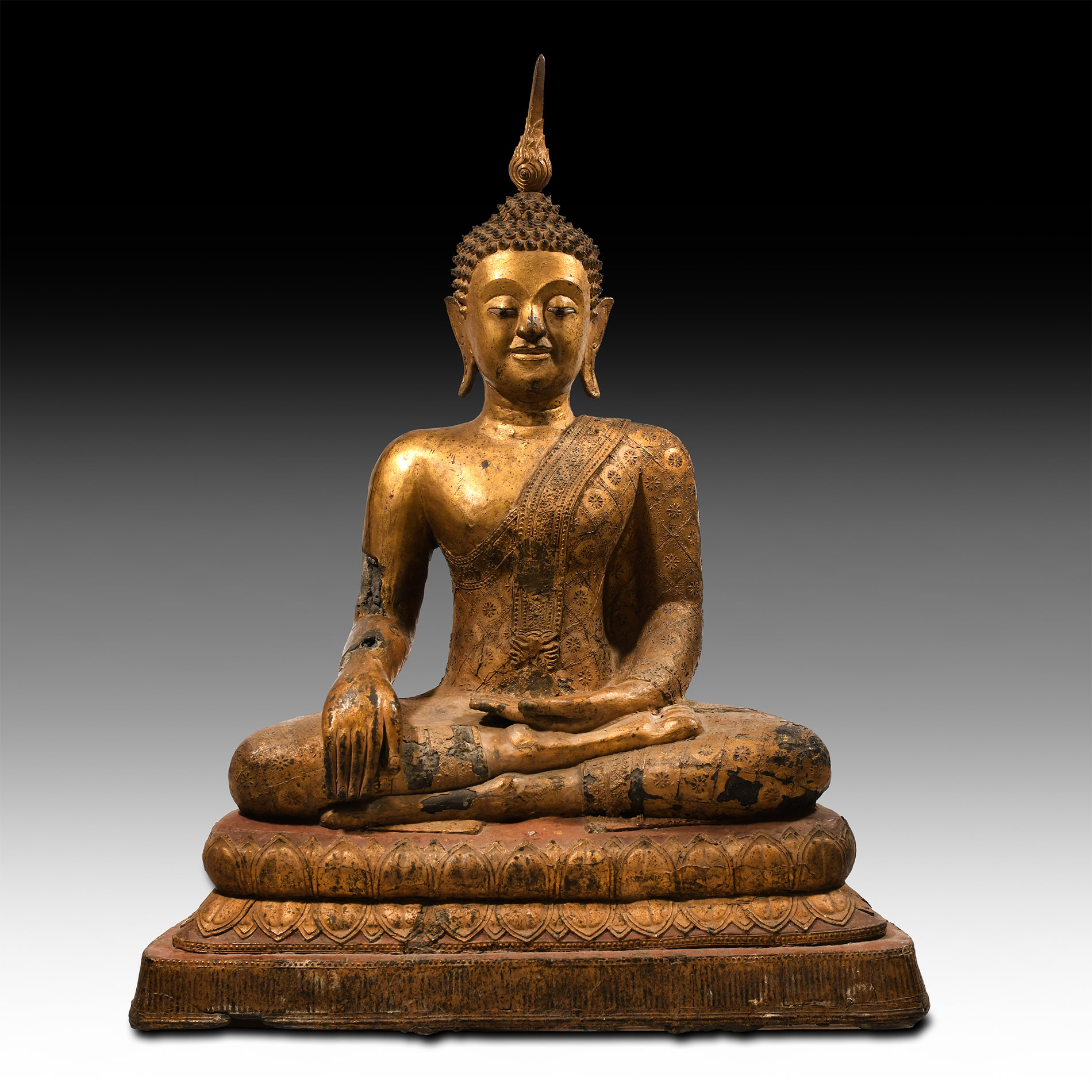
Very Large Thai Gilt Bronze Buddha Shakyamuni
19TH-20TH CENTURY A.D.
37 3/8 in. (99.5 kg, 95 cm high).
A large gilt bronze Shakyamuni Buddha figure seated cross-legged in virasana on a semi-circular lotus flower dais, right hand in bhumisparsha mudra, the left resting on his lap, wearing a samghati adorned with floral motifs, his face with a meditative expression and with downcast eyes below arched eyebrows, aquiline nose, gentle smile, elongated earlobes, the hair in tight curls surmounted by a flame.
ProvenanceFrench collection, 1960s-early 2000s.
From an important Paris gallery, France.
with Ogotai (?) Auctions, Paris, France, 22 January 2016, lot 2.
This lot has been checked against the Interpol Database of stolen works of art and is accompanied by search certificate number no.11714-199350.
The historical Buddha, Shakyamuni Buddha, (born Prince Siddhartha Gautama) was the founder of the Buddhist religion; he lived and taught in 6th century India. Born to a royal or aristocratic family of the Shakya kingdom, at age 29 he learned of the deep suffering experience by the people of his land, causing him to relinquish his title and palace home and after six years of study, self-sacrifice and meditation, became an enlightened Buddha.
Here, Buddha is shown seated in a yogic meditative posture, his right hand gesturing towards the Earth Goddess at the moment prior to his enlightenment. He displays many of the lakshanas, or auspicious marks of Buddhahood- the extended earlobes remind the viewer of his former princely status; three rings around the neck; urna formed from a curl of hair.
TimeLine Auctions follows a vetting process to ensure the authenticity and legality of all items, reinforcing our commitment to integrity and responsible trading. Each antiquity, antique, and coin lot undergoes thorough examination by a vetting committee of at least ten external specialists, professional trade association members, scientists, and archaeologists: Our Vetting Process
AUCTIONS:
TimeLine is a leading auction house specialising in antiquities, ancient art, collectables, natural history, coins, medals, and books. Our auctions offer museums, collectors, historians, and enthusiasts the opportunity to acquire unique and historically significant pieces.
LOT 0433
Very Large Thai Gilt Bronze Buddha Shakyamuni
Estimate £10,000 - 14,000€11,600 - 16,240 (for guidance only)$13,500 - 18,900 (for guidance only)
-
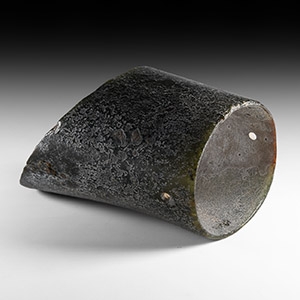
Chinese Hongshan Hoof-Shaped Black Jade Hair Ornament
Hongshan Dynasty, circa 3500 B.C.Estimate: £5,000 - 7,000 (+bp*)
Opening Bid: £2,500
A black jade hoof-shaped hair ornament of open-ended, truncated cylindrical form, two piercings towards the base for attachment; retaining its original patina. 188 grams, 12.5 cm high
Acquired in Hong Kong, 1980s. Ex Prof. David Anderson collection, circa 2009. UK private collection. This lot has been checked against the Interpol Database of stolen works of art and is accompanied by search certificate number no.11709-198346.
The Hongshan Neolithic culture flourished in north-east China between ca. 4700 to 2900 B.C. Such items were tomb deposits, usually found cradling the head of the interred human remains. It is presumed such pieces gathered the hair which would be passed through the cylindrical body. They invariably feature a rippling effect around the top interior, and two holes at the bottom which may once have accommodated a wooden peg. Confucius stated that 'Jade is the incorruptible stone', leading to the trend for those who discovered such artefacts in Chinese tombs to polish them, removing their authenticating patina, before returning them to the grave to be photographed, so as to propagate the myth that they were unearthed in unblemished condition. -
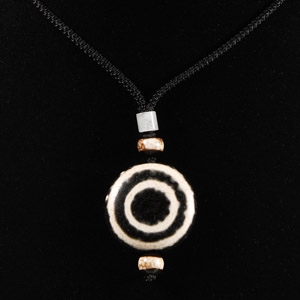
Chinese Giant 'Eye' Agate Bead Necklace
20th century A.D.Sold for (Inc. bp): £33
A large, bifacial banded agate bead, chemically treated to show the circular 'eye' design; suspended on a cord, additional beads above and below. 30 grams, 62 cm long
Ex London, UK, gallery. Property of a London gentleman. -
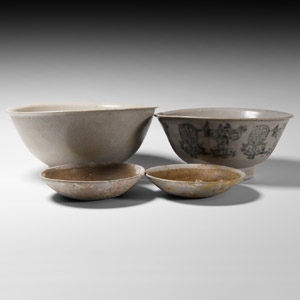
Chinese Tek Sing Shipwreck Pottery Collection
19th century A.D.Estimate: £100 - 140 (+bp*)
Opening Bid: £50
A group of four glazed ceramic vessels: two shallow dishes and two footed bowls with everted rim and basal ring. 659 grams total, 9.1-16 cm wide
Acquired 1980-2015. Ex Abelita family collection.
The Tek Sing (True Star) wreck is one of the famous recovery stories of the 20th century. Sailing from the port of Xiamen (then known as Amoy) in February 1822 the vessel Tek Sing was bound for Jakarta, Indonesia laden with porcelain goods and 1600 Chinese emigrants. The captain decided to pass through the Gaspar Strait, between the Bangka-Belitung Islands, and ran aground on a reef. The vessel sank in about 100 feet of water. The next morning, February 7, an English East Indian vessel captained by James Pearl, passing through the same waters, encountered debris and some survivors and managed to rescue about 190 of the latter.
