
Loading, please wait...
_900x900.jpg "Very Large Roman Gold Ring with Engraved Head of the God Neptune and Warships")
_200x200.jpg "Very Large Roman Gold Ring with Engraved Head of the God Neptune and Warships")
.jpg "Very Large Roman Gold Ring with Engraved Head of the God Neptune and Warships")
LOT 0203
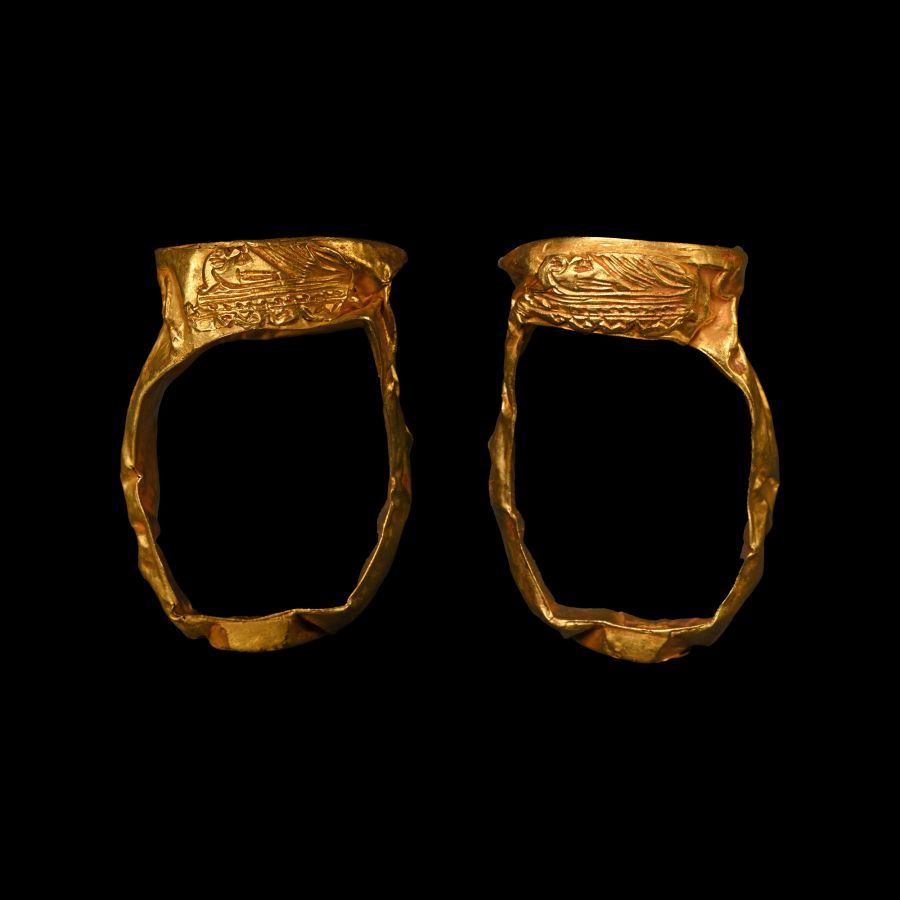
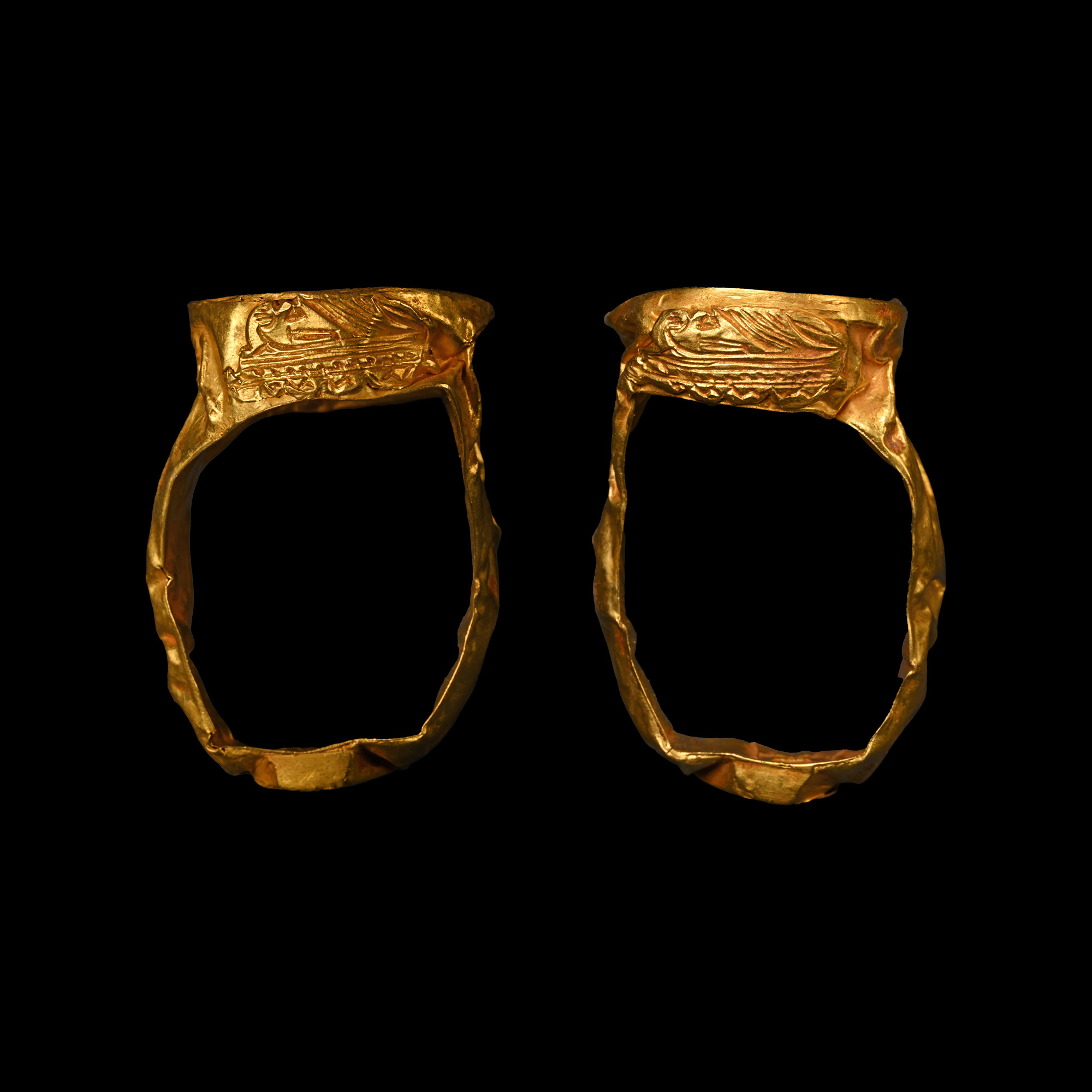
Very Large Roman Gold Ring with Engraved Head of the God Neptune and Warships
1ST CENTURY B.C.-1ST CENTURY A.D.
1 1/2 in. (7.40 grams, 37.31 mm overall, 22.71 x 27.56 mm internal diameter (approximate size British Z+3, USA 13 3/4, Europe 32.57, Japan 31)).
A substantial hollow-form ring with a hexagonal plaque to the base of the hoop, expanding shoulders with a low-relief image of a standing nude goddess; raised oval bezel with an applied repoussé disc of a warship to each end; applied bezel with a chiselled image of god of the sea Neptune facing right, depicted with thick, lustrous beard and hair, the hair tied with a thin ribbon.
ProvenanceEx Angelopolo collection, Vienna.
Acquired in the mid 1980s-1990s.
Private collection, Switzerland, thence by descent.
Private collection, since the late 1990s.
Accompanied by an academic report by Dr Raffaele D’Amato.
This lot has been checked against the Interpol Database of stolen works of art and is accompanied by search certificate number no.12571-232087.
This lot has been cleared against the Art Loss Register database, and is accompanied by an illustrated lot declaration signed by the Head of the Antiquities Department, Dr Raffaele D'Amato.
Cf. Chadour, A.B., Rings. The Alice and Louis Koch Collection, volume I, Leeds, 1994, items 140-144, for type of ring; cf. denarius of Sextus Pompeius in the British Museum, with head of Neptune and naval triumph, museum number no.R9266, in Grueber, H.A., Coins of the Roman Republic in the British Museum, vol.2, Coinages of Rome (continued), Roman Campania, Italy, the social war, and the provinces, London, 1970, no.15, p.562; for the type of represented warship cf. D’Amato, R., Republican Roman Warships 509-27 BC, Oxford, 2015, pp.38, 41.
FootnotesThe ring carries a rare combination of the god Neptune (Greek Poseidon) with two warships. This can only mean that it belonged to a navarcha, a commander of a fleet or a warship. In the turbulent era of the civil wars that followed the death of Caesar, important naval conflicts sealed the fate of the Roman Res Publica. Sextus Pompeius, son of the great Pompey, was able to build a naval power in the South of the Italian Peninsula, especially in Sicily, adopting the image of the god Neptune who - with an image very similar to that of our ring - was represented on the coins he minted, together with naval triumphs and warships.
The ships depicted on the ring belong to the Liburna type, protagonist of the famous battle of Actium in 31 B.C. They were smaller and faster ships, armed with 82 oars disposed upon two orders, about 33 meters long, with 114 oarsmen, 10-15 sailors, and 40 marines. The Liburna’s hull had a pointed, streamlined prow built for speed, as well a fully-detailed ram (rostrum).
TimeLine Auctions follows a vetting process to ensure the authenticity and legality of all items, reinforcing our commitment to integrity and responsible trading. Each antiquity, antique, and coin lot undergoes thorough examination by a vetting committee of at least ten external specialists, professional trade association members, scientists, and archaeologists: Our Vetting Process
AUCTIONS:
TimeLine is a leading auction house specialising in antiquities, ancient art, collectables, natural history, coins, medals, and books. Our auctions offer museums, collectors, historians, and enthusiasts the opportunity to acquire unique and historically significant pieces.
LOT 0203
Very Large Roman Gold Ring with Engraved Head of the God Neptune and Warships
Sold for (Inc. bp): £3,640
-
.jpg)
Large Roman Green Mosaic Glass Fragment
Late 1st century B.C.-early 1st century A.D.Estimate: £3,000 - 4,000 (+bp*)
Opening Bid: £1,500
Irregular panel fragment made from mosaic-type glass in shades of green and cream; one polished face; mounted on a custom-made stand. 473 grams total, glass: 16.3 cm
Dr Jutaro Kawabe, Nagoya, Japan, assembled during the 1960s-1980s. with Hoshigaoka Gallery until the late 1990s. This lot has been checked against the Interpol Database of stolen works of art and is accompanied by search certificate number no.13093-248078.
The decoration is well documented in the Eastern Roman Empire, especially the Syro-Palestinian coast. The most frequently occurring colours in these glass mosaics are opaque red, but green and blue tints are not uncommon. -
.jpg)
Roman Carnelian Gemstone with Eros, the Greek God of Love Holding a Theatrical Mask
1st century A.D.Estimate: £4,000 - 5,000 (+bp*)
Opening Bid: £2,000
Plano-convex in section with intaglio scene: a small winged character stands beneath a large theatrical mask, supporting it on his shoulders; supplied with a museum-quality impression. 1.8 grams, 17 mm
Acquired on the UK art market. Private collection, England. This lot has been checked against the Interpol Database of stolen works of art and is accompanied by search certificate number no.13118-249633.
The young Eros appears with his face inside the wide-open mouth of the mask, looking out as a spectator. The mask is held in his small hands and is characterised by a thick beard, large orbital cavities, and short hair with ribbons. He is depicted in three-quarters seen from behind, engraved and polished with great skill. The stone has a convex surface with traces of ancient burning at the bottom and slight wear marks. -
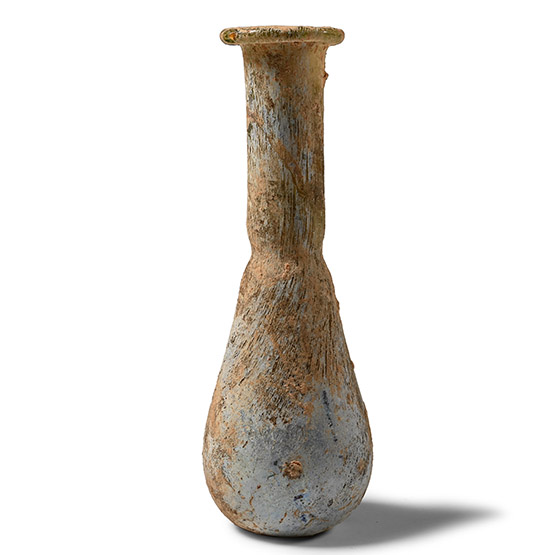
Roman Glass Vessel
1st-2nd century A.D.Sold for (Inc. bp): £65
With piriform lower body, extended cylindrical neck and flange rim; iridescent surfaces. 31.4 grams, 10.1 cm
From a London, UK, collection, 1990s.
This toilet bottle (Clairmont balsamarium type F) is characterised by the cylindrical neck with slight constriction at the bottom. Similar examples have been found in the Wadi Eshari, Jordan (Wadi-Es-Sir).
