
Loading, please wait...
LOT 0113
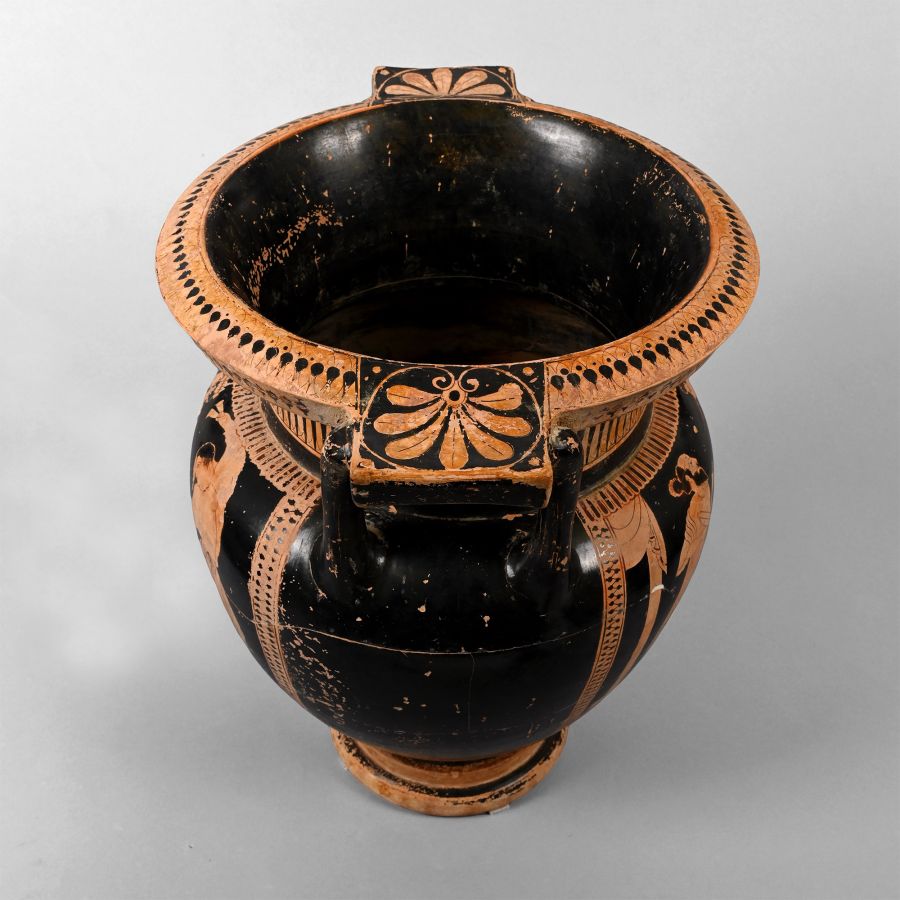
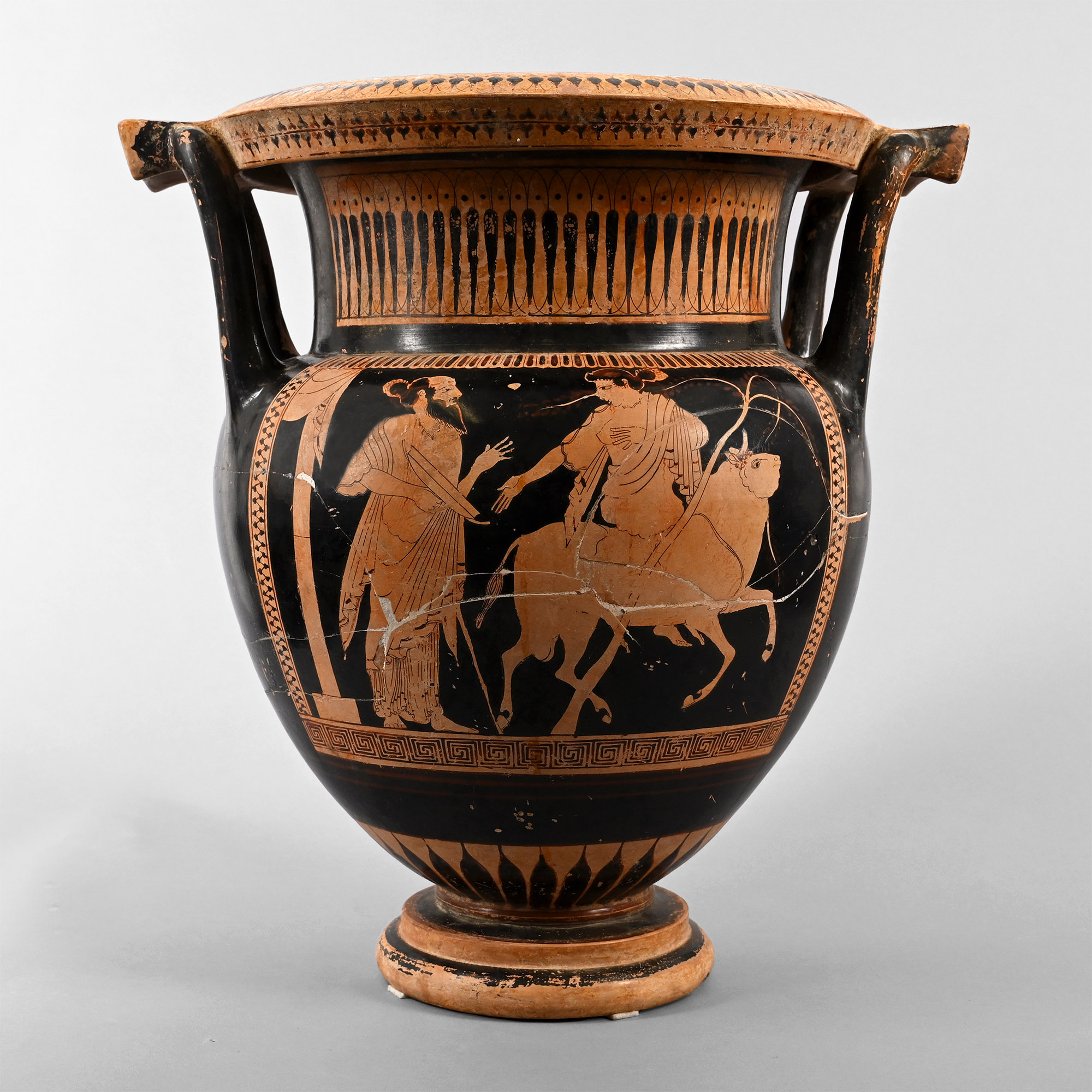
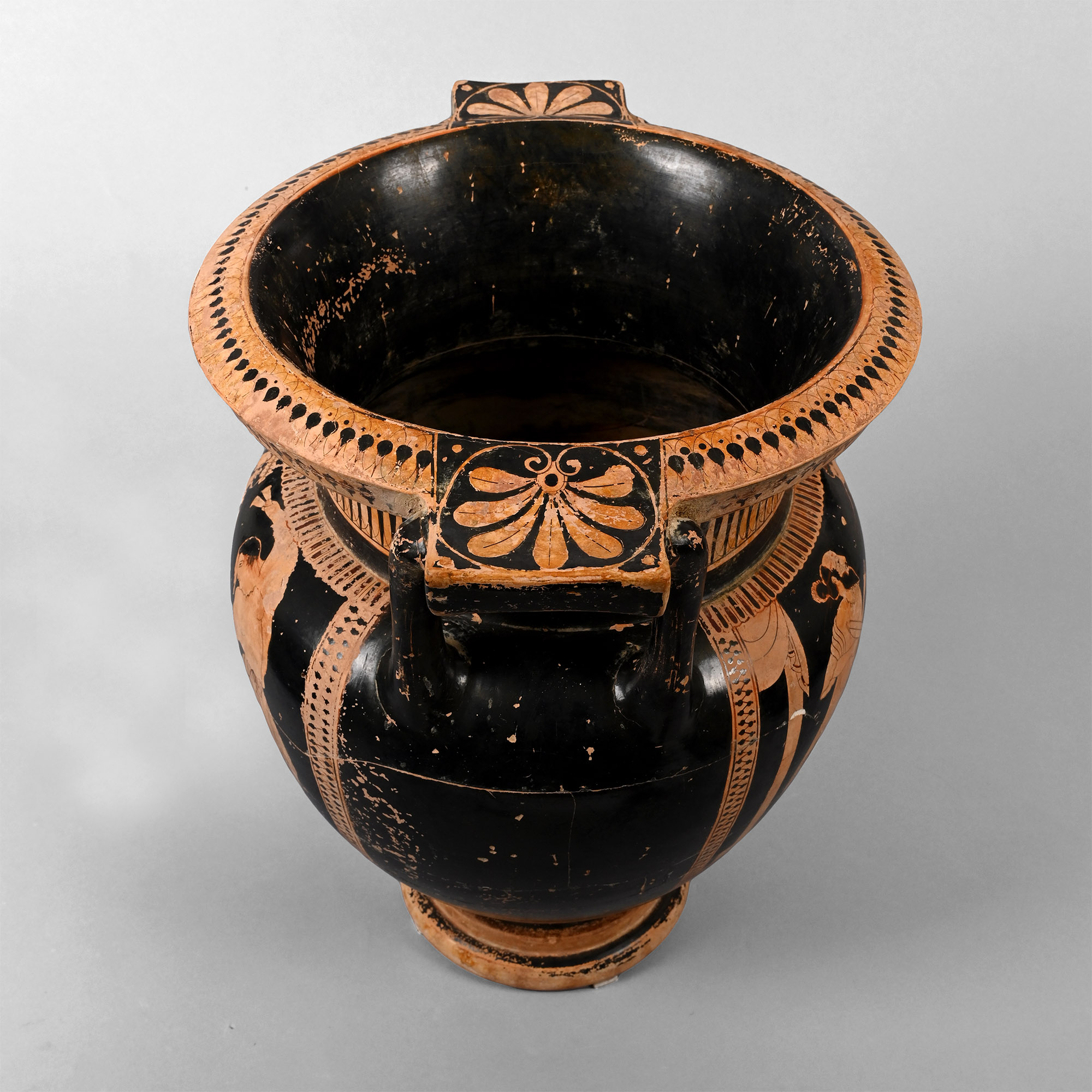
Very Large Greek Red-Figure Column Krater with Bull and Rider
ATTIC, 5TH CENTURY B.C.
17 1/2 in. (5.85 kg, 44.5 cm high).
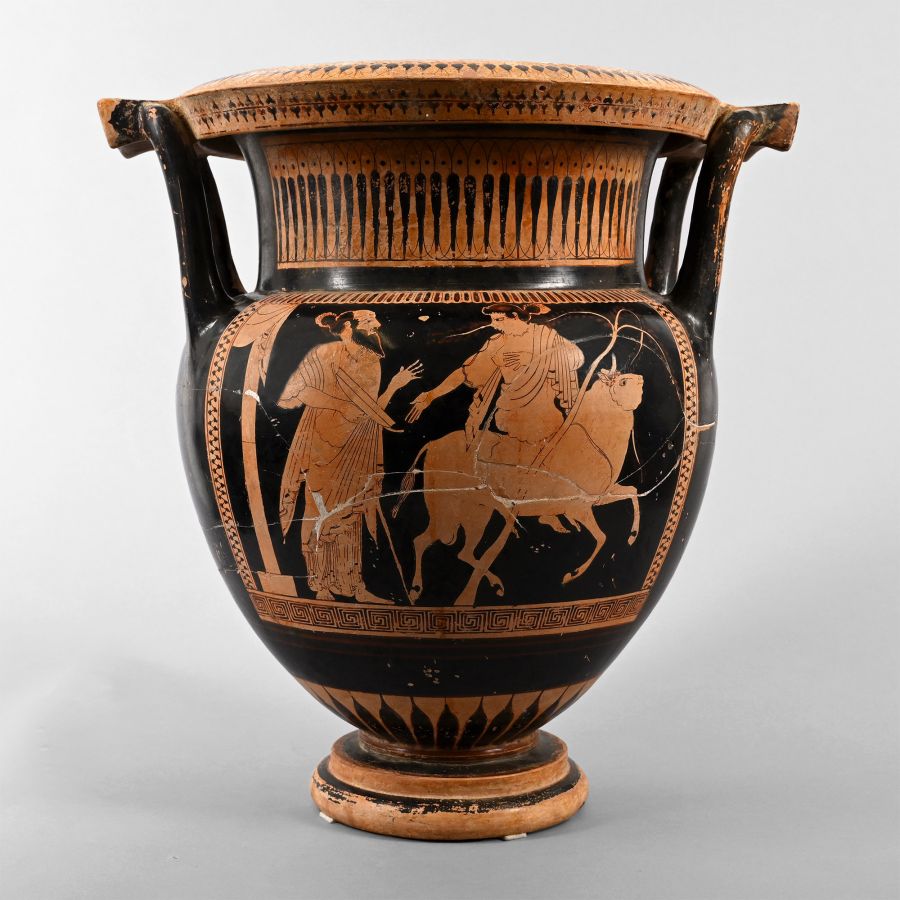
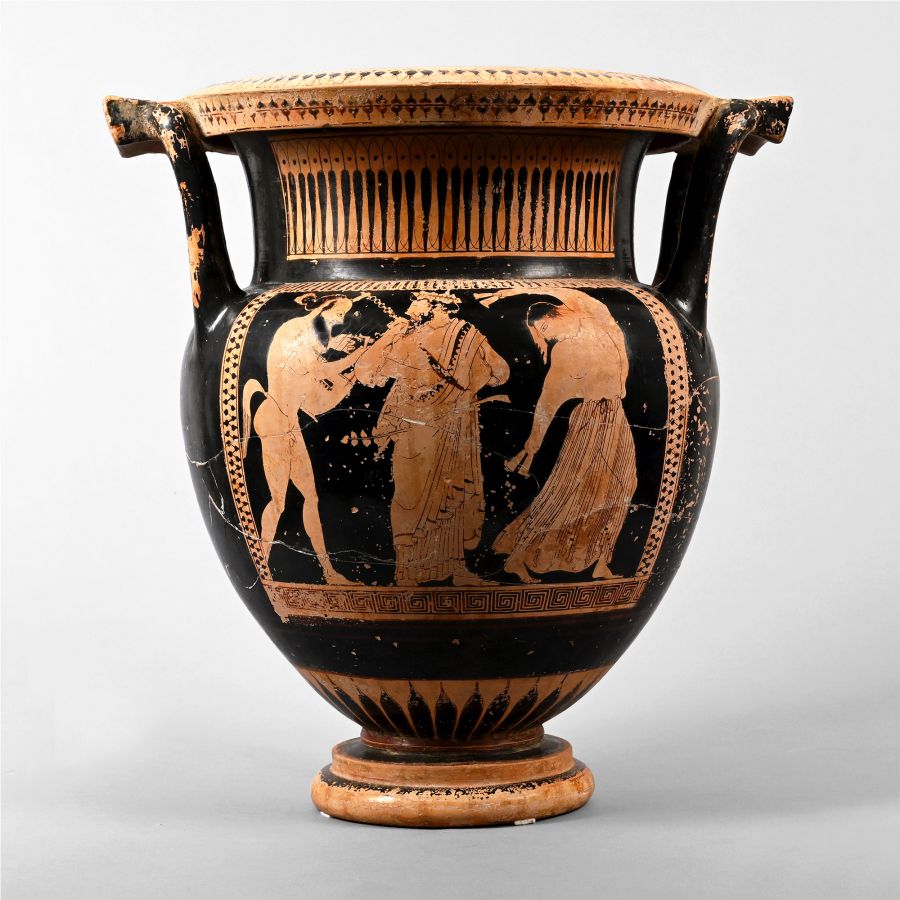
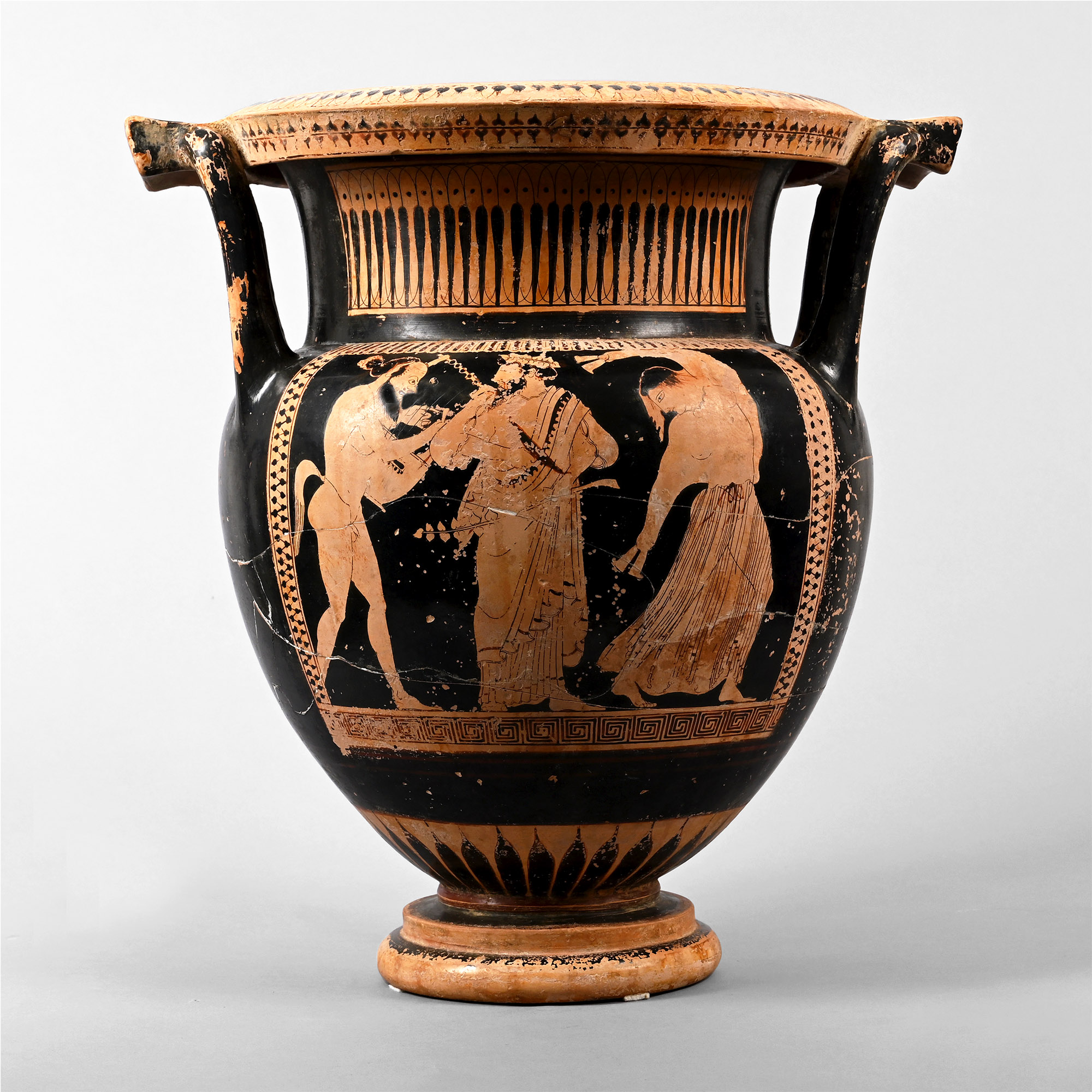
With a flared and stepped foot, poppy-head border around the lower body and neck, strap handles with palmettes to the upper faces opening to two columnar legs; red-figure scenes to the neck and body: Side A, Europa's abduction: standing bearded figure in profile wearing a loose himation holding the lid of a krater in one hand facing a female figure in draped himation revealing one breast, turning to face the male while mounted on an advancing bull and carrying a frond; Side B, Dionysiac scene: satyr standing nude, playing a lyre beside a standing robed male wearing a laurel wreath in his hair, dancing female in active pose with musical instruments in each hand, turning to face the robed figure; some restoration.
ProvenanceGerman private collection (870632).
Anonymous sale, Hampel Fine Arts auction, Munich, 21 September 2012, no.625.
Private collection, acquired on the German art market.
Accompanied by an academic report by Dr Jacques Chamay.
This lot has been checked against the Interpol Database of stolen works of art and is accompanied by search certificate no.13218-249222.
Cf. for similar krater, Boardman, J., Athenian Red Figure Vases the Classical Period, London, 1959, fig.39.
FootnotesThe two figurative scenes are of equal importance. The Dionysian scene depicts the god, in the centre, between a satyr playing a lyre and a dancing maenad. The other scene depicts a well-known subject: the abduction of Europa. This is the daughter of Agenor, king of Tyre in Phoenicia. Of great beauty, she is desired by Zeus. He approaches her in the form of a white bull while she is playing on the beach. Initially frightened, the young woman begins to caress the animal, then becomes more daring and climbs onto its back. Zeus immediately abducts her and rushes out to sea, toward Crete. There, he will be united with Europa, who will bear him three children, including Minos.
CONDITIONTimeLine Auctions follows a vetting process to ensure the authenticity and legality of all items, reinforcing our commitment to integrity and responsible trading. Each antiquity, antique, and coin lot undergoes thorough examination by a vetting committee of at least ten external specialists, professional trade association members, scientists, and archaeologists: Our Vetting Process
AUCTIONS:
TimeLine is a leading auction house specialising in antiquities, ancient art, collectables, natural history, coins, medals, and books. Our auctions offer museums, collectors, historians, and enthusiasts the opportunity to acquire unique and historically significant pieces.
LOT 0113
Very Large Greek Red-Figure Column Krater with Bull and Rider
Estimate £25,000 - 35,000€29,000 - 40,600 (for guidance only)$33,750 - 47,250 (for guidance only)
Opening Bid
£12,500 (EUR 14,500; USD 16,875) ‡+BP*
-

Greek Core-Formed Glass Amphoriskos
5th-3rd century B.C.Estimate: £1,500 - 2,000 (+bp*)
Opening Bid: £833
Elongated piriform amphora shape, tubular neck and everted rim, decorated with polychrome festooning and trails, applied amber-green handles and knop foot. 152 grams, 18 cm high
Acquired in the early 1990s. Ex private American collection; thence by descent. Private collection since 1998. This lot has been checked against the Interpol Database of stolen works of art and is accompanied by search certificate no.12206-222129. -
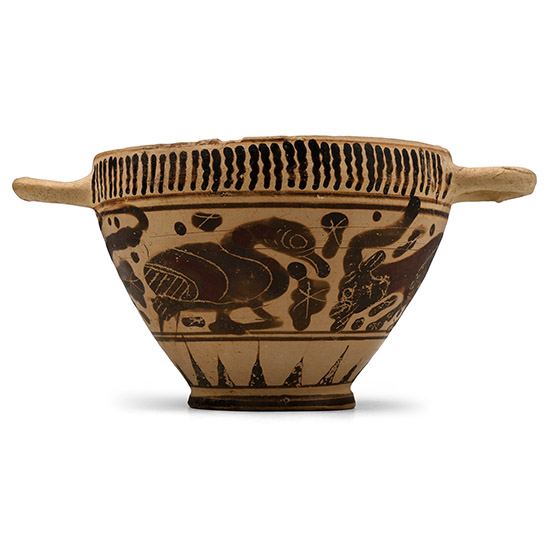
Greek White-Ground Kotyle with Panther, Goat and Swan
Corinthian, 6th century B.C.Estimate: £2,500 - 3,500 (‡+bp*)
Opening Bid: £1,250
Squat in profile with lateral loop handles, vertical stripes to the rim, frieze with a grazing goat, a panther to its rear and a perching swan. 102 grams, 15.1 cm
Ex private collection, Tokyo, Japan, since the 1980s. Private European collection, acquired in 2010. This lot has been checked against the Interpol Database of stolen works of art and is accompanied by a search certificate no.13227-249320.
In agreement with most scholars of the Corinthian pottery, Amyx and Payne used the term kotyle, rather than skyphos, to designate the distinctive group of deep cups with no offset lip, horizontal handles set near the rim, a convex tapering body and a narrow, echinoid foot. -
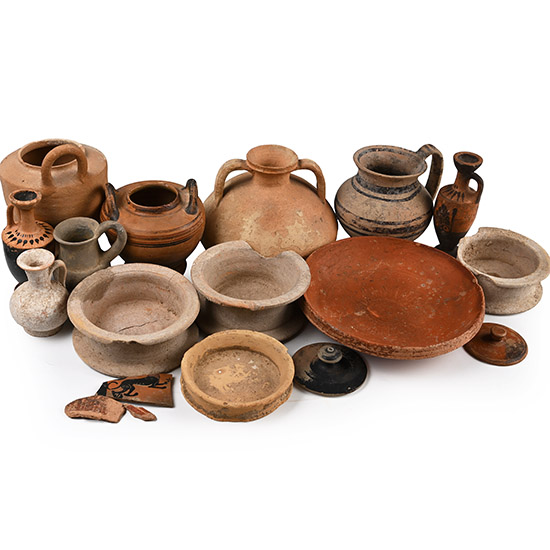
Greek Collection of Terracotta Vessels and Bases
5th-3rd century B.C.Estimate: £700 - 900 (‡+bp*)
Bids: 2 | Current Bid: £400
Mixed group of artefacts, including: a vessel fragment with a panther; a single-handled jug with painted circumferential bands; a low redware dish with an incised sunburst motif; a small lekythos with palmette design; a small lekythos with painted decoration; a squat vessel with two strap handles and a short neck, low relief spiral decoration on the base. 2.6 kg total, 3-17.5 cm
Ex Prof. Kurt Alder, Riehen; thence by descent. 1. two clay vessels and clay dish: ex Jacob Hirsch; with Galerie Fischer, Lucerne, Auction 17 November 1976, no.1493. 2. Apulian lekythos with palmettes: with Galerie Fischer, Lucerne, Auction 17 November 1976, no.1542. 3. Apulian lekythos: with Galerie Fischer, Lucerne, Auction 16–20, 1976, no.1542. 4. Daunian handled jug: with Galerie Koller, Zurich, Auction 34, no.2532. 5. potsherd fragment: with Münzen und Medaillen AG, Basel. 6. lebes with lid: acquired in September 1975.
