
Loading, please wait...
LOT 0419
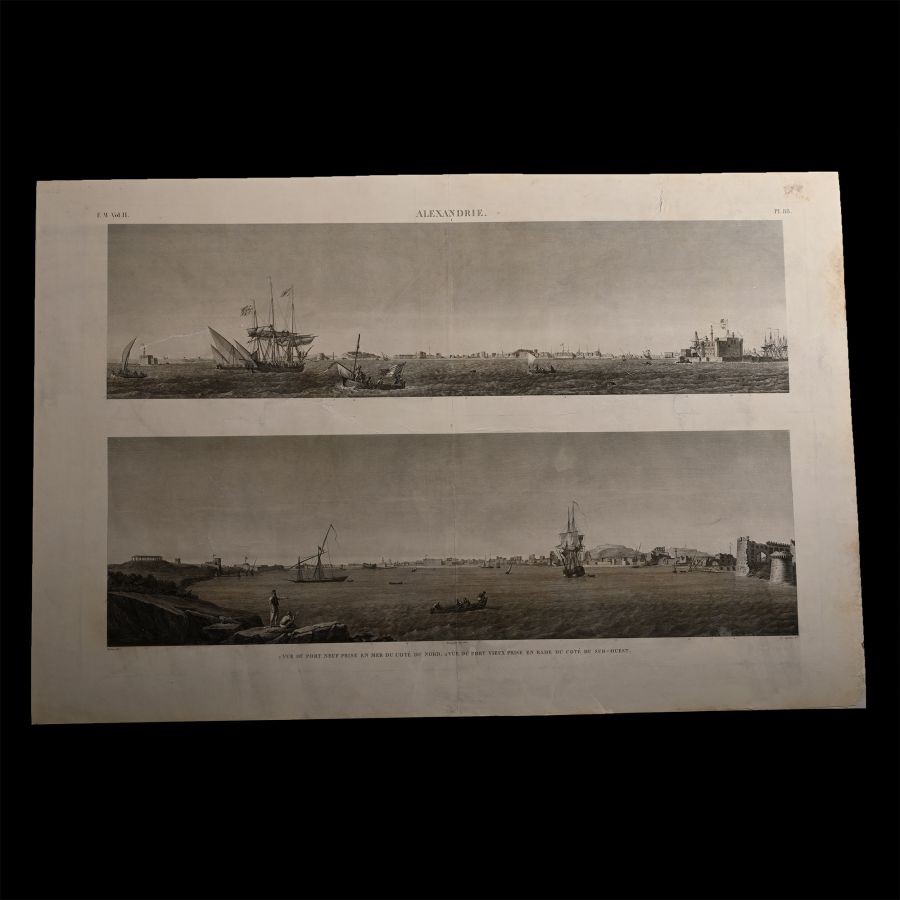
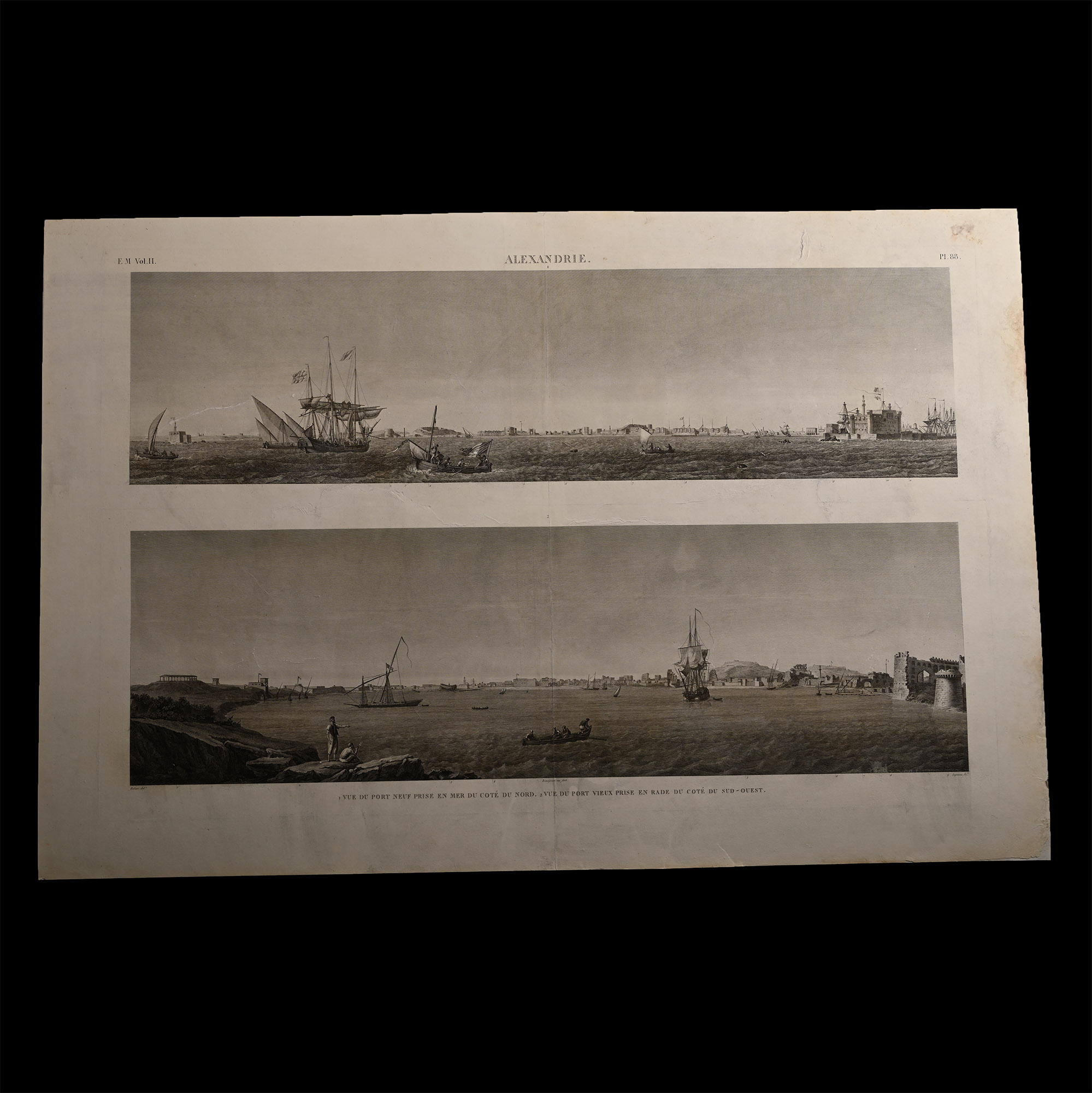
Very Large Egyptian Expedition Lithograph of Views of Alexandria
EARLY 19TH CENTURY A.D.
41 1/8 x 27 1/8 in. (259 grams, 104.5 x 69 cm).
Proof etching on laid paper of plate 88 from Description de l'Égypte : ou, Recueil des observations et des recherches qui ont été faites en Égypte pendant l'expédition de l'armée française. entitled 1. Vue du port neuf en mer du cote du nord. 2. Vue du port vieux prise en rade du cote du sud-ouest.
ProvenanceFrom the collection of a North American priest.
Acquired between 1981-1996.
Property of a North American collector.
Produced between February 1802 and 1830 on the orders of Napoleon Bonaparte; published between 1809 and 1828. Just 1,000 copies were distributed to various institutions, printed on laid paper with an 'Égypte ancienne et moderne' watermark. The book is subtitled Recueil des observations et des recherches qui ont été faites en Égypte pendant l’expédition de l’Armée française, publié par les ordres de Sa Majesté l’Empereur Napoléon le Grand (Gathering of observations and discoveries which were made in Egypt during the expedition of the French army, published on the orders of His Majesty the Emperor Napoleon the Great). It was the world's first encyclopedia devoted exclusively to the remains of ancient Egypt. The plates of this book are the first to present the archaeological sites of Thebes (Luxor).
CONDITIONTimeLine Auctions follows a vetting process to ensure the authenticity and legality of all items, reinforcing our commitment to integrity and responsible trading. Each antiquity, antique, and coin lot undergoes thorough examination by a vetting committee of at least ten external specialists, professional trade association members, scientists, and archaeologists: Our Vetting Process
AUCTIONS:
TimeLine is a leading auction house specialising in antiquities, ancient art, collectables, natural history, coins, medals, and books. Our auctions offer museums, collectors, historians, and enthusiasts the opportunity to acquire unique and historically significant pieces.
LOT 0419
Very Large Egyptian Expedition Lithograph of Views of Alexandria
Estimate £80 - 100€93 - 116 (for guidance only)$108 - 135 (for guidance only)
-
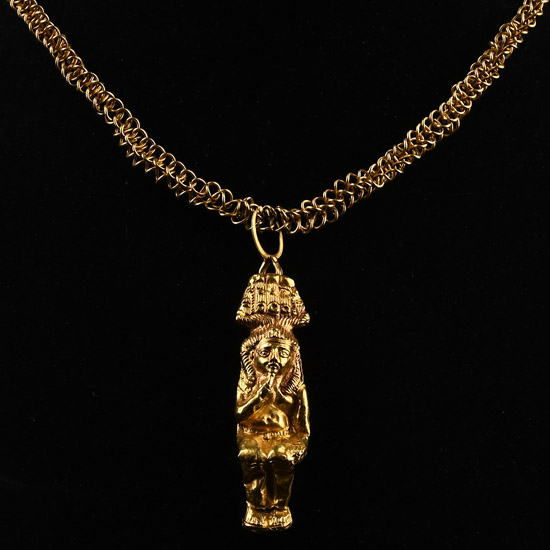
Egyptian Gold Necklace with Harpocrates Pendant
Roman Period, 1st century B.C.-1st century A.D.Estimate: £15,000 - 20,000 (‡+bp*)
Opening Bid: £7,500
Gold chain of double-looped links terminating in corrugated end elements, with hook-and-eye clasp; suspension ring embellished with applied granulation and a ribbed loop; hollow-formed sheet-gold pendant in the round depicting Harpocrates seated, his right forefinger raised to his mouth, wearing a finely detailed nemes headdress surmounted by a complex hemhem, crown incorporating multiple hedjet elements, flanking uraei, and ram's horns. 49.80 grams, 40.5 cm
Ex Elie Boustros collection, Lebanon. Private collection, acquired in the late 1980s-early 1990s; thence by descent. This lot has been checked against the Interpol Database of stolen works of art and is accompanied by search certificate number no.13203-249297.
The fully three-dimensional modelling of the pendant aligns it with a group of high-quality Roman-period Egyptian goldwork characterised by pronounced plasticity and sculptural ambition. A pertinent comparison may be drawn with the gold diadem depicting Serapis from the Dush Treasure, discovered concealed within the wall of a Roman fort in the Baris Oasis (Reddé, M., Douch IV. Le trésor de Douch, DFIFAO 28, Cairo, 1992). That assemblage, plausibly associated with a nearby temple of Serapis and Isis, demonstrates a similarly bold treatment of divine imagery in precious metal. Comparable small-scale representations of Harpocrates in gold - often amuletic in function - are known from Roman Egypt, though examples combining such intricate crown iconography with fully rounded modelling remain relatively rare. The present piece therefore occupies an interesting position between personal adornment and cultic or apotropaic object, reflecting both Alexandrian iconographic synthesis and provincial workshop virtuosity. Harpocrates is the Greek version of the Egyptian Hor-pa-khered, which means ‘Horus the Child’. This name refers to Horus as the divine infant of Isis and Osiris. Wearing an amulet of Harpocrates was believed to provide the same protection that Isis offered to her beloved son. -
.jpg)
Egyptian Wooden Stele for Pa-di-Amun-(em)-ipat with Ra-Horakhty
Late Period-Ptolemaic Period, 664-30 B.C.Sold for (Inc. bp): £20,800
Arch-topped and composed of two vertical boards, coated with gesso and skilfully painted on one side; the lunette decorated with a winged sun-disc and two pendant uraei; the central vignette depicting the deceased worshipping the falcon-headed god Ra-Horakhty with the Four Sons of Horus standing behind, each with their name written above; the lower register with six lines of hieroglyphic text providing an offering formula for the benefit of the deceased: Transliteration of the hieroglyphs: 1) ḥtp-dı-͗nsw rꜤ-ḥr-Ꜣḫtı͗nṯr Ꜥ nb pt sḥḏ [.....] wsır͗ ẖntt [ım͗ntt?] 2) nṯr Ꜥ nb Ꜣbḏw dı⸗͗f pr.t-ḫrw t ḥnḳt kꜢ Ꜣpd [....] ḫt nb(t) (n) fr(t) wꜢbt […] 3) ḫt nbt nḏm dı⸗͗f ḥtpw ḏfꜢw [...]f ḫꜢ m t dı⸗͗f ḫꜢ m 4) ḥnḳt dı⸗͗f ẖꜢ ır͗p [...] dı⸗͗f ḫꜢ m ı͗[...] dı⸗͗f ḫꜢ ı(͗Ꜣ)r(r)t dı⸗͗f 5) m snṯr ḥr ḫꜢwt [...] ḳrs nfr ḥr ım͗nt nfr 6) n [..] wsır͗ [......] pꜢ-dı-͗ım͗n(m) ıp͗ Ꜣ.t ms (n) ḫꜢ [....] Translation: 1) An offering that the king and Ra-Horakhty, Great God, Lord of Heaven, the illuminated [...] Osiris Foremost [of the West?] 2) Great God, Lord of Abydos (that) he may give a voice-offering (of) bread, beer, oxen, and fowl […] everything good and pure […] 3) everything sweet, he gives offerings of provisions […] a thousand of bread, he gives a thousand of 4) beer, he gives a thousand of wine […], he gives a thousand of vines, he gives a thousand of 5) incense on the altar […] a good burial in the beautiful West 6) for […] the Osiris[…] Pa-di-Amun-(em)-ipat born (to) Kha[…]; on the verso, an old handwritten collection label reading: 'From Harding & Sm[ith] Collection Sale Sotheby 2 Nov 1922 L.N. 234. A families [sic] stele, arched top, with the deceased worshipping a standing Horus attended by the four Children of Horus and six horizontal lines of inscription in colour. SP/10a'; mounted in a custom-made wooden frame. 1.94 kg, 45 cm high
From the collection of the late W. Harding Smith (1848-1922). with Sotheby, Wilkinson & Hodge, 34 & 35 New Bond Street, 2 November 1922, no.234. Old handwritten label to verso reading 'From Harding & Sm[ith] Collection collection Sale Sotheby 2 Nov 1922 L.N.234...' Accompanied by an academic report by Egyptologist Paul Whelan. Accompanied by a copy of the 1922 Sotheby, Wilkinson & Hodge catalogue pages. This lot has been checked against the Interpol Database of stolen works of art and is accompanied by search certificate number no.13251-253195.
The syncretism of two strong gods, Re and Horus, is one of the most significant events in Egyptian mythology, and it appears to have had a substantial iconographic impact on Egyptian history. Re's power was augmented by this, which consisted of a falcon-headed man crowned with a sun disc; in the mornings, Re was combined with Horus to become Re-Horakhty. -
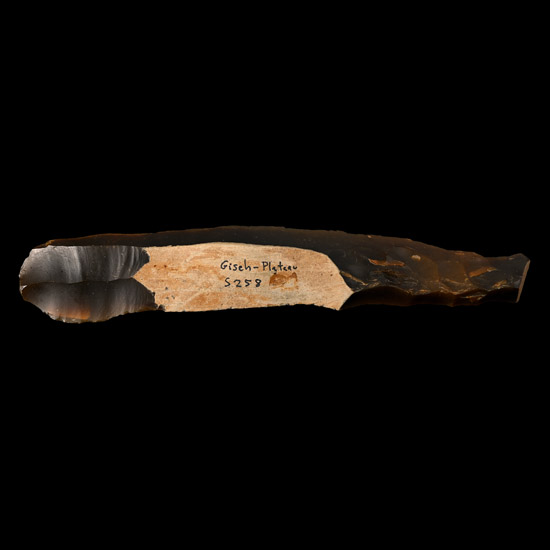
Exceptionally Long Egyptian Stone Age Knapped Flint Blade
Neolithic Period, circa 6,000 B.P.Sold for (Inc. bp): £293
Curved in profile, tongue-shaped with two cutting edges; from the Giza Plateau, Egypt. 77 grams, 19.8 cm
Ex J Dickey collection. Ex Jerry Sherman collection, acquired on the US art market.
