
Loading, please wait...
LOT 0472
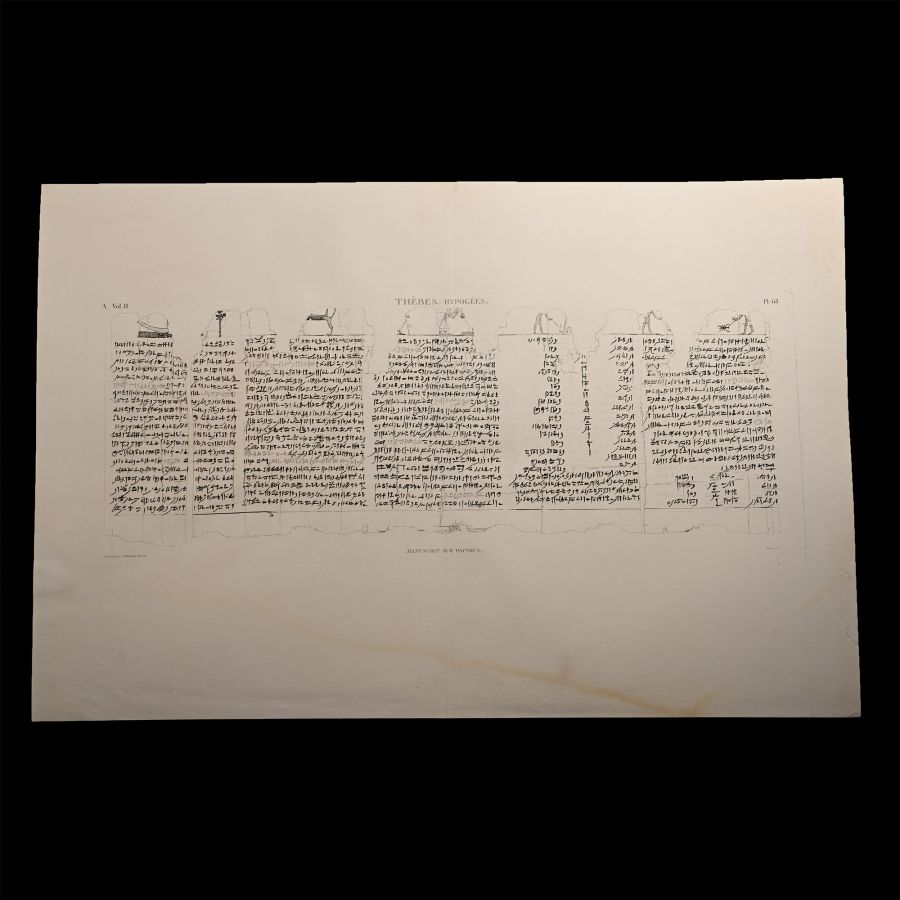
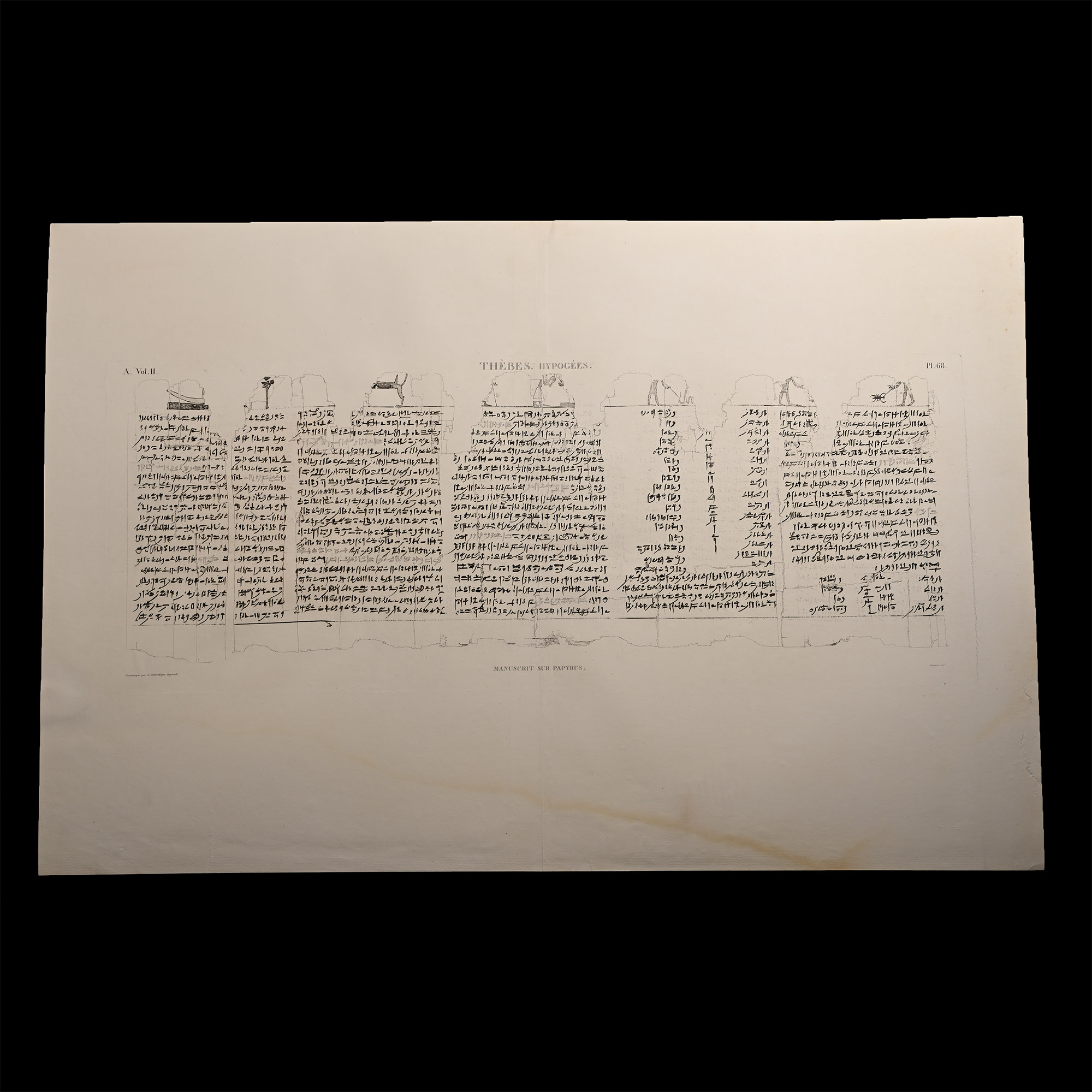
Very Large Egyptian Expedition Lithograph of the Hypogees Papyrus Manuscript from Thebes
EARLY 19TH CENTURY A.D.
40 7/8 x 26 7/8 in. (256 grams, 104 x 68.5 cm).
Proof etching on laid paper of plate 68 from Vol .II of Description de l'Égypte : ou, Recueil des observations et des recherches qui ont été faites en Égypte pendant l'expédition de l'armée française. entiled Thèbes. Hypogées. Manuscrit sur papyrus.
ProvenanceFrom the collection of a North American priest.
Acquired between 1981-1996.
Property of a North American collector.
Cf. reprint of the whole work in Various, Recueil des observations et des recherches qui ont été faites en Égypte pendant l’expédition de l’Armée française, publié par les ordres de Sa Majesté l’Empereur Napoléon le Grand, Köln, 1989, pp.244-245.
FootnotesProduced between February 1802 and 1830 on the orders of Napoleon Bonaparte; published between 1809 and 1828. Just 1,000 copies were distributed to various institutions, printed on laid paper with an 'Égypte ancienne et moderne' watermark. The book is subtitled Recueil des observations et des recherches qui ont été faites en Égypte pendant l’expédition de l’Armée française, publié par les ordres de Sa Majesté l’Empereur Napoléon le Grand (Gathering of observations and discoveries which were made in Egypt during the expedition of the French army, published on the orders of His Majesty the Emperor Napoleon the Great). It was the world's first encyclopedia devoted exclusively to the remains of ancient Egypt. The plates of this book are the first to present the archaeological sites of Thebes (Luxor). The papyrus manuscript was recovered from an underground tomb chamber (hypogeum). The text is written in a cursive style of hieroglyphs known as hieratic.
CONDITIONTimeLine Auctions follows a vetting process to ensure the authenticity and legality of all items, reinforcing our commitment to integrity and responsible trading. Each antiquity, antique, and coin lot undergoes thorough examination by a vetting committee of at least ten external specialists, professional trade association members, scientists, and archaeologists: Our Vetting Process
AUCTIONS:
TimeLine is a leading auction house specialising in antiquities, ancient art, collectables, natural history, coins, medals, and books. Our auctions offer museums, collectors, historians, and enthusiasts the opportunity to acquire unique and historically significant pieces.
LOT 0472
Very Large Egyptian Expedition Lithograph of the Hypogees Papyrus Manuscript from Thebes
Estimate £80 - 100€93 - 116 (for guidance only)$108 - 135 (for guidance only)
-
Egyptian Stone Scarab Group
Late Period-Ptolemaic Period, 664-30 B.C. and laterSold for (Inc. bp): £287
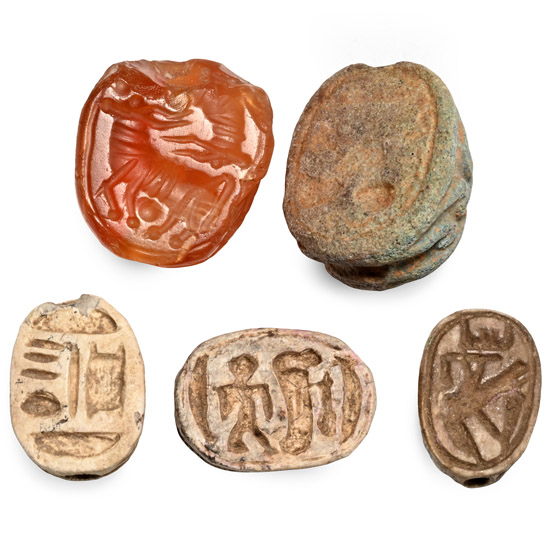
Comprising five scarabs with anatomical detailing: one carnelian with two antelopes tête-bêche; one with worn hieroglyphs on the underside; one with two neb signs flanking others; one with two neb signs flanking a standing human figure, uraeus and nefer; and one with the Horus falcon above the sign for gold (nbw). 7.5 grams total, 12-16 mm
From the private collection of a European gentleman (1942-2024), formed since the 1970s.
The falcon on the sign of gold, meaning 'Golden Horus (or falcon)', is found in the titles of Egyptian kings and was therefore considered a potent symbolic motif on scarabs. -
.jpg)
Egyptian Predynastic Stone Frog
4th millennium B.C.Sold for (Inc. bp): £1,300
Pyramidal in form with shallow-carved hip and facial detailing. 537 grams, 81 mm
with Artemis Gallery, Munich, Germany, 2001. Private collection, Europe. This lot has been checked against the Interpol Database of stolen works of art and is accompanied by a search certificate number no.12580-232124.
The frog had a great role in ancient Egyptian mythology and was connected with the mythology of creation. A number of gods and goddesses were connected with the frog such as Heqet, Ptah, and Heh. The connection with the god Ptah as a god of creation was probably due to the idea that Ptah was the only god who created the world in ancient Egypt through his heart and his tongue. Every work of the god came about through what his heart devised and his tongue commanded. Frogs were often associated with Hekat, deity of birth and fecundity. Amulets of frogs were frequent votive gifts at such Predynastic and Archaic sites at Abydos, Naqada, and Saqqara. -
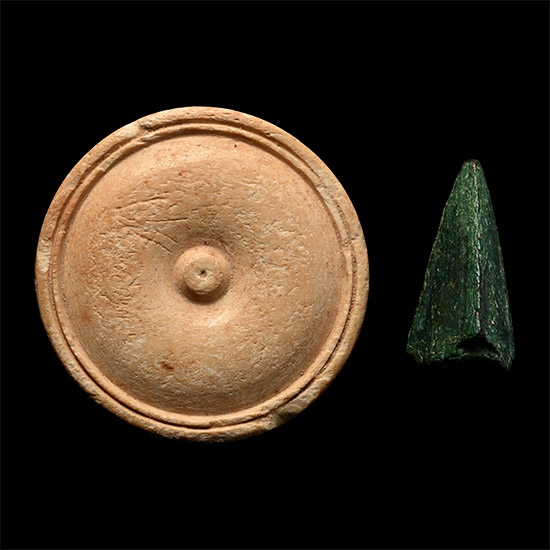
Egyptian Bone Gaming Counter and Bronze Arrow Tip
Graeco-Roman Period, circa 3rd century B.C.-2nd century A.D.Sold for (Inc. bp): £52
Comprising: turned discoid counter with raised tiered rim and central boss, plain reverse with incised 'L · III' legend (numeral '53'); triangular-section arrowhead with low flanges to one face and mounting hole, socket to rear. 4.82 grams total, 17-26 mm
Ex John Cummings Ltd., Lincolnshire, UK. From the private collection of a Canadian gentleman living in Essex, UK, formed since the 1920s-circa 1990. Property of an Essex lady until the late 1990s; thence by descent. From the private collection of an Essex gentleman since the late 1990s. Accompanied by an old information card.
