
Loading, please wait...
LOT 0426
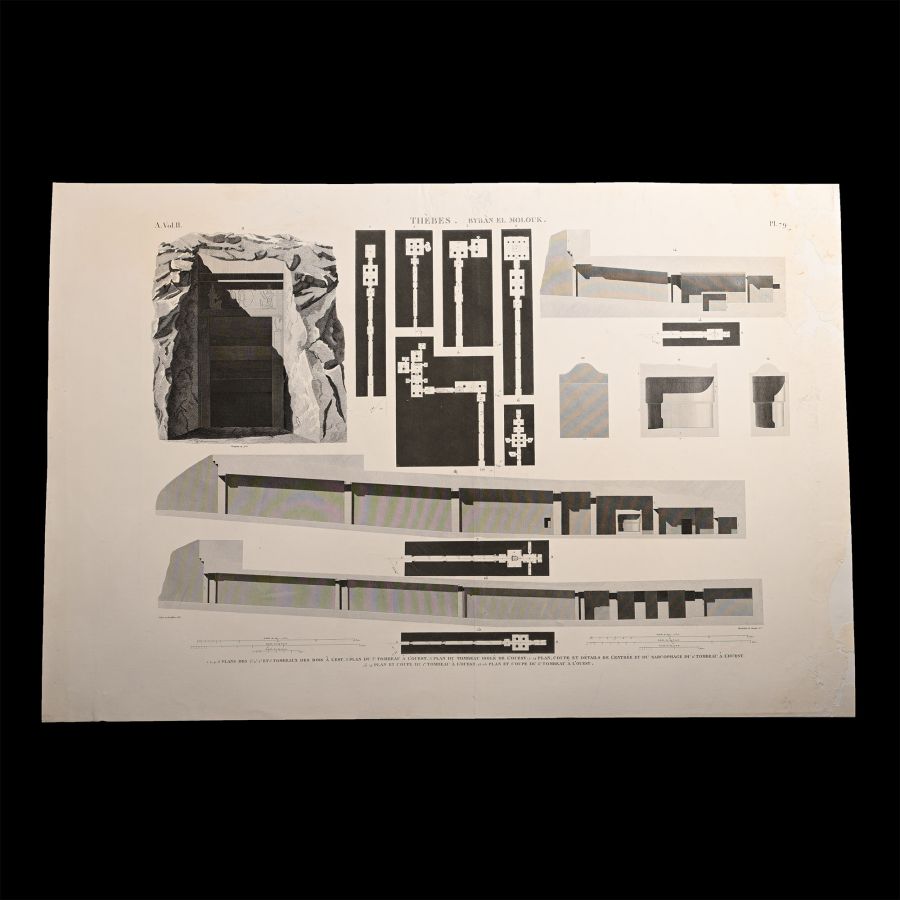
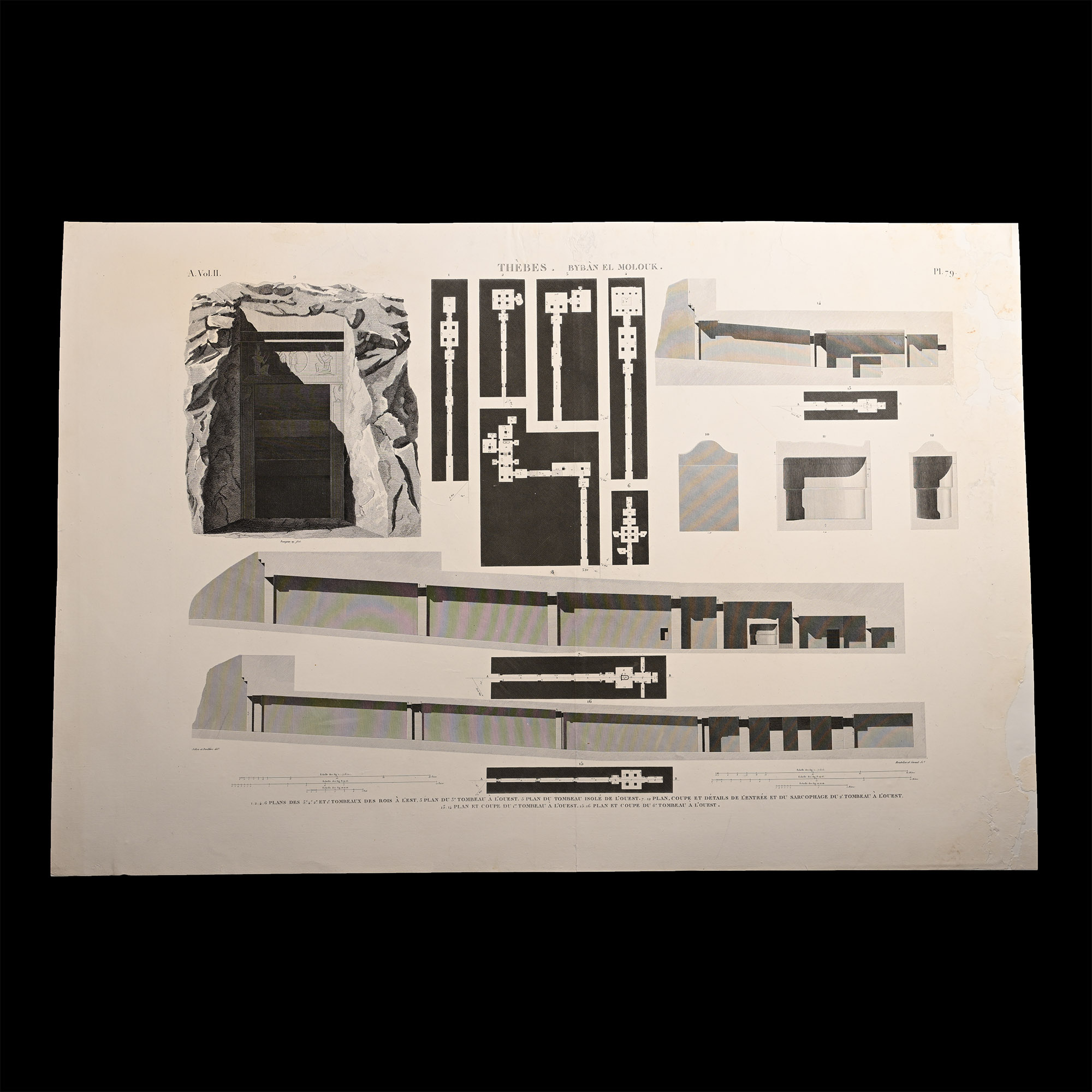
Very Large Egyptian Expedition Lithograph of Bayban el Molouk at Thebes
EARLY 19TH CENTURY A.D.
40 3/8 x 27 1/8 in. (208 grams, 102.5 x 69 cm).
Proof etching on laid paper of plate 79 Thèbes - Byban el Molouk entitled Plan des 2e, 4e, 2e et 1er tombeaux des rois a l'Est. Plan du 3e tombeau a l'Ouest. Plan du Tombeau isolé de l'Ouest. Plan, coupe et détails de l'entrée et du sarcophage du 2e tombeau a l'Ouest. Plan et coupe du 1er tombeau a l'Ouest. Plan et coupe du 6e tombeau a l'Ouest.
ProvenanceFrom the collection of a North American priest.
Acquired between 1981-1996.
Property of a North American collector.
Produced between February 1802 and 1830 on the orders of Napoleon Bonaparte; published between 1809 and 1828. Just 1,000 copies were distributed to various institutions, printed on laid paper with an 'Égypte ancienne et moderne' watermark. The book is subtitled Recueil des observations et des recherches qui ont été faites en Égypte pendant l’expédition de l’Armée française, publié par les ordres de Sa Majesté l’Empereur Napoléon le Grand (Gathering of observations and discoveries which were made in Egypt during the expedition of the French army, published on the orders of His Majesty the Emperor Napoleon the Great). It was the world's first encyclopedia devoted exclusively to the remains of ancient Egypt. The plates of this book are the first to present the archaeological sites of Thebes (Luxor). This plate shows plans and sections of some of the royal tombs in the Valley of the Kings.
CONDITIONTimeLine Auctions follows a vetting process to ensure the authenticity and legality of all items, reinforcing our commitment to integrity and responsible trading. Each antiquity, antique, and coin lot undergoes thorough examination by a vetting committee of at least ten external specialists, professional trade association members, scientists, and archaeologists: Our Vetting Process
AUCTIONS:
TimeLine is a leading auction house specialising in antiquities, ancient art, collectables, natural history, coins, medals, and books. Our auctions offer museums, collectors, historians, and enthusiasts the opportunity to acquire unique and historically significant pieces.
LOT 0426
Very Large Egyptian Expedition Lithograph of Bayban el Molouk at Thebes
Sold for (Inc. bp): £91
-
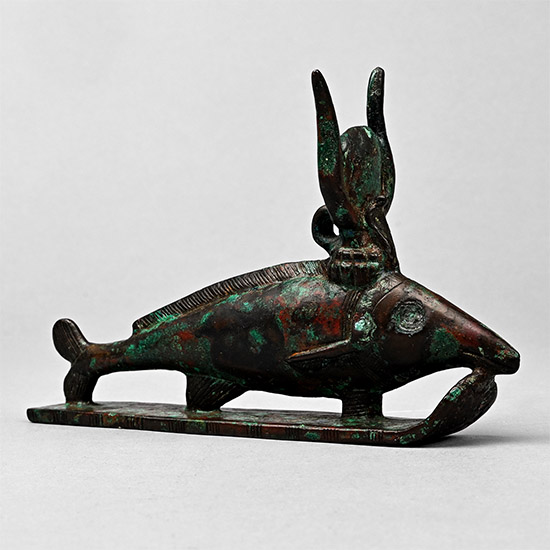
Very Large Egyptian Bronze Oxyrhynchus Fish of Per-Medjed with Hieroglyphic Inscription
Late Period-Ptolemaic Period, 664-30 B.C.Estimate: £4,000 - 6,000 (‡+bp*)
Opening Bid: £2,000
Modelled in the round on a sledge attached by ventral and pectoral fins, a forked tail, a dorsal ridge, and a tapering nose, featuring recessed circular eyes filled with enamel, a horned sun disc headdress fronted by a uraeus, and a suspension loop behind; a few hieroglyphs of a dedication remain visible on the underside of the sledge, which may be interpreted as ‘….the great give life (to)…’ (…t wr rdi͗ Ꜥnḫ t….); presumably, 'the great' followed the name of a deity, now lost. 585 grams, 17 cm
Acquired from Gallery Reiner, Paris, France, 1981. Private collection, Europe. Accompanied by a copy of French passport no.150583 dated 29 November 2013. This lot has been checked against the Interpol Database of stolen works of art and is accompanied by a search certificate number no.12375-226676.
The Medjed, a type of elephant-snout fish (Mormyrus kannume), was revered in ancient Egyptian religion, particularly in Per-Medjed, better known by its Greek name, Oxyrhynchus Polis. This version of the name, meaning "city of the sharp-nosed," reflects the fish's distinctive appearance as depicted in Egyptian art. These fish were believed to have consumed the penis of Osiris, the god who was dismembered and scattered by his brother Seth. As sacred creatures, figurines of the Medjed were often adorned with a horned sun-disc headdress worn by the goddesses Hathor and Isis, suggesting a close association with both. Some figurines, like this example, featured suspension loops, allowing them to be worn as pendant amulets. -
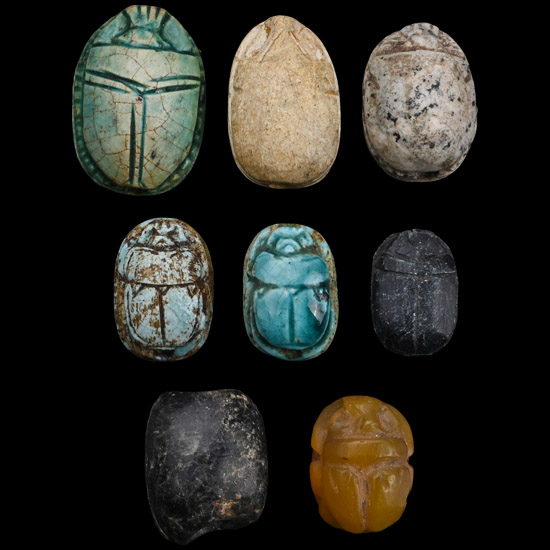
Egyptian Steatite and Other Scarab Collection
New Kingdom-Late Period, 1550-332 B.C.Sold for (Inc. bp): £585
Including carnelian, faience and other materials, some with hieroglyphs to underside. 17.1 grams total, 13-19 mm
From the collection of a gentleman, acquired on the London art market in the 1990s. -
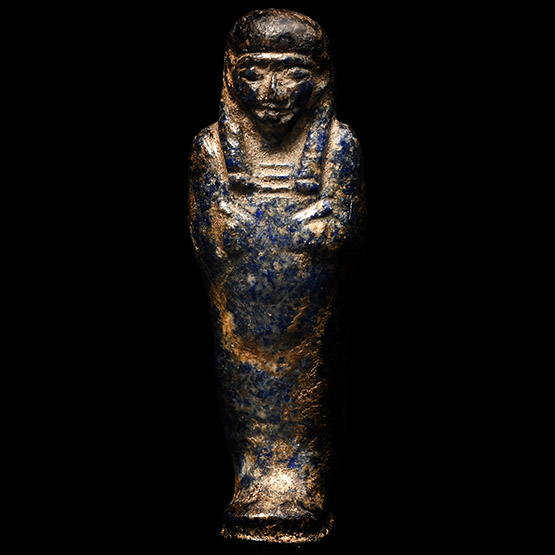
Egyptian Lapis Lazuli Shabti Amulet
New Kingdom, 1550-1070 B.C.Estimate: £1,500 - 2,000 (‡+bp*)
Opening Bid: £750
Carved in the round as a mummiform figure, with a detailed collar and tripartite wig; rear suspension loop. 3.12 grams, 31 mm
Private collection, acquired on the Swiss art market in 1992; thence by descent.
