
Loading, please wait...
LOT 0489
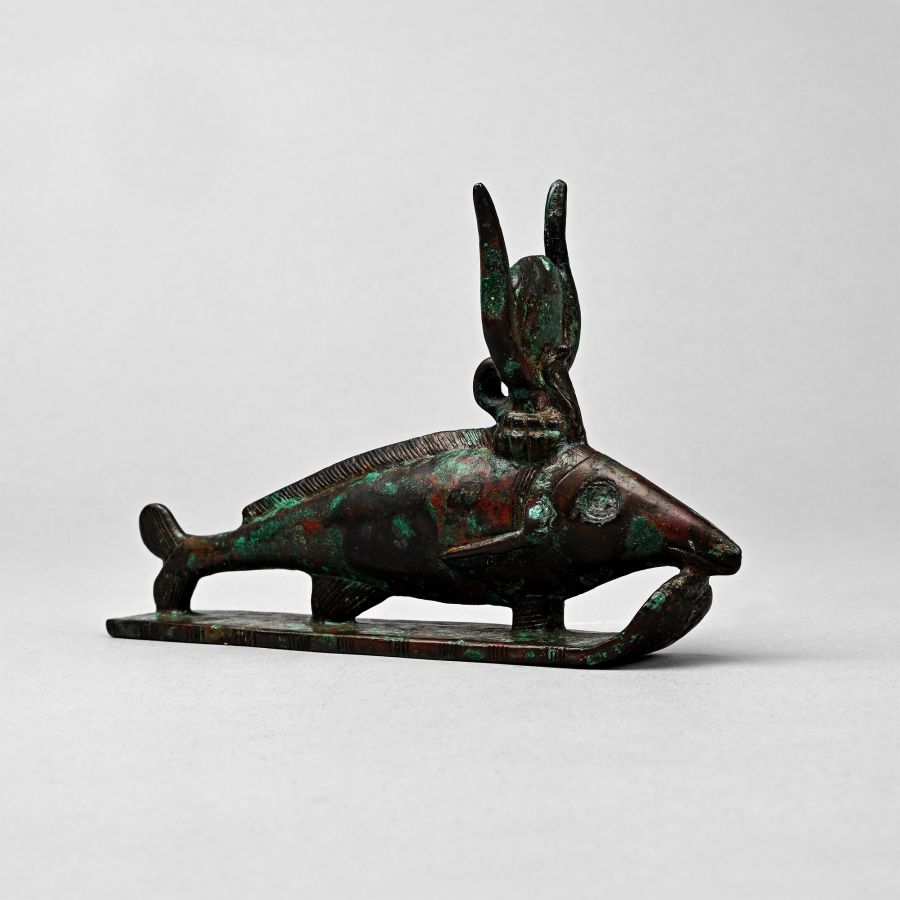
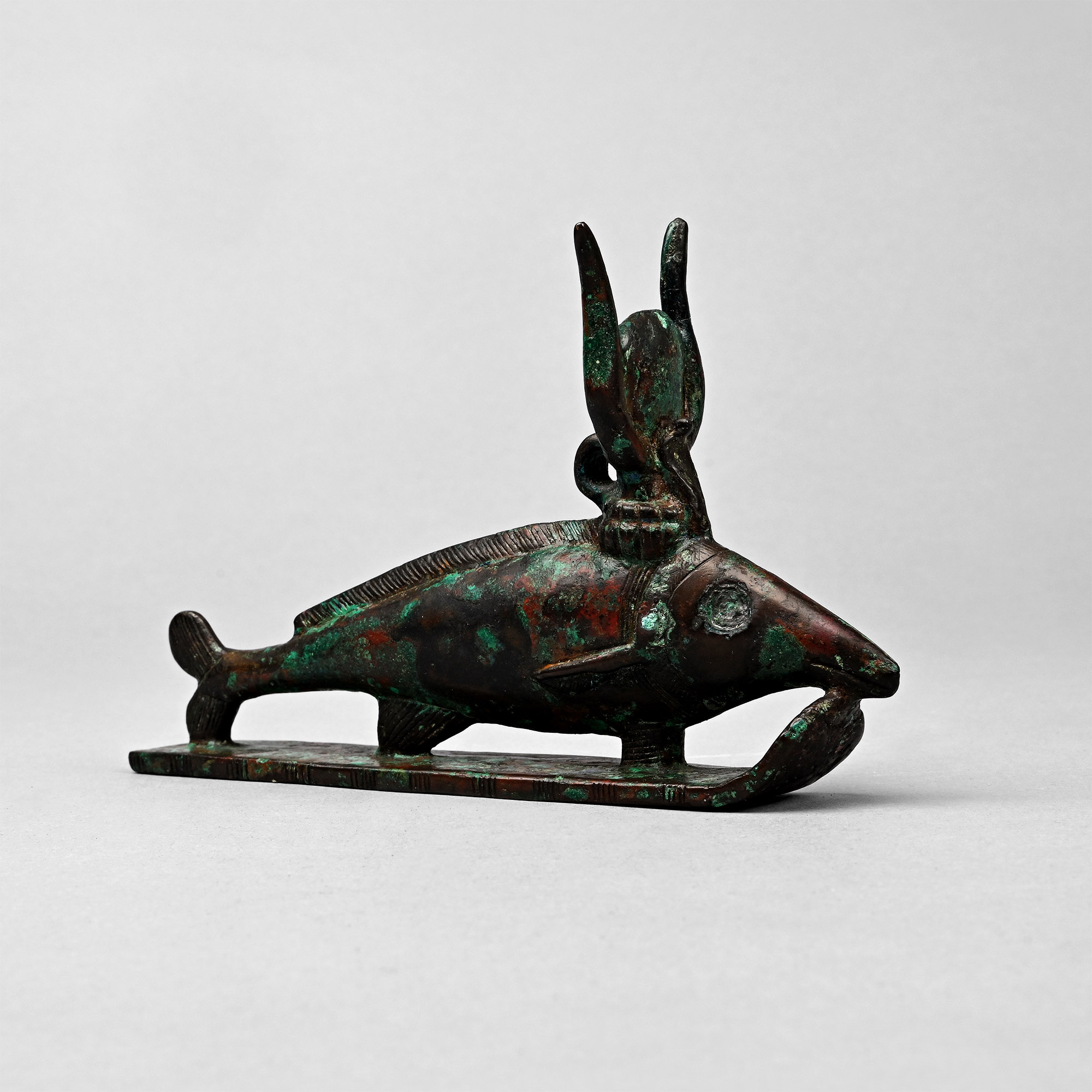
Very Large Egyptian Bronze Oxyrhynchus Fish of Per-Medjed with Hieroglyphic Inscription
LATE PERIOD-PTOLEMAIC PERIOD, 664-30 B.C.
6 3/4 in. (585 grams, 17 cm).
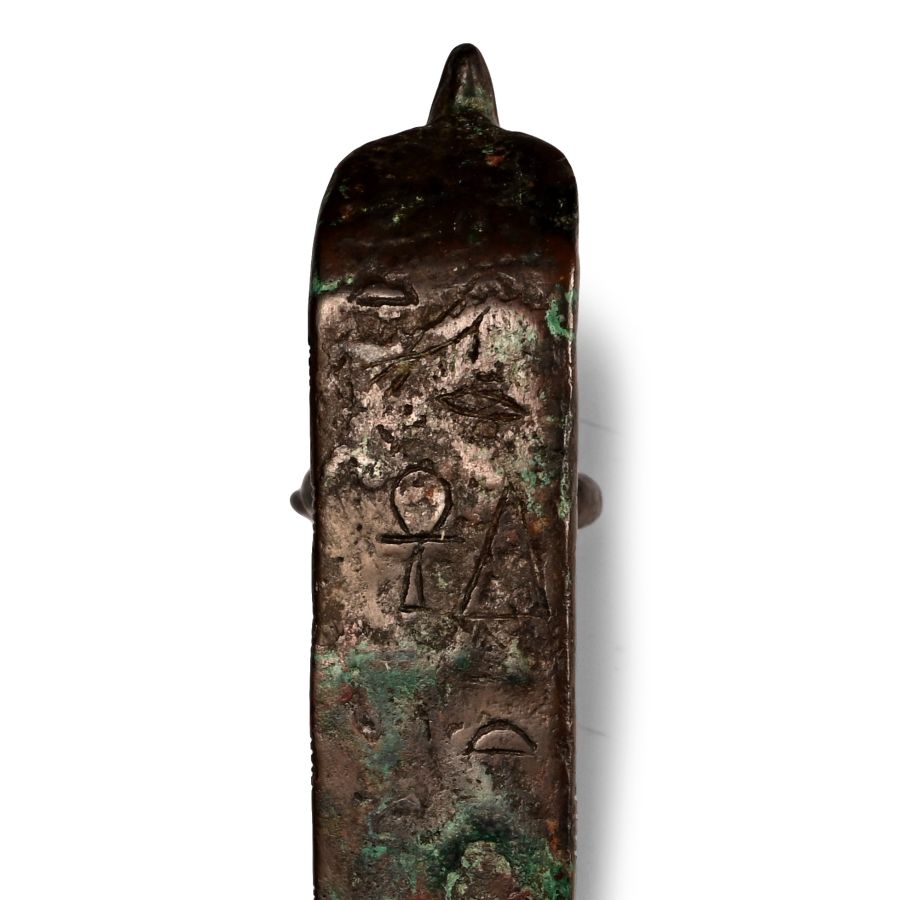
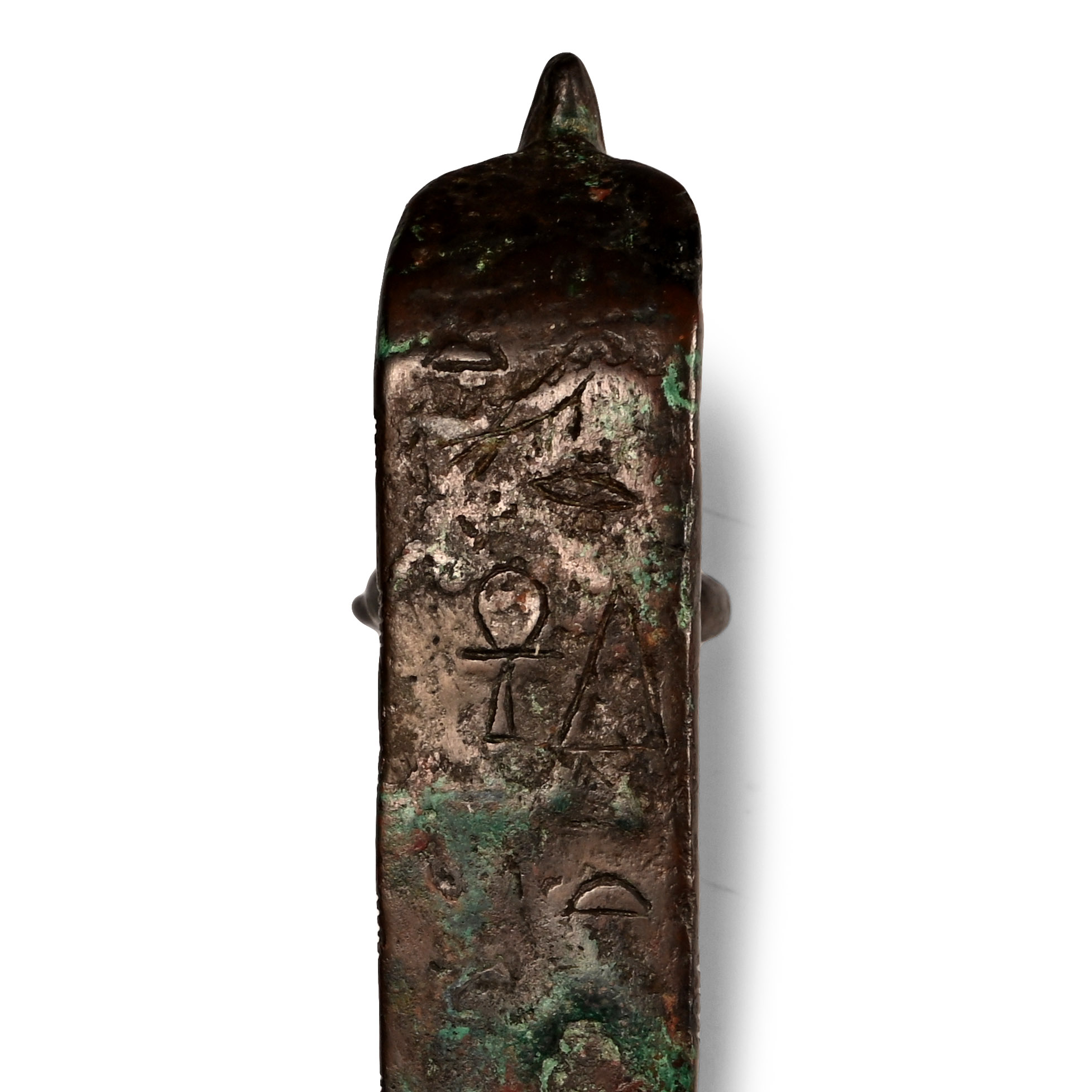
Modelled in the round on a sledge attached by ventral and pectoral fins, a forked tail, a dorsal ridge, and a tapering nose, featuring recessed circular eyes filled with enamel, a horned sun disc headdress fronted by a uraeus, and a suspension loop behind; a few hieroglyphs of a dedication remain visible on the underside of the sledge, which may be interpreted as ‘….the great give life (to)…’ (…t wr rdi͗ Ꜥnḫ t….); presumably, 'the great' followed the name of a deity, now lost.
ProvenanceAcquired from Gallery Reiner, Paris, France, 1981.
Private collection, Europe.
Accompanied by a copy of French passport no.150583 dated 29 November 2013.
This lot has been checked against the Interpol Database of stolen works of art and is accompanied by a search certificate number no.12375-226676.
Cf. Kozloff, A.P., Animals in Ancient Art from the Leo Mildenberg Collection, Mainz am Rhein, 1981, fig. 60, for a similar example; Tiribilli, E., The bronze figurines of the Petrie Museum from 2000 BC to AD 400, London, 2018, p.229, for discussion.
FootnotesThe Medjed, a type of elephant-snout fish (Mormyrus kannume), was revered in ancient Egyptian religion, particularly in Per-Medjed, better known by its Greek name, Oxyrhynchus Polis. This version of the name, meaning "city of the sharp-nosed," reflects the fish's distinctive appearance as depicted in Egyptian art. These fish were believed to have consumed the penis of Osiris, the god who was dismembered and scattered by his brother Seth. As sacred creatures, figurines of the Medjed were often adorned with a horned sun-disc headdress worn by the goddesses Hathor and Isis, suggesting a close association with both. Some figurines, like this example, featured suspension loops, allowing them to be worn as pendant amulets.
CONDITIONTimeLine Auctions follows a vetting process to ensure the authenticity and legality of all items, reinforcing our commitment to integrity and responsible trading. Each antiquity, antique, and coin lot undergoes thorough examination by a vetting committee of at least ten external specialists, professional trade association members, scientists, and archaeologists: Our Vetting Process
AUCTIONS:
TimeLine is a leading auction house specialising in antiquities, ancient art, collectables, natural history, coins, medals, and books. Our auctions offer museums, collectors, historians, and enthusiasts the opportunity to acquire unique and historically significant pieces.
LOT 0489
Very Large Egyptian Bronze Oxyrhynchus Fish of Per-Medjed with Hieroglyphic Inscription
Estimate £4,000 - 6,000€4,640 - 6,960 (for guidance only)$5,400 - 8,100 (for guidance only)
-
.jpg)
Egyptian Green Glazed Somtous Seated on Lotus Flower
Late Period, circa 664-332 B.C.Sold for (Inc. bp): £780
Modelled in the round, the nude seated figure of the child Somtous, with one hand to his lips and a prominent sidelock, emerging from a lotus flower; mounted on a custom-made stand. 39.76 grams total, 68 mm high including stand
Noriuchi Horiuchi, Tokyo, Japan, 1993. Private collection, London, UK.
The earliest attestations of the cult of Somtous, known as Sematawy in ancient Egyptian, date back to the New Kingdom, although it became particularly popular during the Late Period. Associated with Horus (Horsomtous), the symbol of the child emerging from the lotus represented the (re)birth of the sun god. Thus, Somtous was regarded as a life-giving amuletic symbol, sometimes even referred to as 'Sematawy the child who gives life.' -
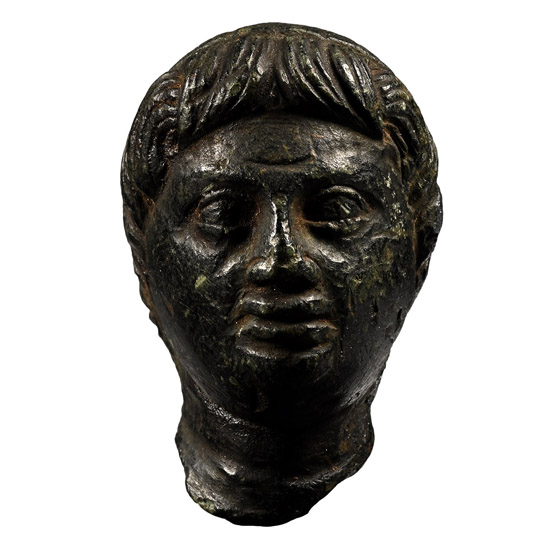
Egyptian Steatite Portrait of a Ptolemaic Prince
2nd-1st century B.C.Sold for (Inc. bp): £975
With a round face, large eyes, a narrow nose that broadens at the end, and full lips downturned at the corners; the forehead with a distinctive deep furrow above the brow; a narrow, twisted diadem encircling his wavy hair; mounted on a custom-made display stand. 84 grams total, 10 cm including stand
Private collection, Bern, Switzerland. with Galerie Rhéa, Zurich, Switzerland. This lot has been checked against the Interpol Database of stolen works of art and is accompanied by a search certificate number no.12631-236408.
The Greek hairstyle is a characteristic feature of Ptolemaic royal portraiture, as is the twisted diadem - a Greek interpretation of the Egyptian headband (the sšd) - which appears on several portrait heads of Ptolemaic boy-kings and princes. The distinctive furrow is intriguing, as it contrasts with the typically blemish-free physiognomy of most Ptolemaic royal sculpture. However, a similar furrow can be seen on the portrait head of a provincial governor from Dendera, dated to the 2nd century B.C. (Bothmer, B.V., Egyptian Sculpture of the Late Period 700 B.C. to A.D. 100, New York, 1960, pp. 144-143, pl. 112, nos. 301-302), which may indicate an artistic trend employed in high-status sculpture at that time. It has been suggested that small royal portrait heads, such as this example, may have served as votives. The lack of an Egyptian-style back pillar on this and similar pieces supports the possibility that they were inserted into statues made of different materials (Ashton, S.-A., Ptolemaic Royal Sculpture from Egypt, BAR International Series 923, Oxford, 2001, p.12). -
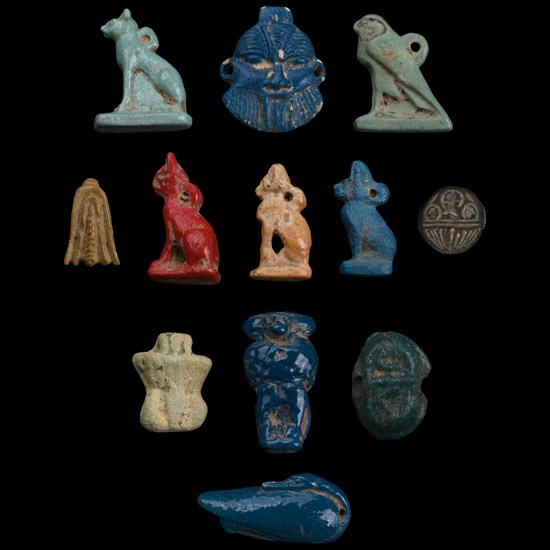
Egyptian Faience Amulet Collection
Late Period-Ptolemaic Period, 664-30 B.C. and laterSold for (Inc. bp): £3,120
Including four seated cats, a Horus falcon, a Bes head, a standing baboon, male genitalia, a trussed duck, and other amuletic types. 18.92 grams total, 15-26 mm
From the collection of a gentleman, acquired on the London art market in the 1990s.
