
Loading, please wait...
_900x900.jpg "Very Large Egyptian Bronze Oxyrhynchus Fish of Per-Medjed with Hieroglyphic Inscription")
_200x200.jpg "Very Large Egyptian Bronze Oxyrhynchus Fish of Per-Medjed with Hieroglyphic Inscription")
_900x900.jpg "Very Large Egyptian Bronze Oxyrhynchus Fish of Per-Medjed with Hieroglyphic Inscription")
_200x200.jpg "Very Large Egyptian Bronze Oxyrhynchus Fish of Per-Medjed with Hieroglyphic Inscription")
_900x900.jpg "Very Large Egyptian Bronze Oxyrhynchus Fish of Per-Medjed with Hieroglyphic Inscription")
_200x200.jpg "Very Large Egyptian Bronze Oxyrhynchus Fish of Per-Medjed with Hieroglyphic Inscription")
.jpg "Very Large Egyptian Bronze Oxyrhynchus Fish of Per-Medjed with Hieroglyphic Inscription")
.jpg "Very Large Egyptian Bronze Oxyrhynchus Fish of Per-Medjed with Hieroglyphic Inscription")
.jpg "Very Large Egyptian Bronze Oxyrhynchus Fish of Per-Medjed with Hieroglyphic Inscription")
LOT 0055
Very Large Egyptian Bronze Oxyrhynchus Fish of Per-Medjed with Hieroglyphic Inscription
LATE-PTOLEMAIC PERIOD, 664-30 B.C.
6 3/4 in. (585 grams, 17 cm).
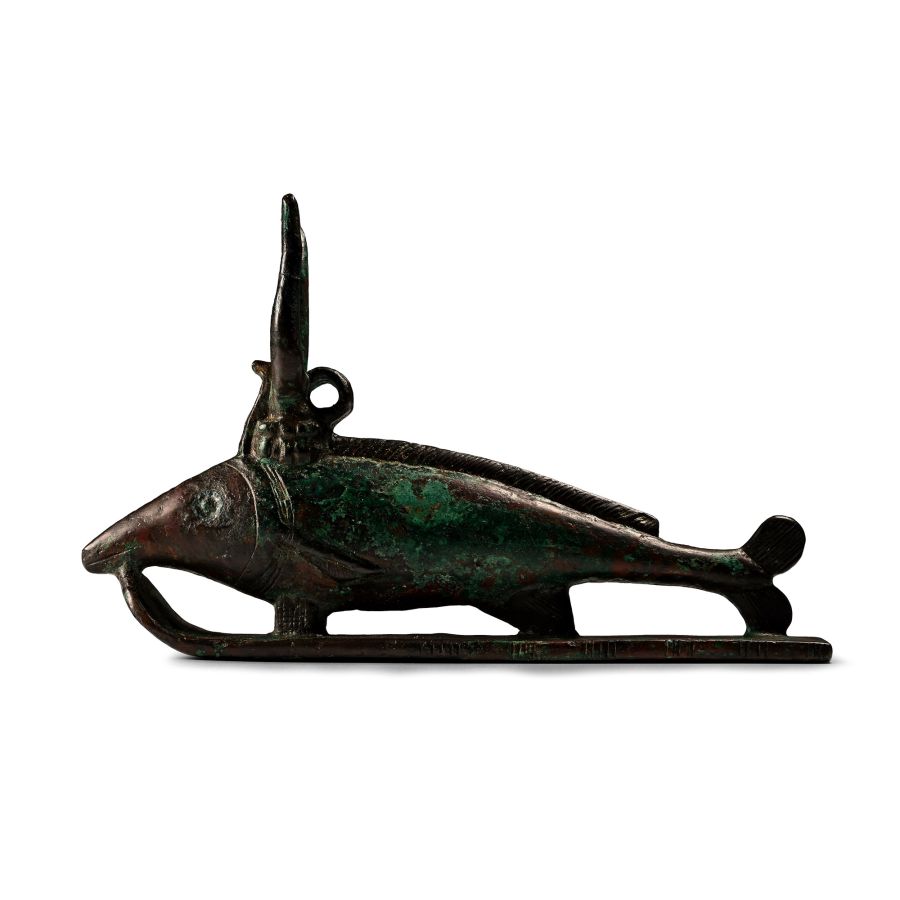
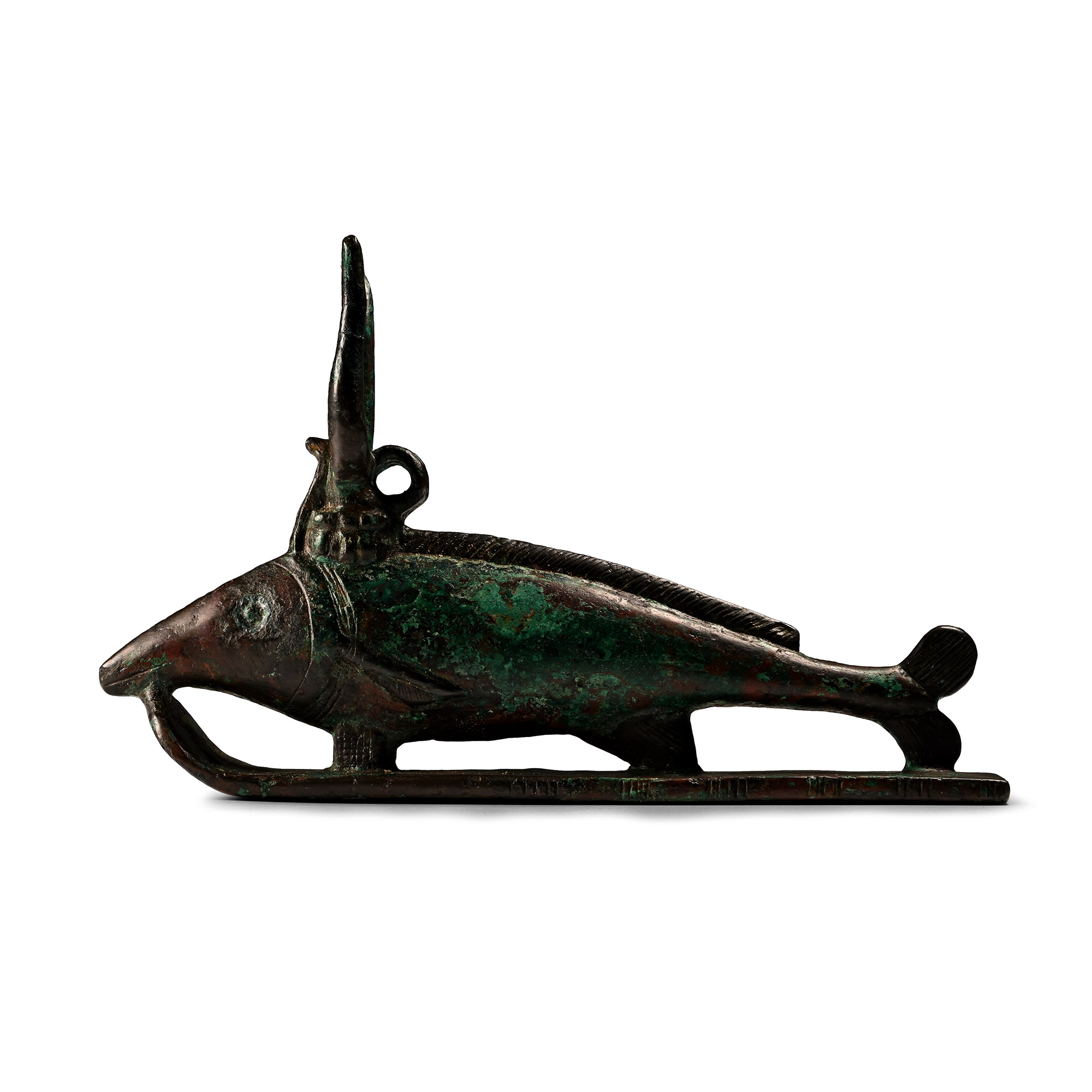
Modelled in the round on a sledge attached by ventral and pectoral fins, a forked tail, a dorsal ridge, and a tapering nose, featuring recessed circular eyes filled with enamel, a horned sun disc headdress fronted by a uraeus, and a suspension loop behind; a few hieroglyphs of a dedication remain visible on the underside of the sledge, which may be interpreted as ‘….the great give life (to)…’ (…t wr rdi͗ Ꜥnḫ t….); presumably, 'the great' followed the name of a deity, now lost.
ProvenanceAcquired from Gallery Reiner, Paris, France, 1981.
Private collection, Europe.
Accompanied by a copy of French passport no.150583 dated 29 November 2013.
This lot has been checked against the Interpol Database of stolen works of art and is accompanied by a search certificate number no.12375-226676.
Cf. Kozloff, A.P., Animals in Ancient Art from the Leo Mildenberg Collection, Mainz am Rhein, 1981, fig. 60, for a similar example; Tiribilli, E., The bronze figurines of the Petrie Museum from 2000 BC to AD 400, London, 2018, p.229, for discussion.
FootnotesThe Medjed, a type of elephant-snout fish (Mormyrus kannume), was revered in ancient Egyptian religion, particularly in Per-Medjed, better known by its Greek name, Oxyrhynchus Polis. This version of the name, meaning "city of the sharp-nosed," reflects the fish's distinctive appearance as depicted in Egyptian art. These fish were believed to have consumed the penis of Osiris, the god who was dismembered and scattered by his brother Seth. As sacred creatures, figurines of the Medjed were often adorned with a horned sun-disc headdress worn by the goddesses Hathor and Isis, suggesting a close association with both. Some figurines, like this example, featured suspension loops, allowing them to be worn as pendant amulets.
CONDITIONTimeLine Auctions follows a vetting process to ensure the authenticity and legality of all items, reinforcing our commitment to integrity and responsible trading. Each antiquity, antique, and coin lot undergoes thorough examination by a vetting committee of at least ten external specialists, professional trade association members, scientists, and archaeologists: Our Vetting Process
AUCTIONS:
TimeLine is a leading auction house specialising in antiquities, ancient art, collectables, natural history, coins, medals, and books. Our auctions offer museums, collectors, historians, and enthusiasts the opportunity to acquire unique and historically significant pieces.
LOT 0055
Very Large Egyptian Bronze Oxyrhynchus Fish of Per-Medjed with Hieroglyphic Inscription
Estimate £4,500 - 6,500€5,220 - 7,540 (for guidance only)$6,080 - 8,780 (for guidance only)
-
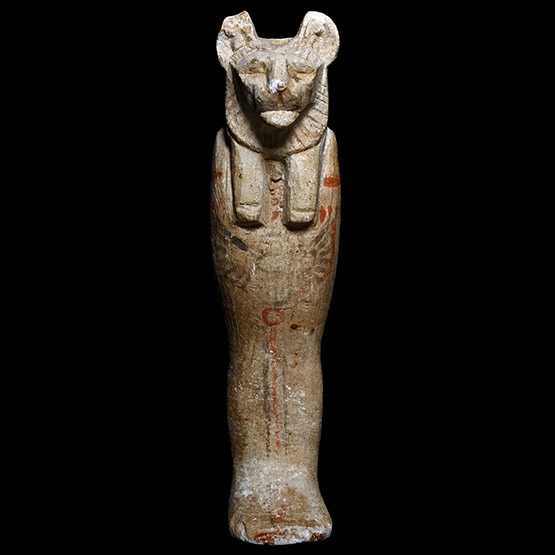
Egyptian Painted Limestone Mummiform Sekhmet Statuette
Circa 7th-6th century B.C.Sold for (Inc. bp): £3,000
Carved in the round depiction of Bastet or Sekhmet in a lion-headed form with a tripartite headdress, with front lappets overlain by the leonine mane; between the ears, a hole possibly for the insertion of a separate sun disc element; red pigment lines and fringe to the shoulders; a black diamond pattern with central red dots decorating the back, and a winged scarab in black on the abdomen; marked on the underside with the collector's reference 'BAOP SAKKARA'; mounted on a custom-made display stand. 29 grams total, 77 mm including stand
Private collection of George Anastase Michaelides (1900-1973) and legally exported from Egypt in the 1940s. Black ink inscription on base "BAOP SAKKARA". Christie's, London, 29 October 2003, no.167. Accompanied by a copy of the relevant Christie's catalogue pages. This lot has been checked against the Interpol Database of stolen works of art and is accompanied by search certificate number no.13101-248076.
Considering the specified Saqqara provenance, it is probable that the statuette originated from the Bubastaeion, dedicated to Bastet. The goddess was more commonly depicted as a cat or a human with a cat's head, although she also sometimes displayed a leonine aspect. It is also possible that the statuette represents her son, Mahes, who was depicted as a man with a lion's head. -
.jpg)
Historic Collection of 565 Slides of Egyptian Archaeological Sites and Artefacts
1960s-1980s A.D.Sold for (Inc. bp): £845
Housed in five linen-covered boxes, covering ancient Egypt, Tutankhamun jewellery, Nefetari, Amun Hr Khopshef, Khaemwast, Tuthmosis IV, Tye, Archaic stele, maceheads, inscriptions, pottery, sculpture, Saqqara tombs, Esna etc. 3.85 kg total, 26.5 x 16.5 x 6.5 cm each box
Property of archaeologist Stephanie Gee, N.W. London, UK, 1960s-1980s.
Stephanie Gee was a prominent archaeologist who took part in several expeditions in Egypt. She was a trusted assistant to the British-Australian archaeologist Veronica Seton-Williams, who excavated in Egypt, Britain, and the Near East. Stephanie also took part in the Tell El-Farâ'în expeditions of 1965-1968, and assisted Seton-Williams with preparing the 1966 expedition report. Their collaboration continued and Stephanie helped with the manuscript of Seton-Williams’ book ‘The Road to El-Aguzein’, a narrative account of her life that was first published in 1988. -
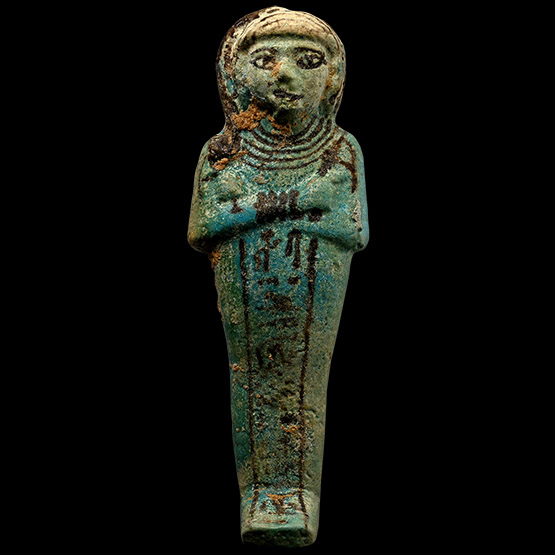
Egyptian Faience Ushabti
2nd millennium B.C.Sold for (Inc. bp): £2,106
Mummiform figure with black-pigment facial detailing, sidelock, tripartite wig, dorsal seed-net, tiered collar, and vertical panel of hieroglyphic text. 134 grams, 15 cm
Acquired in the mid 1980s. Private collection, Switzerland, thence by descent. Private collection, since the late 1990s. This lot has been checked against the Interpol Database of stolen works of art and is accompanied by a search certificate number no.12848-241648.
A shabti (also known as ushabti or shawabti) is a small funerary figurine found in ancient Egyptian tombs, from around 2000 BCE to 30 BCE. Its main purpose was to act as a servant for the deceased in the afterlife, carrying out manual tasks like farming or irrigation as directed by the gods. Shabtis were frequently inscribed with a magical formula from the Book of the Dead to ensure they would animate when summoned.
