
Loading, please wait...
_900x900.jpg "Very Large Cypriot Terracotta Bichrome Ware Plate")
_200x200.jpg "Very Large Cypriot Terracotta Bichrome Ware Plate")
.jpg "Very Large Cypriot Terracotta Bichrome Ware Plate")
LOT 0039
Very Large Cypriot Terracotta Bichrome Ware Plate
CIRCA 750-600 B.C.
21 1/4 in. (6.7 kg, 54 cm).
Broad disc with basal ring; tondo with outer band of wave-pattern in black and red on cream field, concentric inner bands with geometric and hatched patterns; two holes close to rim; repaired and partly restored with fresh painted extension of the existing design, iron retaining rim with attachment lugs.
Provenancewith Bonhams, London, 29 April 2009, no.339.
Accompanied by a copy of an Art Loss Register certificate no.S00075782.
Accompanied by a copy of the relevant Bonham's catalogue pages.
This lot is accompanied by an illustrated lot declaration signed by the Head of the Antiquities Department, Dr Raffaele D’Amato.
Cf. similar but less elaborate version of the type in the British Museum under accession no.1896,0201.20.
CONDITIONTimeLine Auctions follows a vetting process to ensure the authenticity and legality of all items, reinforcing our commitment to integrity and responsible trading. Each antiquity, antique, and coin lot undergoes thorough examination by a vetting committee of at least ten external specialists, professional trade association members, scientists, and archaeologists: Our Vetting Process
AUCTIONS:
TimeLine is a leading auction house specialising in antiquities, ancient art, collectables, natural history, coins, medals, and books. Our auctions offer museums, collectors, historians, and enthusiasts the opportunity to acquire unique and historically significant pieces.
-
.jpg)
Very Large Cypriot Terracotta Bichrome Ware Plate
Circa 750-600 B.C.Sold for (Inc. bp): £1,300
Broad disc with basal ring; tondo with outer band of wave-pattern in black and red on cream field, concentric inner bands with geometric and hatched patterns; two holes close to rim; repaired and partly restored with fresh painted extension of the existing design, iron retaining rim with attachment lugs. 6.7 kg, 54 cm
with Bonhams, London, 29 April 2009, no.339. Accompanied by a copy of an Art Loss Register certificate no.S00075782. Accompanied by a copy of the relevant Bonham's catalogue pages. This lot is accompanied by an illustrated lot declaration signed by the Head of the Antiquities Department, Dr Raffaele D’Amato. -
.jpg)
Large Greek Geometric Terracotta Oinochoe with Swastikas
8th century B.C.Estimate: £5,000 - 7,000 (‡+bp*)
Opening Bid: £2,430
With flared mouth, wide neck, bulbous body and ring foot, painted in brown and red matte glaze; geometric pattern spread over several registers separated by bundles of encircling stripes, triangles with hatching inside them, neck with metopes containing swastikas, rosettes and rhombuses with a band of rhombuses beneath; the shoulder with five line friezes arranged one above the other; the body decorated with meander and a band of rhombuses and triangles with hatching below, a broad black stripe (in places reddish as a result of misfiring) to the lower part; transition to the ring foot and ring foot painted black; wide strap handle attached to the shoulder and painted on the outside with a wavy line framed by dots, edge stripes and three small stars, the connecting bar patterned with stripes; museum-quality restoration. 2.04 kg, 35.5 cm
Ex Madame P., Paris. Accompanied by an academic report by Dr Raffaele D'Amato. This lot has been checked against the Interpol Database of stolen works of art and is accompanied by search certificate number no.12460-228686. This lot has been cleared against the Art Loss Register database, and is accompanied by an illustrated lot declaration signed by the Head of the Antiquities Department, Dr Raffaele D’Amato.
Vessels of the Geometric period (900-700 BCE) are easily recognisable by their abstract decorative designs, which had their origin in woven textiles and baskets. While early period pottery typically has sparse geometric motifs on a black background, the amount of the decoration increased progressively to the point that objects from the late Geometric period are often entirely covered - in this example, even the strap handle. -
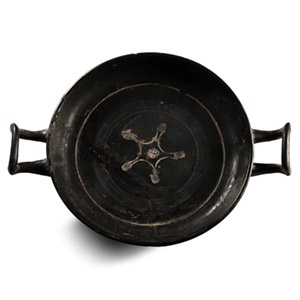
Greek Terracotta Black-Glazed Stemless Cup
4th century B.C.Estimate: £800 - 1,000 (‡+bp*)
Opening Bid: £360
With two lateral handles on a low, profiled ring foot; incised and stamped decoration to the interior comprising a central blossom surrounded by palmettes connected by curved lines, the whole framed by a concentric circle made up of dashes; restored. 227 grams, 20.5 cm
with S.C., Basel, prior 2003. Accompanied by a copy of an Art Loss Register certificate no.S00075178. This lot is accompanied by an illustrated lot declaration signed by the Head of the Antiquities Department, Dr Raffaele D’Amato.
