
Loading, please wait...
LOT 0244
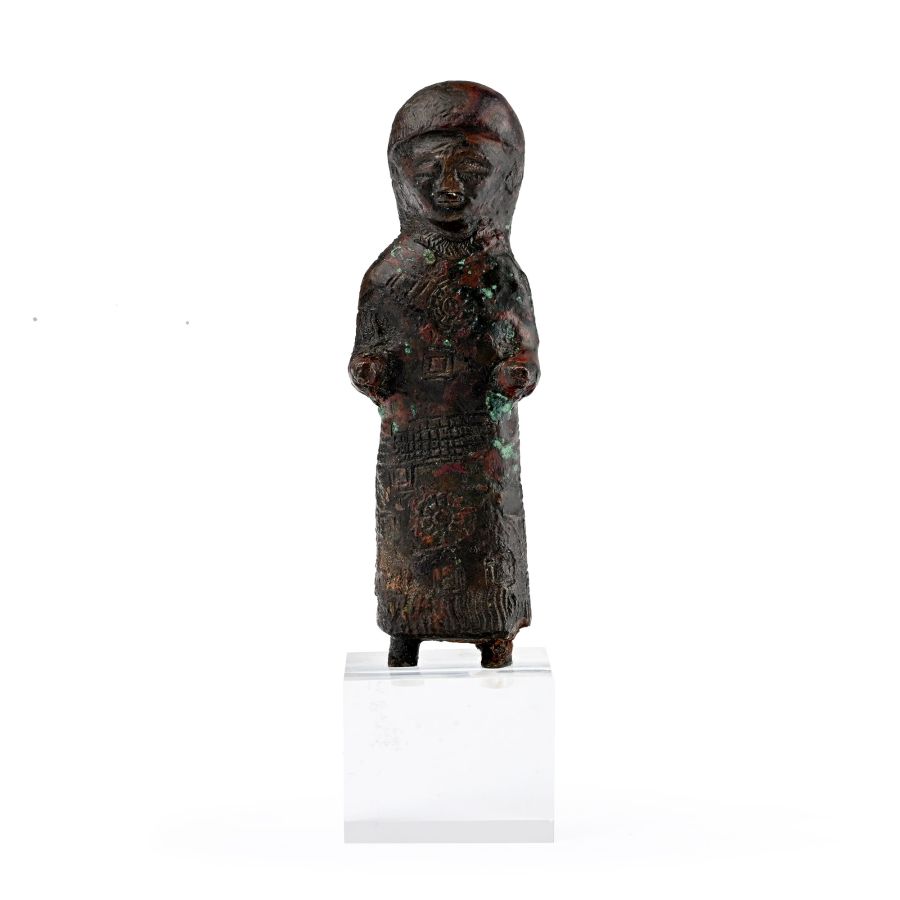
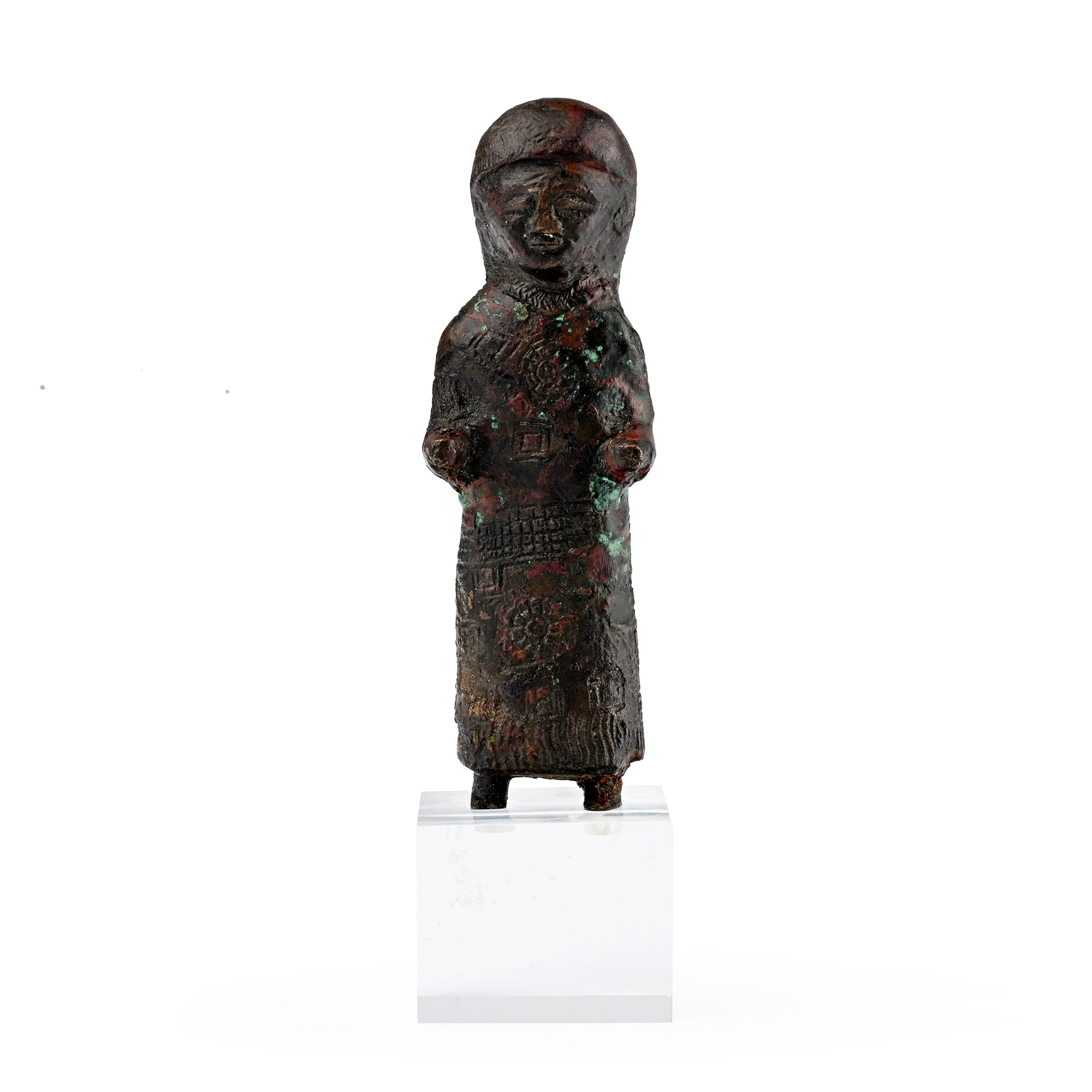
Urartu Copper Figure of a Goddess
8TH-7TH CENTURY B.C.
3 in. (3 3/4 in.) (115 grams, 76 mm (130 grams, 95 mm including stand)).
Columnar in form with bulbous hairstyle descending to a tapering tail; stub arms to the sides and small right-angled feet; impressed herringbone texture to the hair; robe with hatched detailing to the collar, belt and hem, rosette and other detailing; supplied with a custom-made display stand.
ProvenancePrivate collection, Europe.
Acquired in 2003.
This lot has been checked against the Interpol Database of stolen works of art and is accompanied by a search certificate number no.12894-241695.
This lot has been cleared against the Art Loss Register database, and is accompanied by an illustrated lot declaration signed by the Head of the Antiquities Department, Dr Raffaele D'Amato.
TimeLine Auctions follows a vetting process to ensure the authenticity and legality of all items, reinforcing our commitment to integrity and responsible trading. Each antiquity, antique, and coin lot undergoes thorough examination by a vetting committee of at least ten external specialists, professional trade association members, scientists, and archaeologists: Our Vetting Process
AUCTIONS:
TimeLine is a leading auction house specialising in antiquities, ancient art, collectables, natural history, coins, medals, and books. Our auctions offer museums, collectors, historians, and enthusiasts the opportunity to acquire unique and historically significant pieces.
LOT 0244
Urartu Copper Figure of a Goddess
Estimate £6,000 - 8,000€6,960 - 9,280 (for guidance only)$8,100 - 10,800 (for guidance only)
-
.jpg)
Luristan Bronze Vessel
Circa 950 B.C.Sold for (Inc. bp): £98
With flattened base and everted rim, two circumferential bands on the body. 248 grams, 95 mm wide
Ex London, UK, collections, 1990s-2000s. This lot has been cleared against the Art Loss Register database, and is accompanied by an illustrated lot declaration signed by the Head of the Antiquities Department, Dr Raffaele D'Amato.
The people of Luristan were mainly nomadic, constantly moving in summer and winter pastures, and needed metal utensils. Therefore, in addition to weapons, these excellent metal workers produced, in considerable numbers, light and elegant bronze vases and cups. -
South Mesopotamian Stone Male Figure
2nd millennium B.C. and laterSold for (Inc. bp): £156
Carved in the round with textured hair, holding an object to his left shoulder; in seated pose. 13.12 grams, 43 mm
Ex S collection, London, UK, 1970-1990s. This lot has been cleared against the Art Loss Register database, and is accompanied by an illustrated lot declaration signed by the Head of the Antiquities Department, Dr Raffaele D'Amato. -
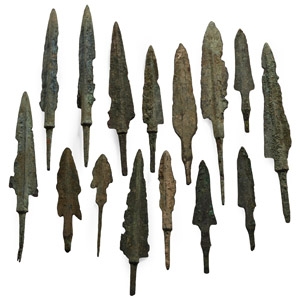
Luristan Bronze Arrowhead Collection
14th-10th century B.C.Sold for (Inc. bp): £143
Comprising: a group of large tanged arrowheads, mainly of triangular type with mid-rib; one barbed example; four foliate blades and a single arrowhead with double points with stem and tang. 325 grams total, 8.8-15.3 cm
From the London art market, 1990s. This lot has been cleared against the Art Loss Register database, and is accompanied by an illustrated lot declaration signed by the Head of the Antiquities Department, Dr Raffaele D'Amato.
The most interesting specimen of the group is certainly the double-pointed arrowhead, belonging to the type II of Khorasani's classification. These arrowheads were made in cast bronze with a double point with stem and tang, located one above the other and positioned at right angles to each other (see also Muscarella, 1988, figs.411 and 418).
