
Loading, please wait...
LOT 1191
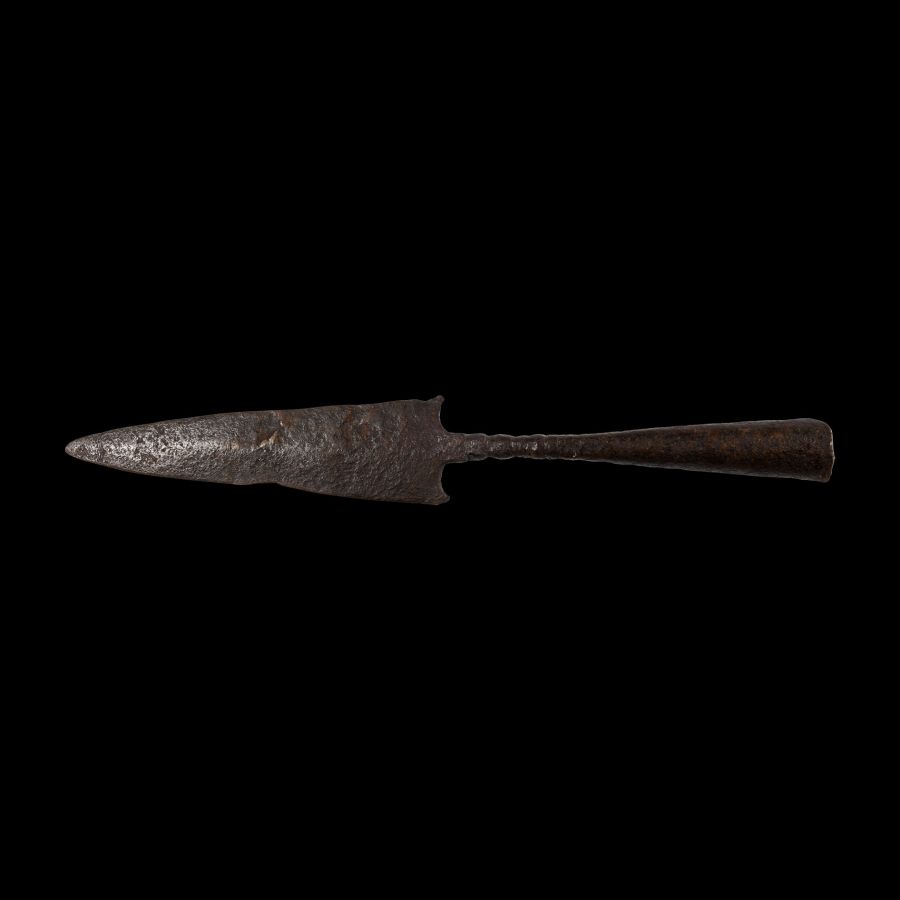
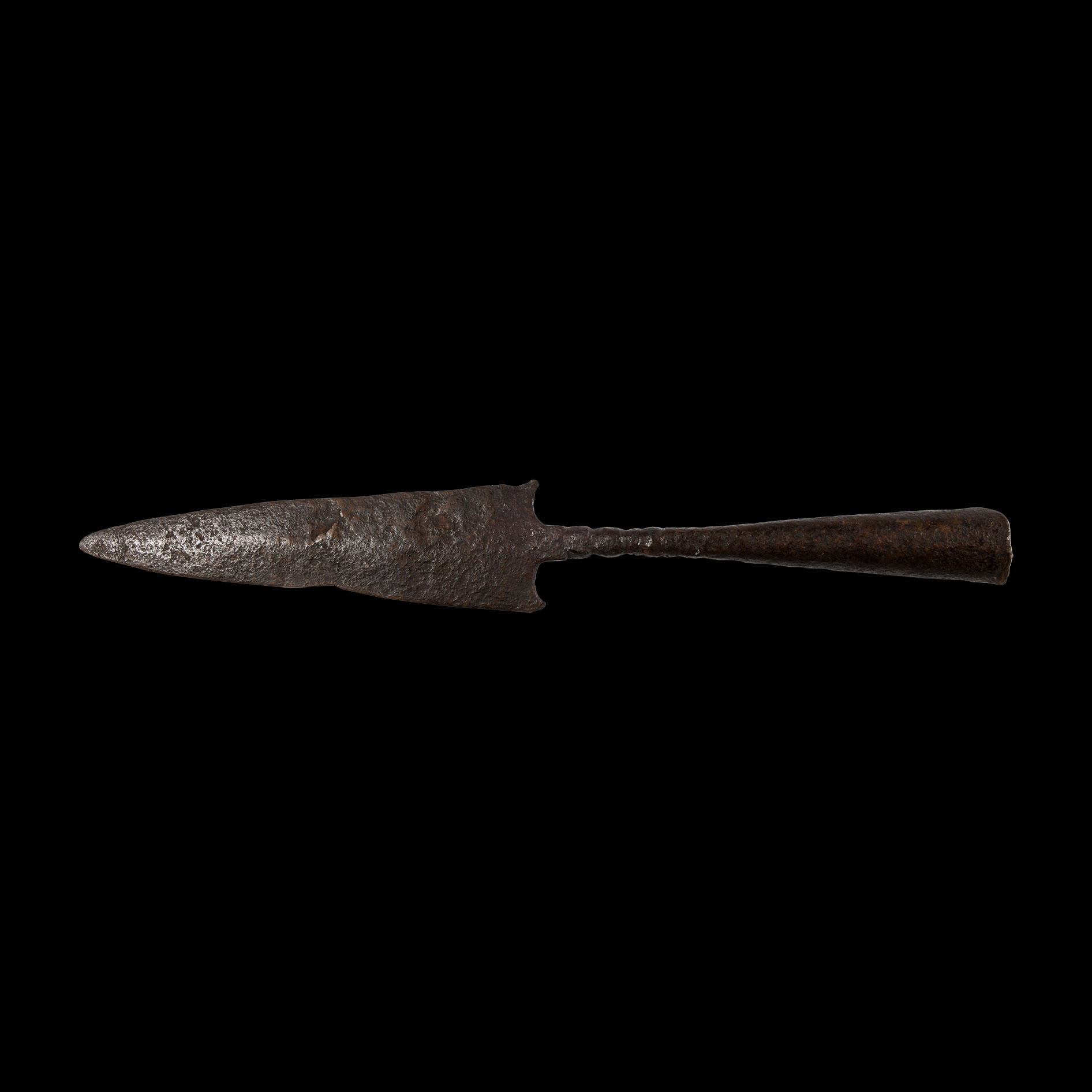
Ummayad Bronze Spearhead
7TH-8TH CENTURY A.D.
13 3/8 in. (245 grams, 34 cm).
Formed with a broadly triangular blade, narrow neck and tapering round-section socket.
ProvenanceEx old English collection.
The Kusmirek Collection, UK.
Cf. Nicolle, D., The military technology of the Classical Islam, Edinburgh, 1982, volume I, fig.120.
FootnotesThe basic Arabic term for a spear or lance, whether used by cavalry or infantry, was rumh. In the 7th century it normally would have been ten or twelve cubits long, i.e. four and a half metres.
CONDITIONTimeLine Auctions follows a vetting process to ensure the authenticity and legality of all items, reinforcing our commitment to integrity and responsible trading. Each antiquity, antique, and coin lot undergoes thorough examination by a vetting committee of at least ten external specialists, professional trade association members, scientists, and archaeologists: Our Vetting Process
AUCTIONS:
TimeLine is a leading auction house specialising in antiquities, ancient art, collectables, natural history, coins, medals, and books. Our auctions offer museums, collectors, historians, and enthusiasts the opportunity to acquire unique and historically significant pieces.
LOT 1191
Ummayad Bronze Spearhead
Estimate £250 - 350€290 - 410 (for guidance only)$340 - 470 (for guidance only)
-
.jpg)
Neo-Assyrian Bronze Horse Trapping with Eagle-Headed God Nisroch and Winged Supernatural Figures
9th-8th century B.C.Sold for (Inc. bp): £15,600
The left side of a trapping for a horse pulling a chariot, comprising two hammered elements with a hinge; rectangular upper section with a loop to one end, decorated with an eagle-headed genius-demon, wearing a tunic and a fringed kilt, a shawl wrapped around the body, hanging down on the back, carrying a bucket of purifying water in his right hand and a conical pot of incense in his left hand, bracelets to arms, two rows of lotus buds above; the discoid lower section divided in two registers, each with a winged genii in combat with winged bulls; the dividing raised band with fish motifs similar to the border formed of fish; the edges of both elements with punched edges for the attachment of leather lining; Neo-Assyrian or Urartian; mounted on a custom-made display stand. 3.75 kg total, 59 cm including stand
Acquired in the 1960s. Ex private collection, Switzerland, thence by descent in 1996. Accompanied by an academic report by Dr Raffaele D'Amato. This lot has been checked against the Interpol Database of stolen works of art and is accompanied by search certificate number no.11780-205646.
These pieces of horse armour, destined to be the lateral protection for horses, were usually fixed at the four corners of the yoke (Connolly, 1986, p.17). Sometimes these side pendants provided protection for the upper part of horse's legs. Drawings and reconstructions of an Urartian chariot compiled from archaeological evidence shows the likely positioning on the shoulder of the horse (Gorelik, 1995, p.4). They served to protect the horse and also as symbols of divine protection. Similar pieces are visible on Assyrian reliefs (Born-Seidl, 1995, figs.53-54, relief from Nimrod; 62, from Assur; Curtis, 2013, pl.LXXV; Dezső, 2012, pl.12-13). -
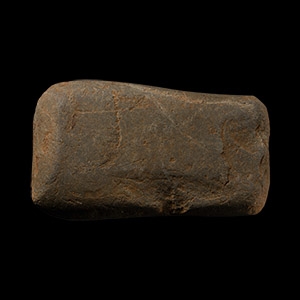
Roman Whetstone Sword Sharpening Stone
1st-4th century A.D. or laterSold for (Inc. bp): £20
Roughly wedge-shaped with one broken edge and one chamfered. 280 grams, 92 mm
Found Berkshire, UK. -
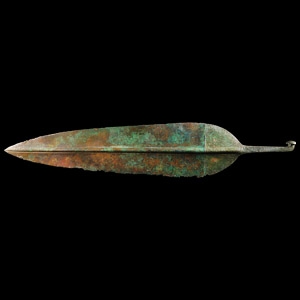
Heavy Western Asiatic Leaf-Shaped Spearhead
14th-10th century B.C.Estimate: £600 - 800 (+bp*)
Opening Bid: £300
The leaf-shaped ovate blade with rounded, gently curved shoulders and raised midrib, flat rectangular-sectioned tang tapering to a sharply bent end with a fastening button. 844 grams, 46.2 cm
Acquired 1980-2015. Ex Abelita family collection.
Similar spearheads were excavated in the Marlik Royal cemetery by Dr Negahban, see for example in tomb 47, Trench XXIIE. They were the evolution of a typology which began much earlier in Mesopotamia and the fertile crescent, the type 4 of the Stronach classification, with straight tang and square section, usually thickened at the base with a button tang. The foliate blade was wide and exaggerated in some specimens excavated at Marlik.
