
Loading, please wait...
LOT 0128
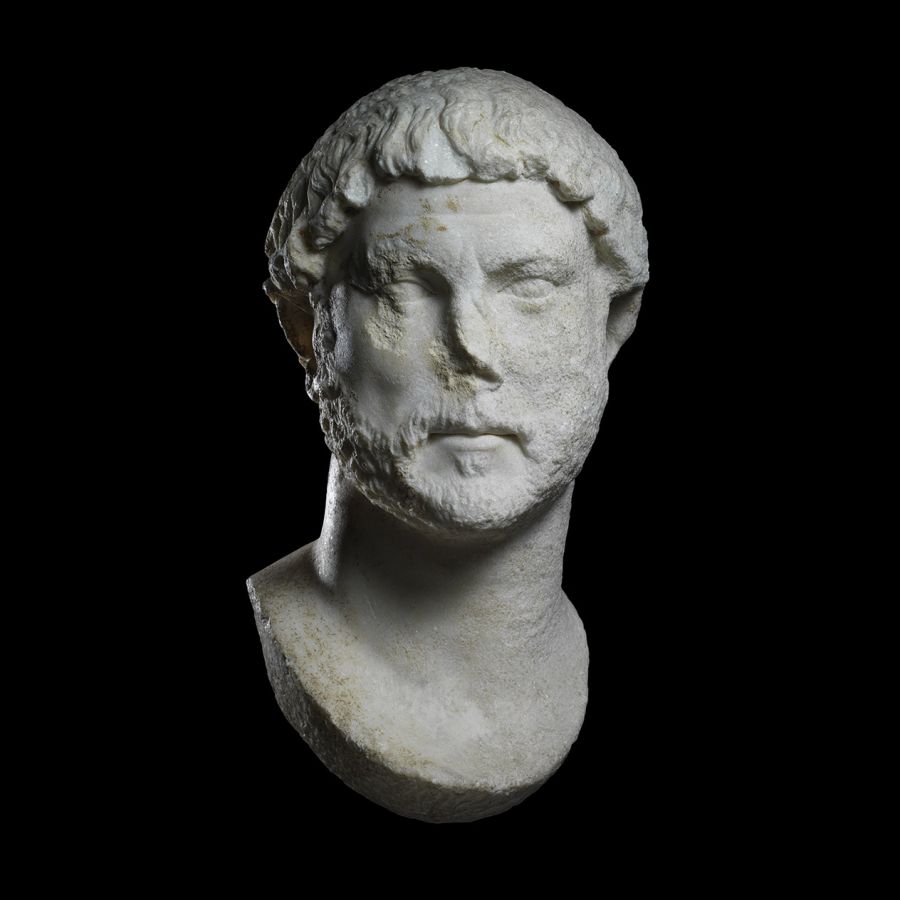
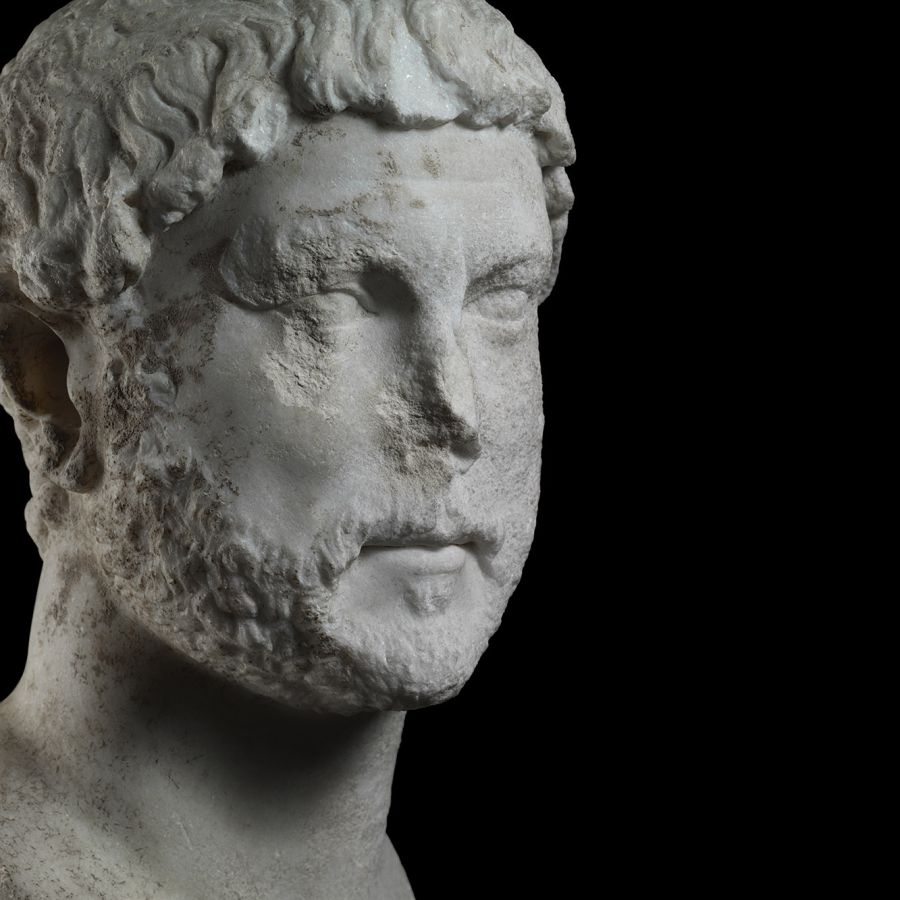
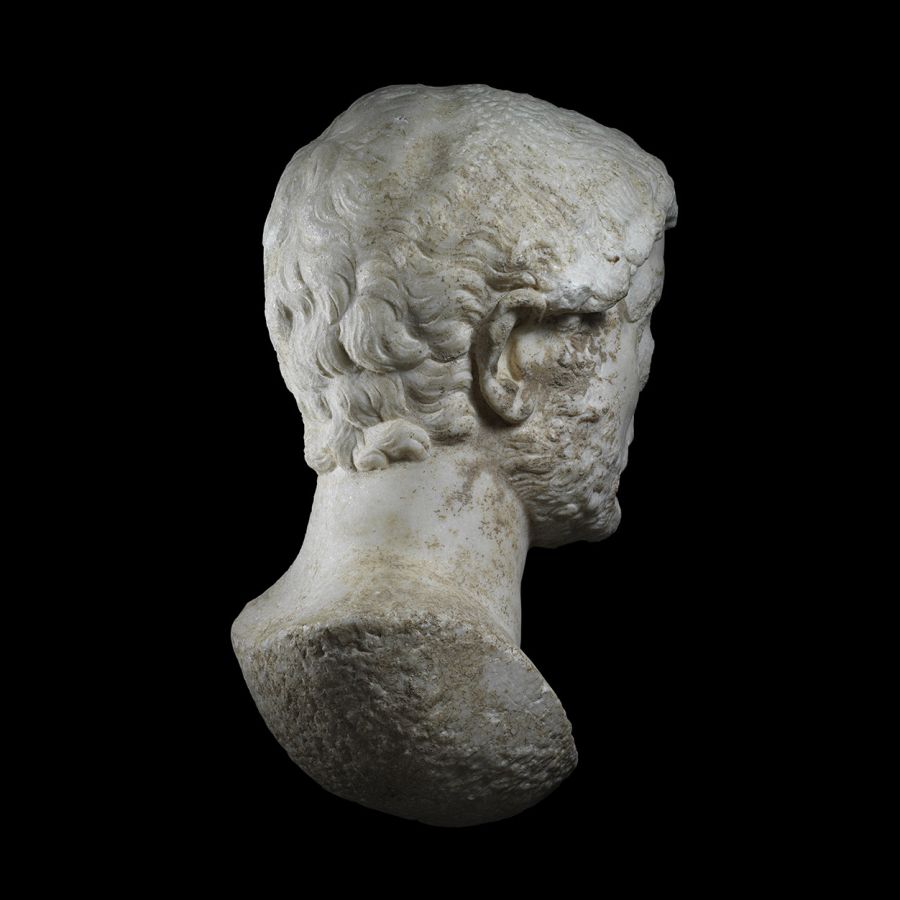
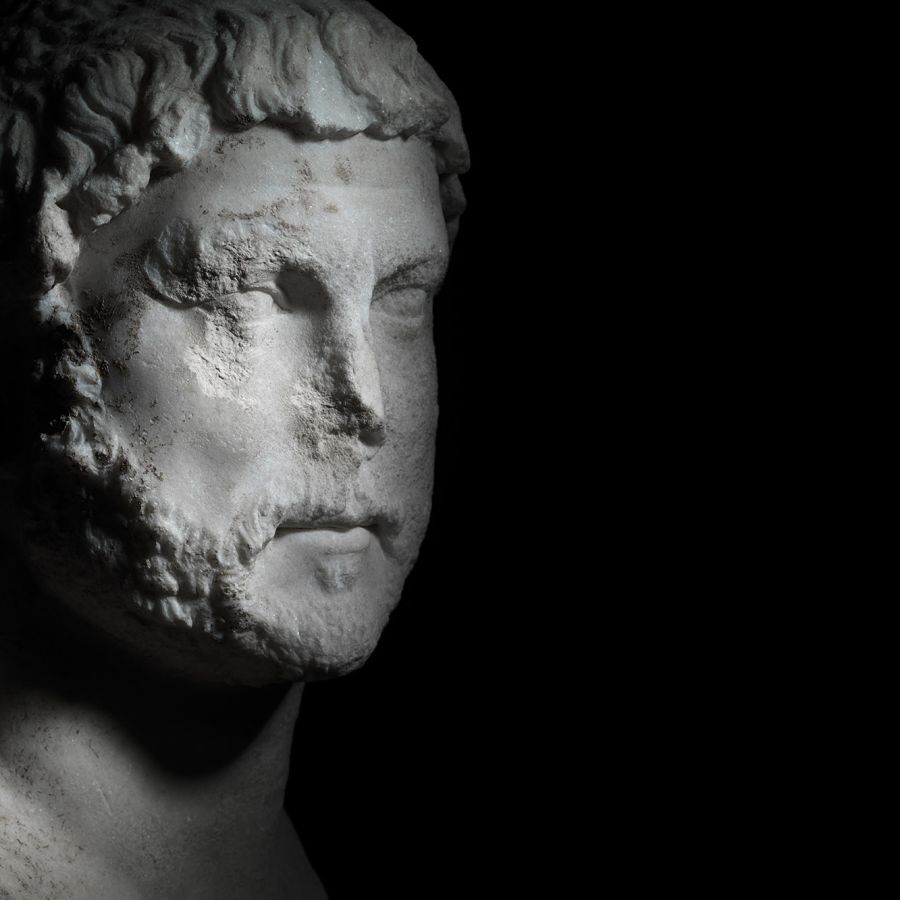
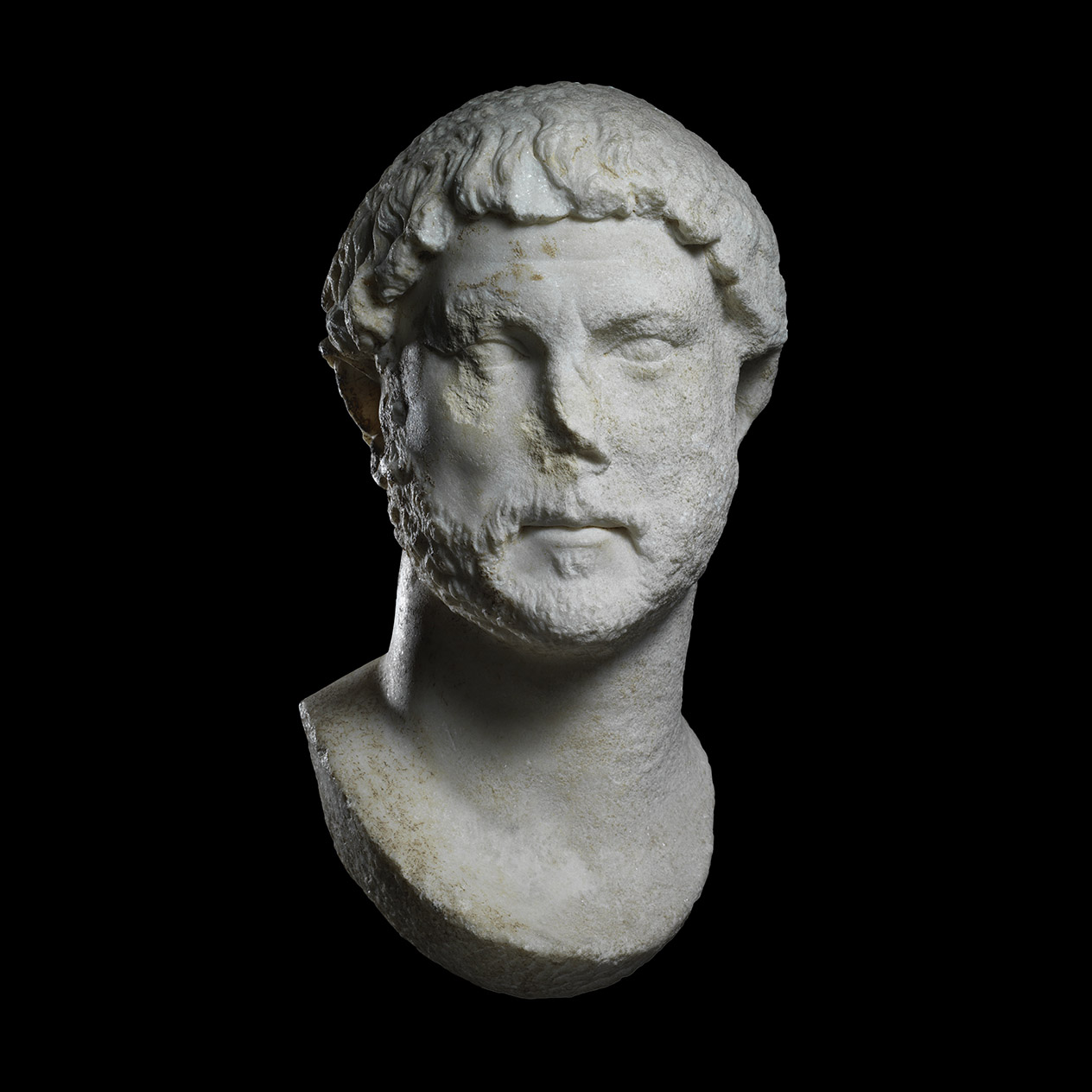
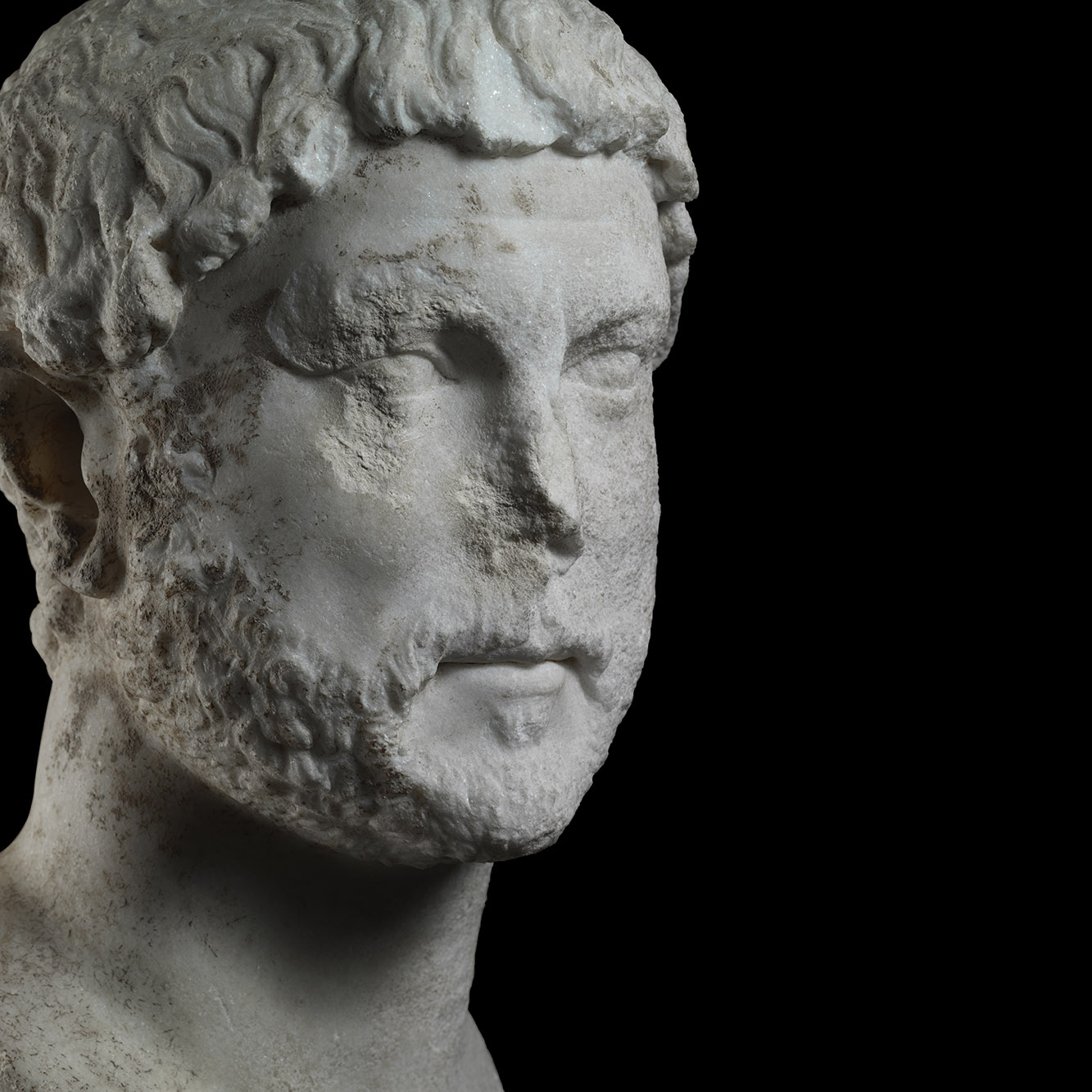
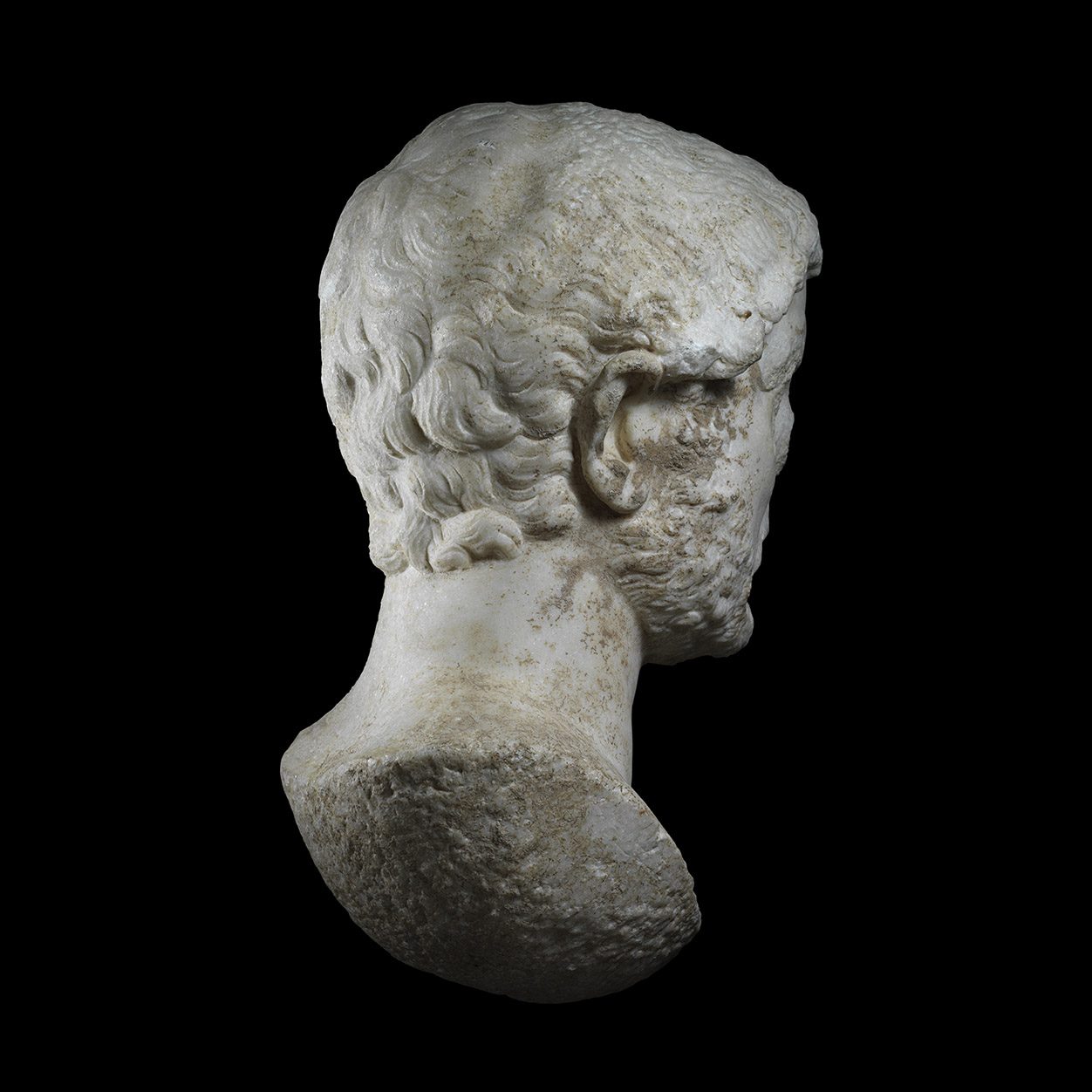
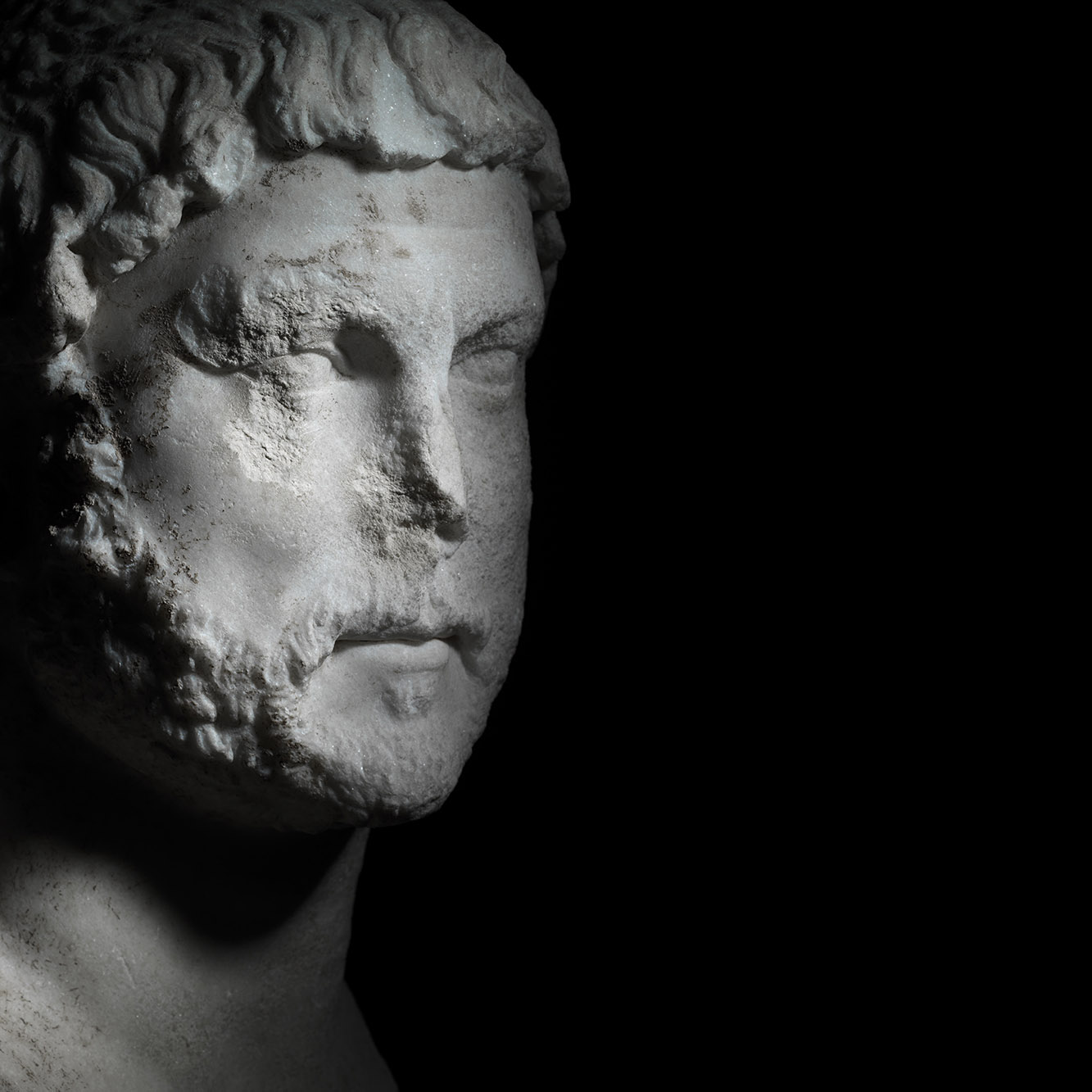
Twice the Life-Size Marble Portrait of Emperor Hadrian
HADRIANIC PERIOD, 126-140 A.D.
23 5/8 in. (56.4 kg total, 60 cm high including stand).
A characteristic portrait of the Emperor Hadrian, his hair arranged in wavy strands swept forward from the crown, ending in a row of lively curls that frame his forehead and temples; his narrow eyes slightly shaded by the pupils and by the sharply defined upper eyelids, giving him a thoughtful expression; thick beard composed of tight curls and covering his chin, extending high up the full cheeks; a gently waved moustache above his closed lips; thick neck with the preserved start of the right shoulder suggesting his head was turned slightly to the right, indicating that the portrait once belonged to a full-length statue or to a bust; mounted on a custom-made display stand.
ProvenanceSwiss art market, February 1988.
Private collection, Liechtenstein.
Acquired by the current owner in 2023 through a private transaction.
Accompanied by a copy of an Art Loss Register certificate no.S00122139.
Accompanied by an academic report by Dr Raffaele D'Amato.
This lot has been checked against the Interpol Database of stolen works of art and is accompanied by search certificate number no.12777-239295.
This lot has been cleared against the Art Loss Register database, and is accompanied by an illustrated lot declaration signed by the Head of the Antiquities Department, Dr Raffaele D'Amato.
Cf. Fittschen K., Zanker P., Katalog der römischen Porträts in den Capitolinischen Museen und den anderen kommunalen Sammlungen der Stadt Rom. Bd. I. Kaiser und Prinzenbildnisse, Mainz am Rhein, 1985, for comparable examples; La Regina, A., Rome, 1000 Ans de Civilisations, Montreal, 1992, p.124, no.177 (Museo Nazionale di Napoli, inv.no.6075); Johansen, F., Catalogue Roman Portraits II, Ny Carlsberg Glyptotek, Copenhagen, 1995, p.110, fig. 40; Opper, T., Hadrian: Empire and conflict, London, 2008, figs. 28 (bust from Italica), 35 (Baia), 124 (Tivoli), 154, 171 (Luku), 200 (Rome, Mausoleum of Hadrian); D’Amato, R., Negin, A., Decorated Roman Armour, from the Age of the Kings to the death of Justinian the Great, London, 2017, figs.103-104.
FootnotesBorn in AD 76, Publius Aelius Hadrianus became emperor in AD 117, following the death of his adoptive father, Trajan. Portrait heads of Hadrian, like the present example, were often made for statues that stood in temples or public buildings, either to honour the emperor before an official visit or to commemorate his presence afterward. This particular portrait is a striking depiction of Hadrian, showing him with balanced and compact facial features. His hair is arranged in wavy strands swept forward from the crown, ending in a row of lively curls that frame his forehead and temples. His narrow eyes are slightly shaded by the sharply defined upper eyelids, giving him a thoughtful expression. The thick beard is composed of tight curls and covers his chin, extending high up the cheeks, which remain full and show little sign of age. A gently waved moustache sits above his closed lips. His neck is thick, and the preserved start of the right shoulder suggests his head was turned slightly to the right, indicating that the portrait once belonged to a full-length statue. Hadrian is one of the most frequently depicted Roman emperors in surviving portraits, second only to Augustus. His long reign and extensive travels across the empire led many cities to erect statues in his honour, either in anticipation of his arrival or as a tribute after his departure. Unlike the expansionist emperors who came before him, Hadrian focused on strengthening and securing the empire. He travelled widely, visiting regions including Spain, Greece, Asia Minor and Egypt. Even though he ruled for over 20 years, Hadrian is almost always shown in the prime of middle age. He was the first emperor to wear a beard in his official portraiture, likely a reflection of his admiration for Greek culture. This choice marked a significant change in imperial image-making and became the norm for later emperors. His hair typically falls in soft waves, ending in neatly defined curls across the brow. Scholars have identified six major portrait types of Hadrian, distinguished by subtle differences in the way his hair is arranged.
CONDITIONTimeLine Auctions follows a vetting process to ensure the authenticity and legality of all items, reinforcing our commitment to integrity and responsible trading. Each antiquity, antique, and coin lot undergoes thorough examination by a vetting committee of at least ten external specialists, professional trade association members, scientists, and archaeologists: Our Vetting Process
AUCTIONS:
TimeLine is a leading auction house specialising in antiquities, ancient art, collectables, natural history, coins, medals, and books. Our auctions offer museums, collectors, historians, and enthusiasts the opportunity to acquire unique and historically significant pieces.
LOT 0128
Twice the Life-Size Marble Portrait of Emperor Hadrian
Sold for (Inc. bp): £104,000
-
.jpg)
Roman Silver-Gilt Brooch with Diana
1st-2nd century A.D.Estimate: £1,000 - 1,400 (+bp*)
Opening Bid: £500
Modelled in the half-round figure of Diana reaching behind her shoulder to draw an arrow, her left hand reaching towards a hound; catch and spring-plate to the reverse. 14.09 grams, 40 mm
Acquired in the late 1980s-early 1990s. Private collection, London, UK. This lot is accompanied by an illustrated lot declaration signed by the Head of the Antiquities Department, Dr Raffaele D'Amato. -
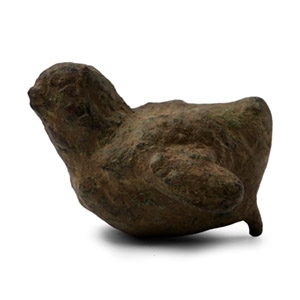
Roman Bronze Bird Figure
1st-4th century A.D.Sold for (Inc. bp): £98
Modelled in the round figure of a fledgling with bulbous body and short, stubby wings, head raised to accept food. 133 grams, 46 mm
Found Little Blakenham, Suffolk, UK. Accompanied by a copy of the British Museum's Portable Antiquities Scheme (PAS) report no.SF-4991D6. This lot is accompanied by an illustrated lot declaration signed by the Head of the Antiquities Department, Dr Raffaele D'Amato. -
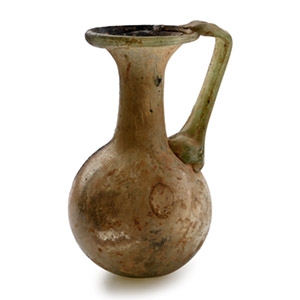
Roman Blown Glass Jug
2nd-4th century A.D.Estimate: £400 - 600 (‡+bp*)
Opening Bid: £200
Bulbous body and rounded underside, long neck, trumpet-shaped mouth with applied rim, applied strap handle with ribbing. 40 grams, 96 mm
Acquired in the 1992. Private collection, Switzerland, thence by descent. Private collection, since the late 1990s. This lot is accompanied by an illustrated lot declaration signed by the Head of the Antiquities Department, Dr Raffaele D'Amato.
