
Loading, please wait...
_900x900.jpg "Turkish Iron Dagger with Brass Hilt and Scabbard")
_200x200.jpg "Turkish Iron Dagger with Brass Hilt and Scabbard")
.jpg "Turkish Iron Dagger with Brass Hilt and Scabbard")
LOT 1811
Turkish Iron Dagger with Brass Hilt and Scabbard
MID 20TH CENTURY A.D.
9 1/8 in. (211 grams, 23.2 cm).
Two-edged jambiya with narrow curved blade, two deep fullers and punched detailing with inset turquoise-coloured pellet; brass bolster and applied bone panels to the grip, silver facing to pommel; brass sheath with low-relief foliage and figural ornament, suspension rings. [No Reserve]
ProvenancePreviously acquired on the UK art market in the early 2000s.
This item is for collection from our premises only.
TimeLine Auctions follows a vetting process to ensure the authenticity and legality of all items, reinforcing our commitment to integrity and responsible trading. Each antiquity, antique, and coin lot undergoes thorough examination by a vetting committee of at least ten external specialists, professional trade association members, scientists, and archaeologists: Our Vetting Process
AUCTIONS:
TimeLine is a leading auction house specialising in antiquities, ancient art, collectables, natural history, coins, medals, and books. Our auctions offer museums, collectors, historians, and enthusiasts the opportunity to acquire unique and historically significant pieces.
-
.jpg)
Viking Iron Sword Pommel, Upper Guard and Lower Guard
Later 10th century A.D.Sold for (Inc. bp): £910
Comprising: lower guard, lentoid in plan and slightly curved in profile with recessed underside, slot to accept the tang; upper guard, lentoid in plan with scooped long edges; pommel with large median lobe and lateral shoulders, Petersen's Type S. 520 grams total, 77-91 mm
London, UK, collection, formed in the late 1990s. -
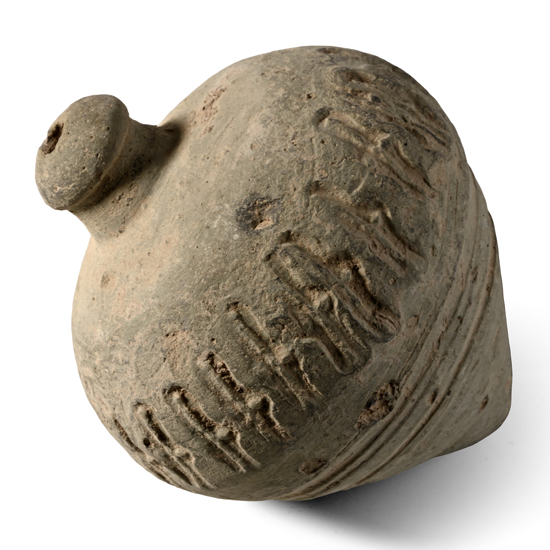
Byzantine 'Greek Fire' Ceramic Fire Bomb or Hand Grenade
9th-11th century A.D.Sold for (Inc. bp): £130
Piriform in profile with impressed motifs on the shoulder; intended to be filled with explosive liquid and a wick, and used as a hand grenade. 461 grams, 10.5 cm
From an important specialist collection, London, UK, 1990s. Accompanied by an academic paper by military specialist Dr Raffaele D'Amato, dated 15 July 2019 and titled 'Eastern Roman Empire - Greek Fire Bomb or Hand Grenade (μεσαίον kακάβιον) 9th-11th century AD'.
Apart from the use of siphons or manual flame-throwers called cheirosiphona, special corps of Roman soldiers employed terracotta grenades, in the form of small jars, abundantly evidenced in archaeological excavations. They were called μεσαία kακαβιά or κυτροκακάβια, where the former had a bulbous shape and the latter a more cylindrical form. -
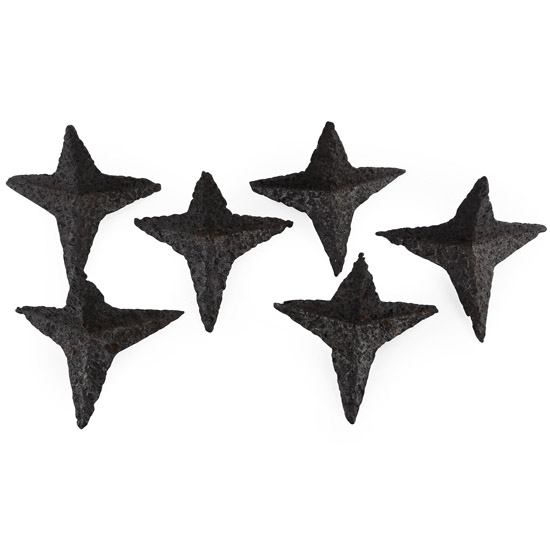
Medieval Iron Caltrop Anti-Cavalry Group
15th century A.D.Sold for (Inc. bp): £208
Comprising six caltrops, hand-forged with square-section spikes. 195 grams total, 85-87 mm
From the private collection of a London gentleman, from his grandfather's collection formed before the early 1970s.
P. Žákovský has been able to classify medieval caltrops, mainly from the 13th to 15th centuries A.D., based on their morphology, into four main typologies, each with different variants. Caltrops with single-pointed spikes, whose interpretation, however, is often ambiguous, belong to type I. The other three types represent classic four-pointed caltrops, and individual types in this group differ from one another just in their cross-section.
