
Loading, please wait...


LOT 1590
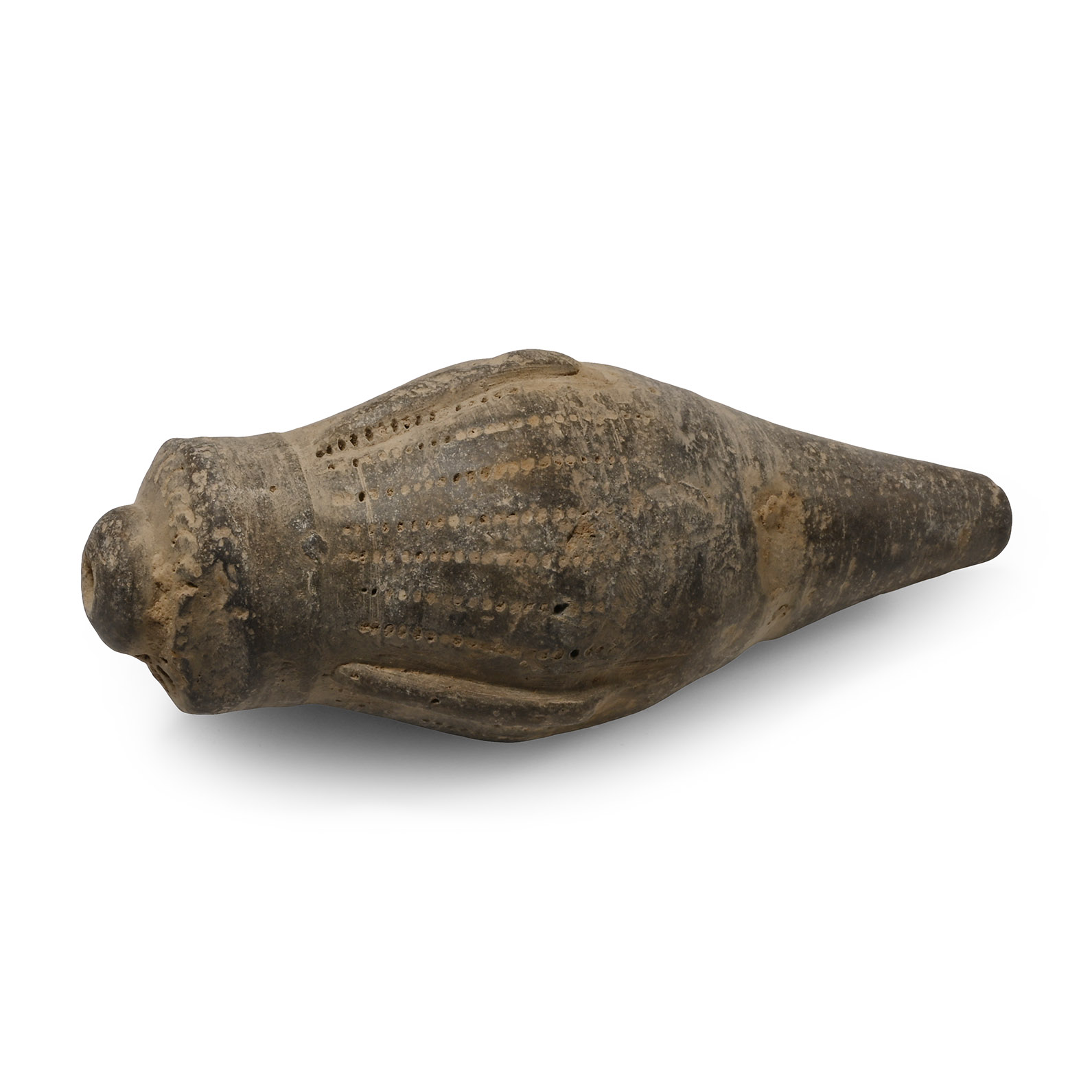
Turco-Mongol 'Greek Fire' Ceramic Fire Bomb or Hand Grenade
14TH-15TH CENTURY A.D.
6 1/4 in. (393 grams, 16 cm).
Cylindrical in form with tapering foot, vertical flanges to the body with pointillé decoration between, carinated shoulder with impressed points, domed mouth. [No Reserve]
ProvenanceFrom an important specialist collection, London, UK, 1990s onwards.
Accompanied by an academic paper by military specialist Dr Raffaele D'Amato, dated 15 July 2019 and titled 'Eastern Roman Empire - Greek Fire Bomb or Hand Grenade (μεσαίον kακάβιον) 9th-11th century AD'.
This lot is accompanied by an illustrated lot declaration signed by the Head of the Antiquities Department, Dr Raffaele D’Amato.
Cf. Arendt, W. I., Granaten des 13-14. Jahrhunderts, die an der Wolga gefunden sind, Zeitschrift fur Historische Waffen-und Kostumkunde, 11 (1926-8), p.42; cf. Arendt, W., Die Spharisch-konischen Gefäße aus Gebranntem Ton, ibid; cf. Ayalon, D., Gunpowder and Firearms in the Mamluk Kingdom, London, 1956, p.16. Apart from the use of siphons or manual flame-throwers called cheirosiphona, special corps of Roman soldiers employed terracotta grenades, in the form of small jars, abundantly evidenced in archaeological excavations. They were called μεσαία kακαβιά or κυτροκακάβια where the former had a bulbous shape and the latter a more cylindrical form.
CONDITIONTimeLine Auctions follows a vetting process to ensure the authenticity and legality of all items, reinforcing our commitment to integrity and responsible trading. Each antiquity, antique, and coin lot undergoes thorough examination by a vetting committee of at least ten external specialists, professional trade association members, scientists, and archaeologists: Our Vetting Process
AUCTIONS:
TimeLine is a leading auction house specialising in antiquities, ancient art, collectables, natural history, coins, medals, and books. Our auctions offer museums, collectors, historians, and enthusiasts the opportunity to acquire unique and historically significant pieces.
LOT 1590
Turco-Mongol 'Greek Fire' Ceramic Fire Bomb or Hand Grenade
Sold for (Inc. bp): £182
-
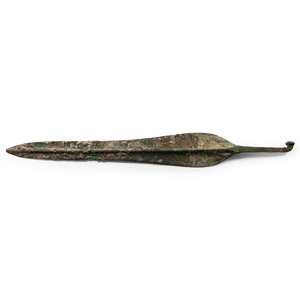
Luristan Bronze Spearhead
Early 2nd millennium B.C.Estimate: £100 - 140 (+bp*)
Opening Bid: £50
Having foliate blade with central rib and slender shoulders, short rectangular shaft and tang with a bent end. 412 grams, 42.5 cm
Acquired 1980-2015. Ex Abelita family collection. This lot is accompanied by an illustrated lot declaration signed by the Head of the Antiquities Department, Dr Raffaele D’Amato.
A number of similar blades, some considered to be spearheads and others to be daggers, all with bent tang, derived from Tepe Hissar Culture III. Some of them, like our specimen, have a button terminal, some others have a plain, pointed terminal. The general dating of these specimens is fixed to the early 2nd millennium B.C. -
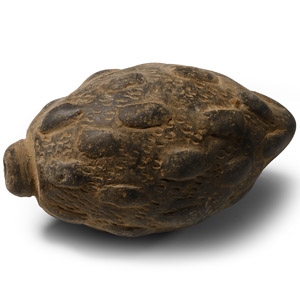
Byzantine 'Greek Fire' Ceramic Fire Bomb or Hand Grenade
9th-11th century A.D.Sold for (Inc. bp): £182
A piriform missile with raised bosses and hatching, intended to be filled with explosive liquid and wick, used as a hand grenade. 660 grams total, 15 cm
From an important specialist collection, London, UK, 1990s onwards. Accompanied by an academic paper by military specialist Dr Raffaele D'Amato, dated 15 July 2019 and titled 'Eastern Roman Empire - Greek Fire Bomb or Hand Grenade (μεσαίον kακάβιον) 9th-11th century AD'. This lot is accompanied by an illustrated lot declaration signed by the Head of the Antiquities Department, Dr Raffaele D’Amato. -
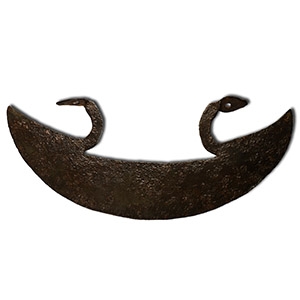
Ethiopian Coptic Iron Halberd
15th-17th century A.D.Sold for (Inc. bp): £364
Single-edged crescent-shaped blade equipped with two curved pins with holes for attachment to a wooden shaft. 308 grams, 23.2 cm
Ex USA private collection, 1970s-1990s. This lot is accompanied by an illustrated lot declaration signed by the Head of the Antiquities Department, Dr Raffaele D’Amato.
The blade belongs to the category of crock-backed blades, as classified by Flinders Petrie. More ancient fine Coptic examples are engraved with zigzag lines, a cross, fishes, and vine pattern. The iron halberd, viii, may be of some later date. The iconography of the medieval churches in Ethiopia suggest that these weapons were used as ceremonial halberds, and worn by guardsmen of rulers and bishops. A form similar to these halberds was used as a hoe in South Africa.
