
Loading, please wait...
LOT 1083
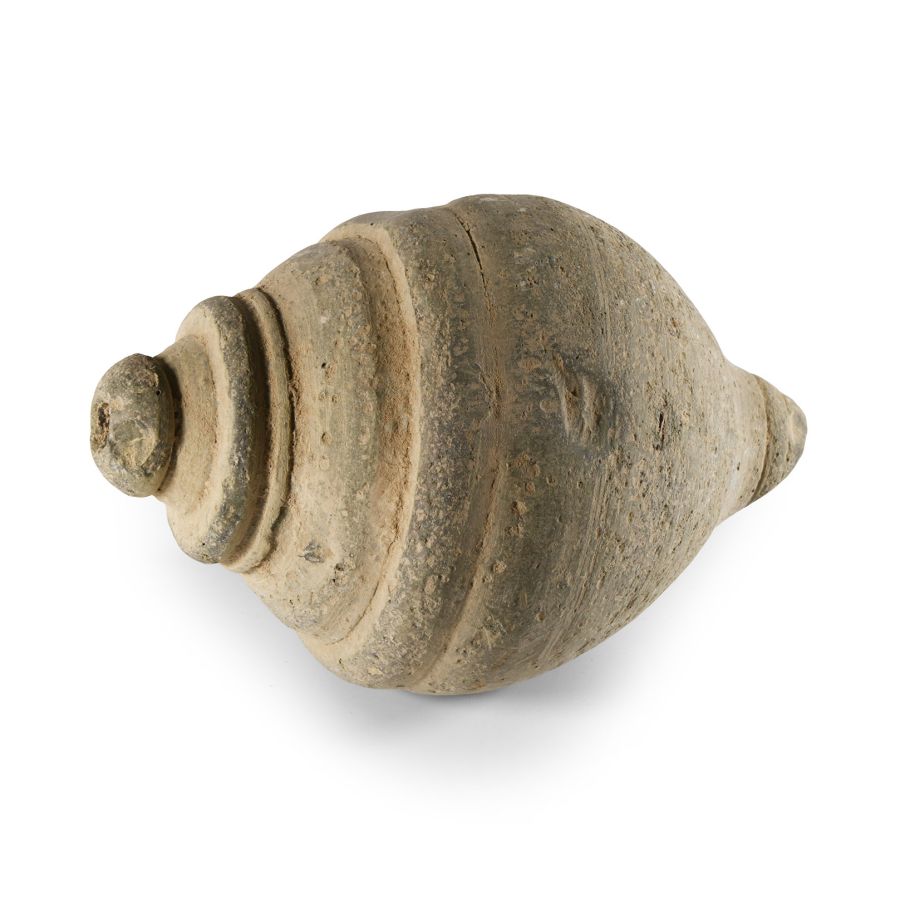
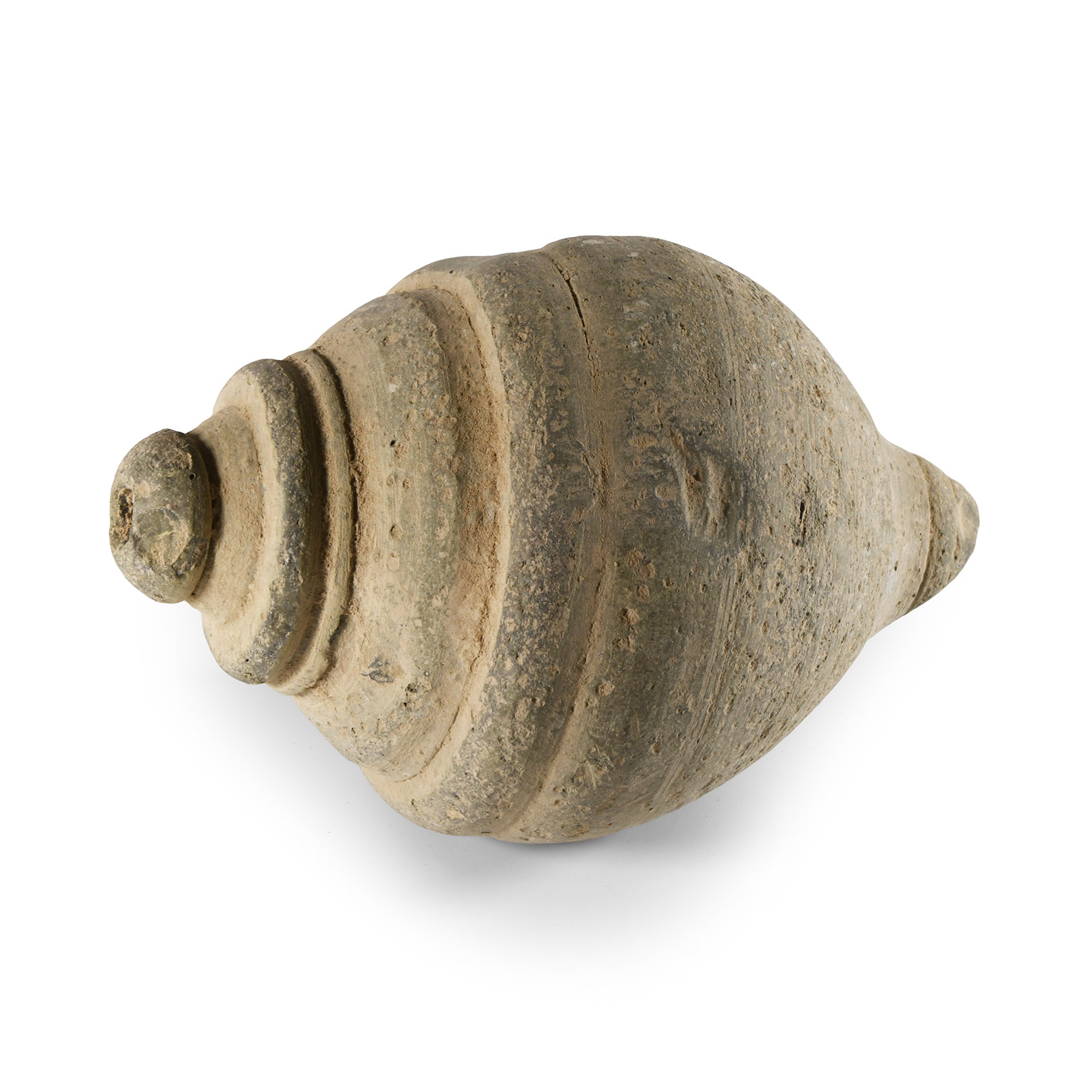
Turco-Mongol Ceramic Fire Bomb or Hand Grenade
14TH-15TH CENTURY A.D.
4 5/8 in. (409 grams, 11.7 cm).
Piriform body with domed filler-hole, raised horizontal flanges to the shoulders; intended to be filled with explosive liquid and wick, used as a hand grenade.
ProvenanceAcquired 1980-2015.
Ex Abelita family collection.
Accompanied by an academic paper by military specialist Dr Raffaele D'Amato, dated 15 July 2019 and titled 'Eastern Roman Empire - Greek Fire Bomb or Hand Grenade (μεσαίον kακάβιον) 9th-11th century AD'.
Cf. Arendt, W. I., Granaten des 13-14. Jahrhunderts, die an der Wolga gefunden sind, Zeitschrift fur Historische Waffen-und Kostumkunde, 11 (1926-8), p.42; cf. Arendt, W., Die Spharisch-konischen Gefasse aus Gebranntem Ton, ibid; cf. Ayalon, D., Gunpowder and Firearms in the Mamluk Kingdom, London, 1956, p.16. For this specific shape see Nicolle, D., Arms and Armour of the Crusading Era, 1050-1350 AD,volume II, London, 1999, fig.800b.
FootnotesThis piece was a sort of ceramic fire grenade, similar to the ones used by the Eastern Romans but of Turco-Mongol type. Apart from the use of manual flame-throwers, special corps of soldiers employed terracotta grenades, in the form of small jars, abundantly evidenced in archaeological excavations.
CONDITIONTimeLine Auctions follows a vetting process to ensure the authenticity and legality of all items, reinforcing our commitment to integrity and responsible trading. Each antiquity, antique, and coin lot undergoes thorough examination by a vetting committee of at least ten external specialists, professional trade association members, scientists, and archaeologists: Our Vetting Process
AUCTIONS:
TimeLine is a leading auction house specialising in antiquities, ancient art, collectables, natural history, coins, medals, and books. Our auctions offer museums, collectors, historians, and enthusiasts the opportunity to acquire unique and historically significant pieces.
-
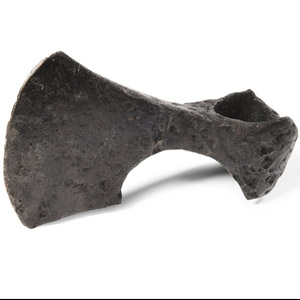
Viking Age Iron Bearded Axehead
9th century A.D.Sold for (Inc. bp): £338
Hand-forged with triangular-section narrow blade widening to a broad bevelled edge with square chin, socket with lateral flanges and rounded panel to the rear. 359 grams, 12.4 cm
From the private collection of a London gentleman, from his grandfather's collection formed before the early 1970s.
The axe seems to belong to the typology of Viking side axes of Wheeler type B (Wheeler III / Rygh 559). Usually these bearded axeheads (skeggöks) had a longer edge, designed to split tree trunks into planks and beams, or heads in two parts. Some of the bearded axes were known as halfÞynna öx, the neck on such 'half thin axe' was thinly forged, to make it lighter. -
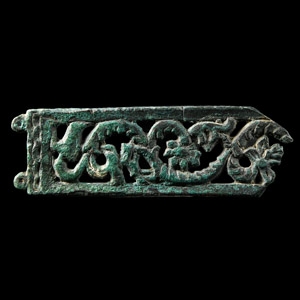
Eastern Roman Tinned Bronze Composite Belt Mount
8th century A.D.Estimate: £100 - 140 (‡+bp*)
Opening Bid: £50
Displaying openwork floriate decoration within a tongue-shaped frame; two pierced attachment lugs to the rear. 27.9 grams, 93 mm
From the collection of a North American gentleman, formed in the 1990s.
The belt is of composite type, decorated with scrollwork in Byzantine style. Many authors discuss the possibility that these belts were produced in the Eastern Roman capital or that they were made in the workshops of the Avar Khaganate, maybe with Roman matrices for producing sheet ornaments. -
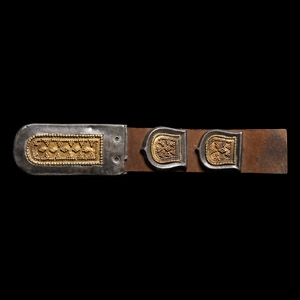
Avar-Byzantine Silver-Gilt Sword Belt Mount Group
7th-9th century A.D.Sold for (Inc. bp): £156
Comprising three belt mounts later remounted onto brown leather comprising: a rectangular strap end with rounded terminal, decorated with granulated borders, lozenges and chevrons; two roughly D-shaped mounts with apex flourish and waisted sides, also decorated with granulated lozenges and chevrons. 26.5 grams, 12.2 cm long
Fine condition.
Acquired in the 1980s-1990s. Ex an important central London gallery, London W1.
This type of belt element, decorated with granulation, is present in the Avar graves of the second half of the 7th century, and was most likely produced in the workshops of the Eastern Roman Empire, from where they reached the Avar lands as imperial gifts (tomb of Kunbàboni) or spoils of war. They were part of multiple belts, to which sabres and knives were attached, commonly used among Avars, Bulgars and Romans during the 7th and 8th centuries A.D.
