
Loading, please wait...
LOT 0351
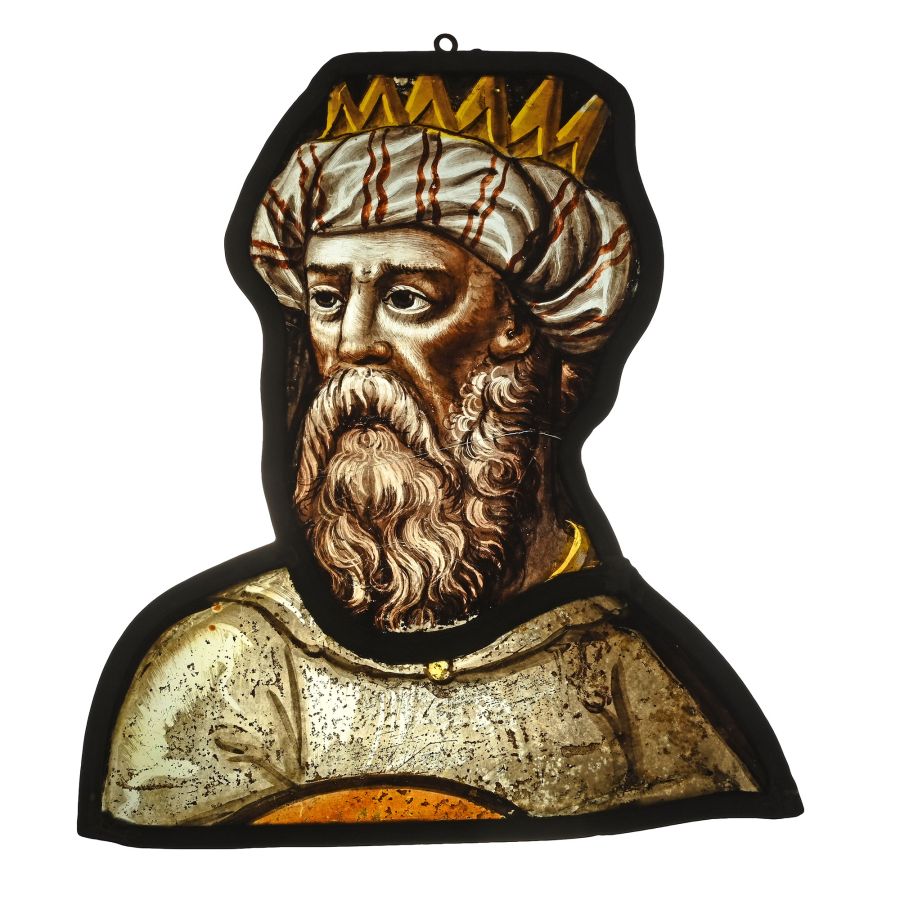
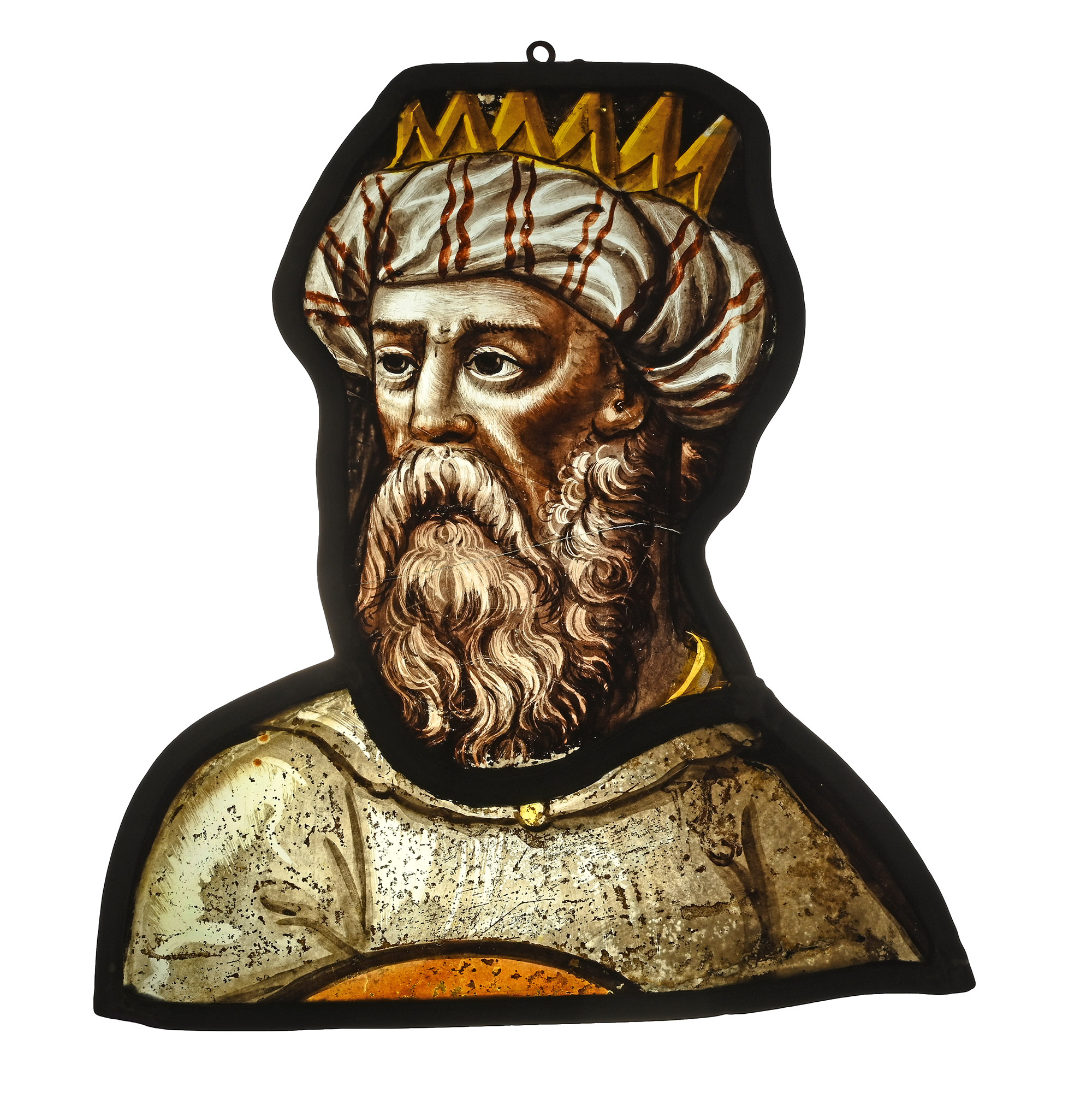
Tudor Period Stained Glass Panel with Head of Magus
FRANCE, CIRCA 1510 A.D.
8 1/2 in. (201 grams, 21.5 cm).
Two irregular panels joined in a lead frame, head of a Magus from the Nativity story; bearded with gold crown above the turban. [No Reserve]
ProvenanceEuropean collection, 19th century, by descent.
with Christie's, London, 15 December 1998, no.70.
This lot has been checked against the Interpol Database of stolen works of art and is accompanied by a search certificate number no.12549-230643.
This lot has been cleared against the Art Loss Register database, and is accompanied by an illustrated lot declaration signed by the Head of the Antiquities Department, Dr Raffaele D’Amato.
Exhibited at the Harwich Museum, Harwich, Essex, UK, 21st January-10th March 2025; accompanied by a copy of a photograph of the artefacts on display.
CONDITIONTimeLine Auctions follows a vetting process to ensure the authenticity and legality of all items, reinforcing our commitment to integrity and responsible trading. Each antiquity, antique, and coin lot undergoes thorough examination by a vetting committee of at least ten external specialists, professional trade association members, scientists, and archaeologists: Our Vetting Process
AUCTIONS:
TimeLine is a leading auction house specialising in antiquities, ancient art, collectables, natural history, coins, medals, and books. Our auctions offer museums, collectors, historians, and enthusiasts the opportunity to acquire unique and historically significant pieces.
-
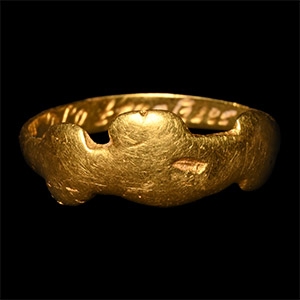
'The Burstow' Clasped Hands 'No Treasure to a True Friend' Gold Posy Ring
1650-1780 A.D.Sold for (Inc. bp): £624
The bezel with a clasped hands motif with a heart at the centre and elaborate cuffs, narrow D-section hoop; inscribed to the inner face 'No treasure to a true friend' with a long S, worn maker's mark at the end of the inscription, appearing to have the letters 'IV' or IW' in Roman capitals within a simple escutcheon. 2.26 grams, 18.54 mm overall, 16.40 mm internal diameter (approximate size British L, USA 5 3/4, Europe 11.24, Japan 10)
Found near Burstow, Tanbridge, Surrey, UK, on Monday 1st May 2023; disclaimed with treasure reference 2023 T419. Accompanied by a copy of the British Museum's Portable Antiquities Scheme report no.SUR-OAA74B. This lot is accompanied by an illustrated lot declaration signed by the Head of the Antiquities Department, Dr Raffaele D’Amato.
If the maker's mark is 'IV' it may correspond to John Vickerman, a goldsmith active in London from 1768 to 1773. Alternatively, if the maker's mark is 'IW' it may correspond to a number of makers: John Williamson, 1650; John Ward, 1660; James Wilkes, 1722; or John White, 1724. -
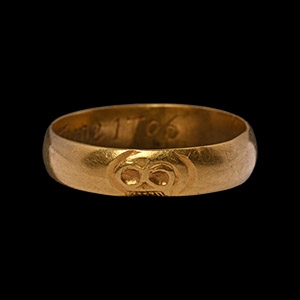
Queen Anne Engraved Gold Memento Mori Skull Ring
Dated 1706 A.D.Sold for (Inc. bp): £1,300
With stylised skull to the outer face, engraved to the inner face 'E. Judd ob. 6 June 1706 and maker's mark 'ID' for Josiah Daniel, London goldsmith of the early 18th century. 4.30 grams, 20.77 mm overall, 18.03 mm internal diameter (approximate size British P 1/2, USA 7 3/4, Europe 16.86, Japan 16)
Acquired on the UK art market. Property of an East Sussex collector. This lot is accompanied by an illustrated lot declaration signed by the Head of the Antiquities Department, Dr Raffaele D’Amato. -
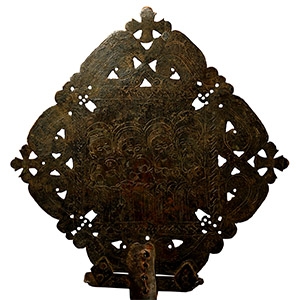
Ethiopian Engraved Bronze Cross with Figures of the Holy Fathers
Circa 1450-1480 A.D.Sold for (Inc. bp): £2,080
A bifacial Yämäṩor Mäsqäl processional cross finial comprising an openwork flat-section panel surmounted by a cross, with interlaced tendril design engraved with four seated saints on both faces in low-relief; tapering tubular socket with circumferential ribbing, lateral angled crosses. 404 grams, 30.5 cm
Ex central London gallery. This lot is accompanied by an illustrated lot declaration signed by the Head of the Antiquities Department, Dr Raffaele D’Amato.
In contrast with the hand cross that is fitted with a grip, the processional cross has a hollow shaft into which the pole supporting the cross is inserted, although the use of both is interconnected in the liturgy and ceremonial aspects of the Ethiopian Orthodox Church. In Amharic, it received the name of yämäṩor mäsqäl or "cross to [carry] on a pole", the term mäṩor also meaning a wooden handle. Processional crosses are used on "every qaddase day" occasions - an expression meaning whenever the liturgy is performed. This includes displaying the cross during the reading of the Gospels and other sacred texts, as well as holding it up to be viewed at the end of the service for the final blessing.
