Loading, please wait...

Use mousewheel to zoom in and out, click to enlarge

Details

LOT 2114

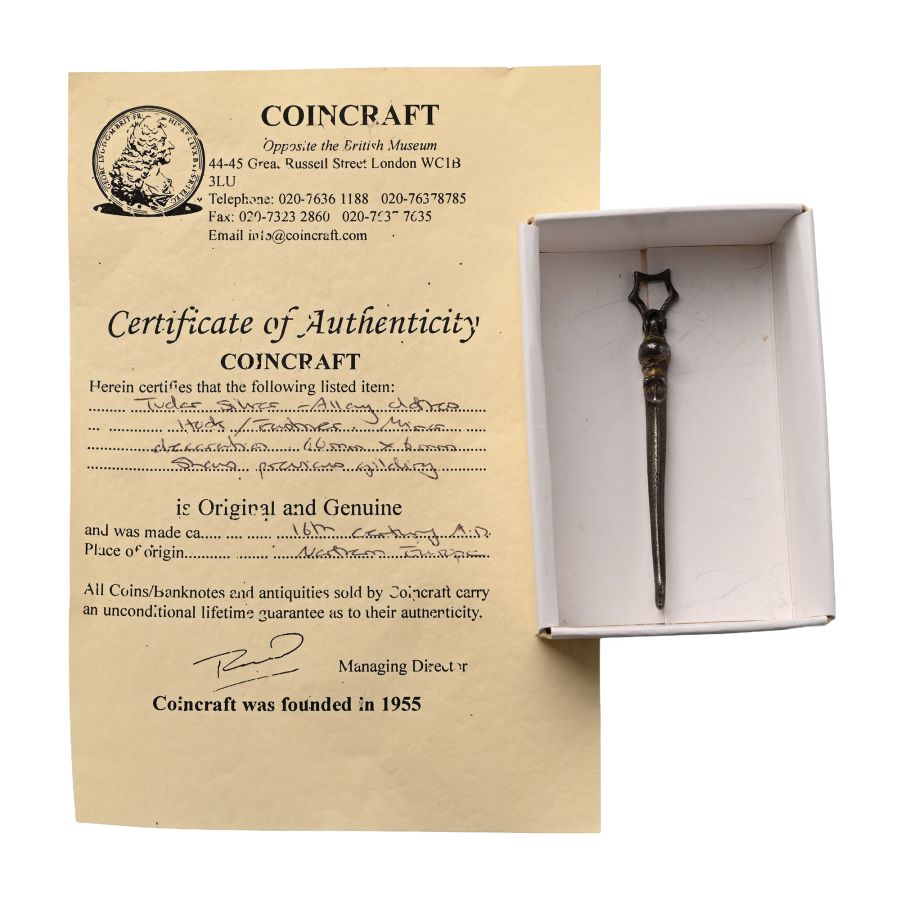
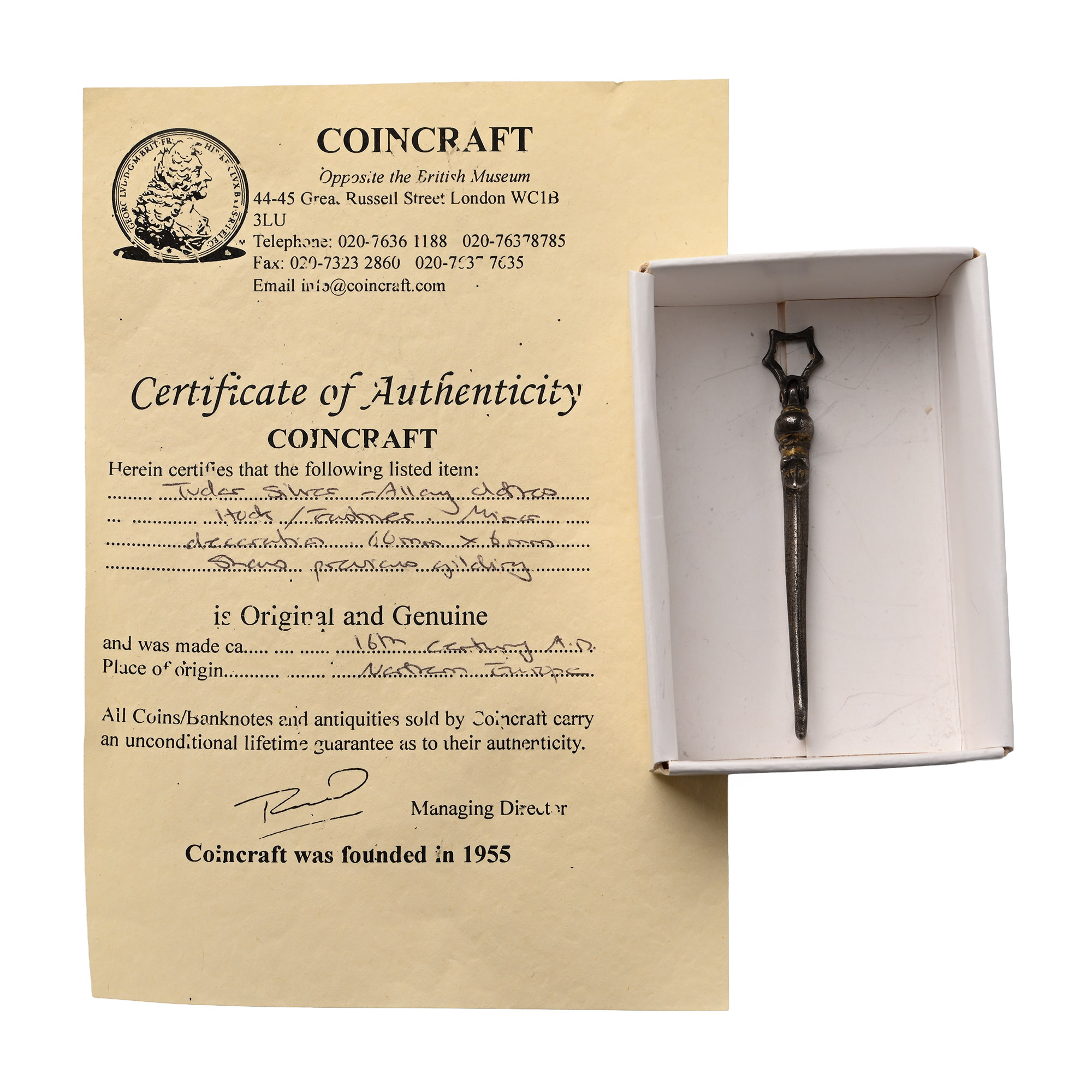
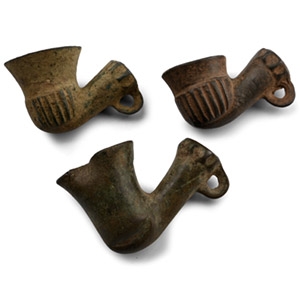
Tudor Period Silver-Gilt Hook Fastener

16TH CENTURY A.D.

2 5/8 in. (5.16 grams, 67 mm).

D-shaped in section with hook finial, bulb and hinge with openwork hexagonal hoop. [No Reserve]

Provenance

From Northern Europe.
Acquired from Coincraft, London, UK.
From the private collection of Kenneth Machin (1936-2020), Buckinghamshire, UK; his collection of antiquities and natural history was formed since 1948; thence by descent.

Accompanied by a Coincraft certificate of authenticity.
This lot is accompanied by an illustrated lot declaration signed by the Head of the Antiquities Department, Dr Raffaele D'Amato.

CONDITION

VETTING:

TimeLine Auctions follows a vetting process to ensure the authenticity and legality of all items, reinforcing our commitment to integrity and responsible trading. Each antiquity, antique, and coin lot undergoes thorough examination by a vetting committee of at least ten external specialists, professional trade association members, scientists, and archaeologists: Our Vetting Process


AUCTIONS:

TimeLine is a leading auction house specialising in antiquities, ancient art, collectables, natural history, coins, medals, and books. Our auctions offer museums, collectors, historians, and enthusiasts the opportunity to acquire unique and historically significant pieces.

LOT 2114

Tudor Period Silver-Gilt Hook Fastener

Sold for (Inc. bp): £26

Print page

RELATED LOTS

  • Bronze Grand Tour Statue of Augustus of Prima Porta
    Bronze Grand Tour Statue of Augustus of Prima Porta
    Italy, circa 1870 A.D.

    Sold for (Inc. bp): £1,300

    Replica of marble statue of Augustus discovered in 1863 in Prima Porta, depicted in advancing pose wearing a military cuirass with mythological scenes, toga draped from the waist over the left arm, barefoot with statuette of Cupid seated on a dolphin beside his right leg; mounted on a custom-made tiered stand. 6.45 kg total, 40.8 cm high including stand


    From the private collection of a S.W. London gentleman, acquired in the 1970s. This lot is accompanied by an illustrated lot declaration signed by the Head of the Antiquities Department, Dr Raffaele D'Amato.

    An elegant 19th century detailed replica of the marble statue of Augustus discovered in 1863 during archaeological excavations at the Villa Livia owned by Augustus's wife, Livia Drusilla, at Prima Porta on the Via Flaminia, 12km north of Rome. The original full-length statue portrays an idealised image of Augustus in the role of imperator, commander of military forces, in contrapposto stance derived from Greek athletic statues of the 5th century BC. This statue represents Augustus in the act of adlocutio, addressing his troops, also seen on the reverse of the dupondii of Germanicus (RIC Gaius 57). Augustus is represented as a great general, a powerful orator, eternally youthful, with the body of a Greek athlete, with a support statuette of Cupid seated on a dolphin alluding to his divine ancestry from Venus through his formal adoption by Julius Caesar. The main element of the statue is the highly decorated cuirass with sphinx-decorated shoulder straps and paludamentum covered with figures arranged in three sections: Caelus, or sky-god at the apex; below him the sun-god Sol in his four-horse chariot and Aurora riding on the back of a female celestial personification; central section with figures of Hispania on the extreme left and another captive female, possibly Gallia, to the right; beneath, Apollo with lyre riding on a winged griffin and Diana on the back of a stag, with Tellus (Mother Earth) cradling two babies below, all framing the most important figures of the cuirass: on the right a Parthian military warrior (identified as Phraates IV) holding a Roman standard towards a helmeted and cuirassed Roman soldier accompanied by a she-wolf or dog (identified as Augustus-Aeneas, Tiberius, Mars or the personification of exercitus Romanus, the Roman army, an allusion to the return of the Roman standards in 20 BC, captured by the Parthians from the Roman general Marcus Licinius Crassus after his ignominious defeat at Carrhae in 53 BC. The statue thus commemorates Augustus’s victory over Parthia. Augustus made much of this, the first significant victory after Actium in 31 BC. Historical sources state that Phraates IV restored the standards to Augustus in 20 BC, although Suetonius reports that it was Tiberius who served as the intermediary for the transfer (Tiberius 9.1).

    Lot Details

  • Bronze Grand Tour Egyptian Sphinx
    Bronze Grand Tour Egyptian Sphinx
    Italy, late 19th century A.D.

    Sold for (Inc. bp): £338

    Hollow-formed miniature of a sphinx couchant with forelegs extended, wearing the nemes crown and with tasseled braid placed along the spine; mounted on a wooden display stand. 1.44 kg total, 25 wide including stand


    From the private collection of a S.W. London gentleman, acquired in the 1970s. This lot is accompanied by an illustrated lot declaration signed by the Head of the Antiquities Department, Dr Raffaele D'Amato.

    The most celebrated Sphinx in Egyptian mythology is the monument built near the pyramids as a protective symbol, to wish the pharaoh a peaceful afterlife. It has a leonine body and a human head. The Sphinx could be shown as male or female, depending on the pharaoh or queen it had to protect. The inclusion of sphinxes in temple complexes became a tradition lasting into the Roman period and Late Antiquity. Many pharaohs had their heads carved atop the guardian statues of their tombs, in part to show their close relationship with the powerful solar deity Sekhmet, a lioness. This cast bronze sphinx is a fine example of neoclassical sculptural art under the influence of Egyptomania and the renewed interest in the culture of ancient Egypt sparked by Napoleon’s Egyptian Campaign from 1798. At a time when only few could afford a trip to Egypt during the peak of Egyptomania contact could be made with Egyptian culture through literature, architecture and art. Particularly influential were Vivant Denon’s Voyage dans la Basse et la Haute Égypte, the Institute of Egypt's Description de l'Égypte, Robert Adams's interior decoration, Verdi’s Aida and the pedestal sphinxes protecting the obelisk of Tuthmosis III (Cleopatra's Needle).

    Lot Details

  • Medieval Stained Glass Panel with Two Hands Playing a Vihuela
    Medieval Stained Glass Panel with Two Hands Playing a Vihuela
    Northern France, circa 1520 A.D.

    Sold for (Inc. bp): £338

    Irregular panel with a pair of youthful hands playing a vihuela (?) with four strings. 66 grams, 25 cm


    Ex Galerie de Chartres, 8 March 2009, no.93. Ex central London gallery. This lot is accompanied by an illustrated lot declaration signed by the Head of the Antiquities Department, Dr Raffaele D'Amato.

    Lot Details

Stay up-to-date with the latest from TimeLine Auctions by joining our mailing list