
Loading, please wait...
LOT 1437
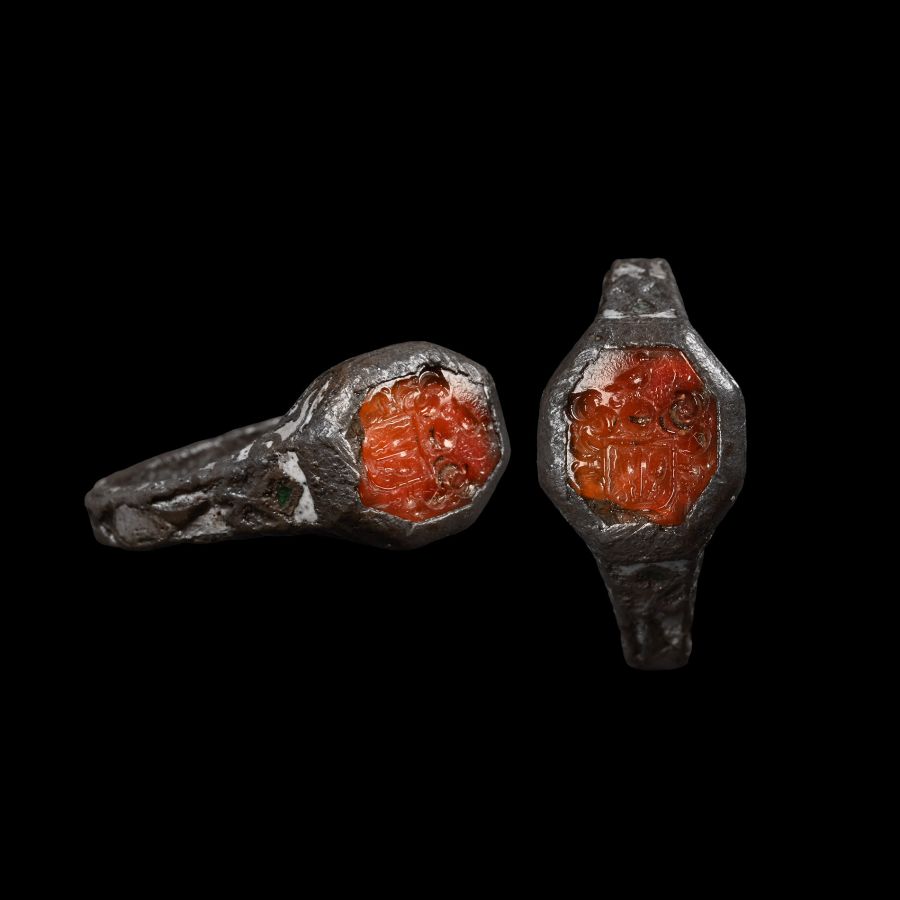
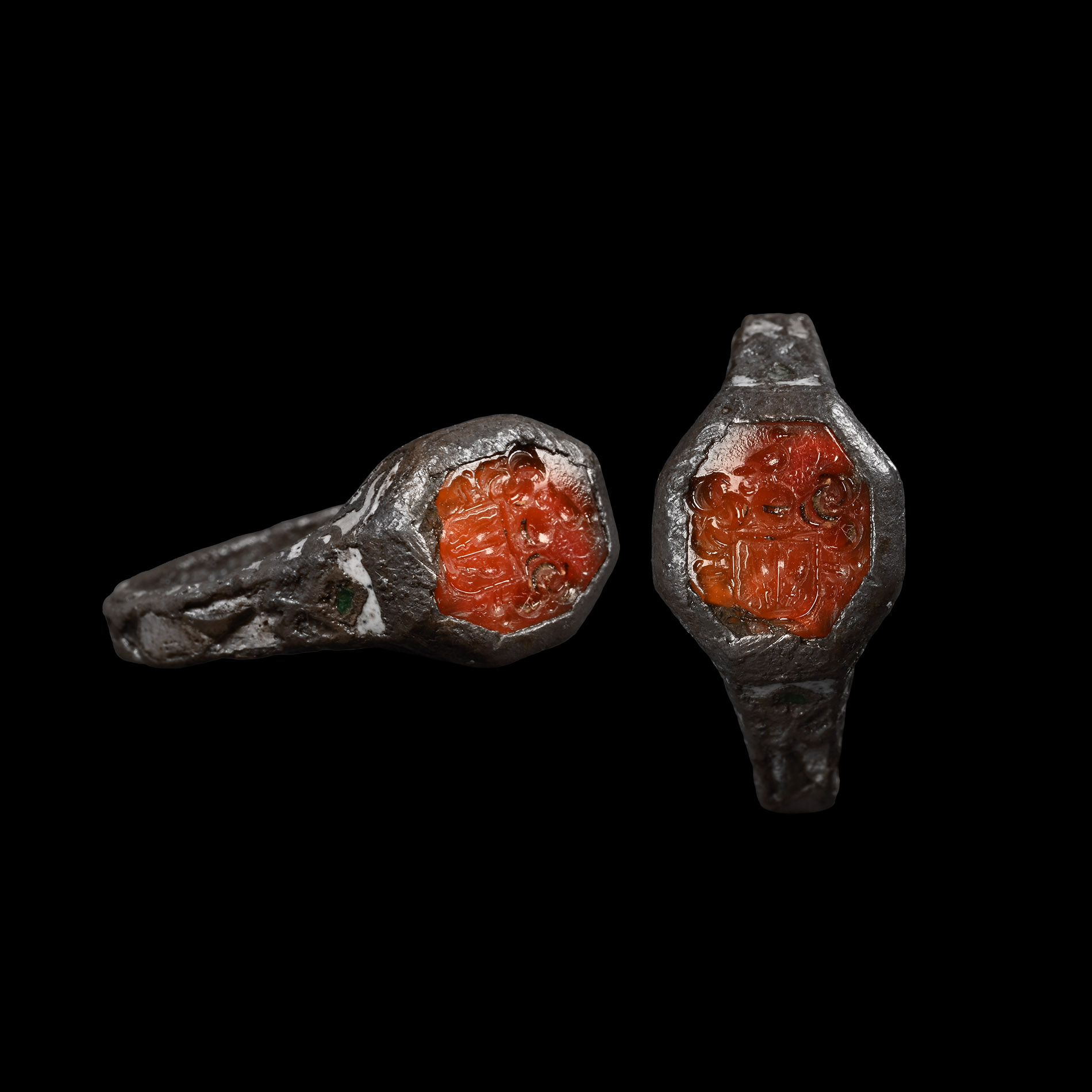
Tudor Period Ring with Armorial Gemstone
CIRCA 16TH-17TH CENTURY A.D.
1 in. (6.87 grams, 26.26 mm overall, 19.02 mm internal diameter (approximate size British P, USA 7 1/2, Europe 16.23, Japan 15)).
A copper-alloy ring composed of a slightly misshapen rectangular-section hoop and octagonal bezel set with a polished carnelian intaglio, engraved with an armorial design composed of a shield surmounted by a helm and bird facing right; remains of polychrome enamelled cells of foliate and geometric forms. [No Reserve]
ProvenanceFound Cambridgeshire in the 1990s.
CONDITIONTimeLine Auctions follows a vetting process to ensure the authenticity and legality of all items, reinforcing our commitment to integrity and responsible trading. Each antiquity, antique, and coin lot undergoes thorough examination by a vetting committee of at least ten external specialists, professional trade association members, scientists, and archaeologists: Our Vetting Process
AUCTIONS:
TimeLine is a leading auction house specialising in antiquities, ancient art, collectables, natural history, coins, medals, and books. Our auctions offer museums, collectors, historians, and enthusiasts the opportunity to acquire unique and historically significant pieces.
-
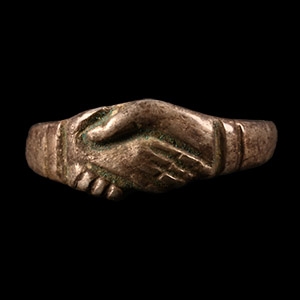
Post Medieval Silver Fede Ring with Clasped Hands
Circa 17th century A.D.Sold for (Inc. bp): £156
A silver mani in fede ring featuring an expanded bezel designed as crudely engraved clasped hands with collared sleeves. 2.84 grams, 21.63 mm overall, 18.93 mm internal diameter (approximate size British R, USA 8 1/2, Europe 18 3/4, Japan 18)
Acquired in the late 1990s-2000. Property of an East London gentleman.
The 'hands clasped in faith' imagery represents the hands of the couple joined in marriage in this and earlier periods. -
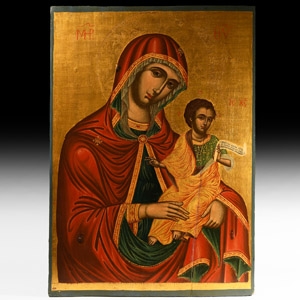
Large Veneto-Cretan Icon of Virgin and Child
17th century A.D. or laterEstimate: £5,000 - 7,000 (+bp*)
Opening Bid: £2,250
A large icon depicting the Virgin holding the Christ on her lap on a gilt background, both nimbate, the haloes with punched foliate decoration; the Virgin wearing a carmine red maphorion embellished with golden embroidery and fringes, elaborate cuffs and neckline to the himation; the Christ seated on the lap, holding his right arm out and making the blessing sign with his hand, left hand holding an open scroll inscribed in Greek πνευμα κυριου επ εμε ου ενεκεν εχρισεν με ευαγγελιζεσθαι πτωχοις απεσταλκεν με for 'The Spirit of the Lord is on me, because he has anointed me to proclaim good news to the poor' (Luke 4:18-21), the green chiton and orange himation embellished with red folds; Greek inscription 'ΜΡ ΘΥ' for 'Mother of God' flanking the Virgin's halo, 'IC XC' for 'Jesus Christ' to the right of the Child and inside his nimbus 'O Ѿ N' for 'The Only One who always exists'; some restoration. 4.3 kg, 60 x 42.5 cm
very good condition; tempera on wood panel; vertical crack minimally restored.
Property of a London lady, part of her family's collection. Accompanied by an academic report by Dr Raffaele D’Amato. This lot has been checked against the Interpol Database of stolen works of art and is accompanied by searcher certificate no.11572-198599.
In the Orthodox church, the spaces between the columns close to the central doors of the Iconostasis (Holy Doors) are occupied by two proskynesis icons, representing Christ giving his blessings to the right and to the left the Virgin Mary, with or without the infant, or in interceding position known as Virgin Chalkoprateia type. -
.jpg)
Tortoise and Lion Amulet Group
20th century A.D.Sold for (Inc. bp): £10
A black jasper figurine depicting a tortoise with domed shell, plate detailing to the back and underneath, small erect head; offered with a green stone cat amulet, pierced longitudinally. 60 grams total, 32-51 mm
Fine condition.
Acquired on the London art market before 1999. Ex property of a West London gentleman.
