Loading, please wait...
LOT 2134
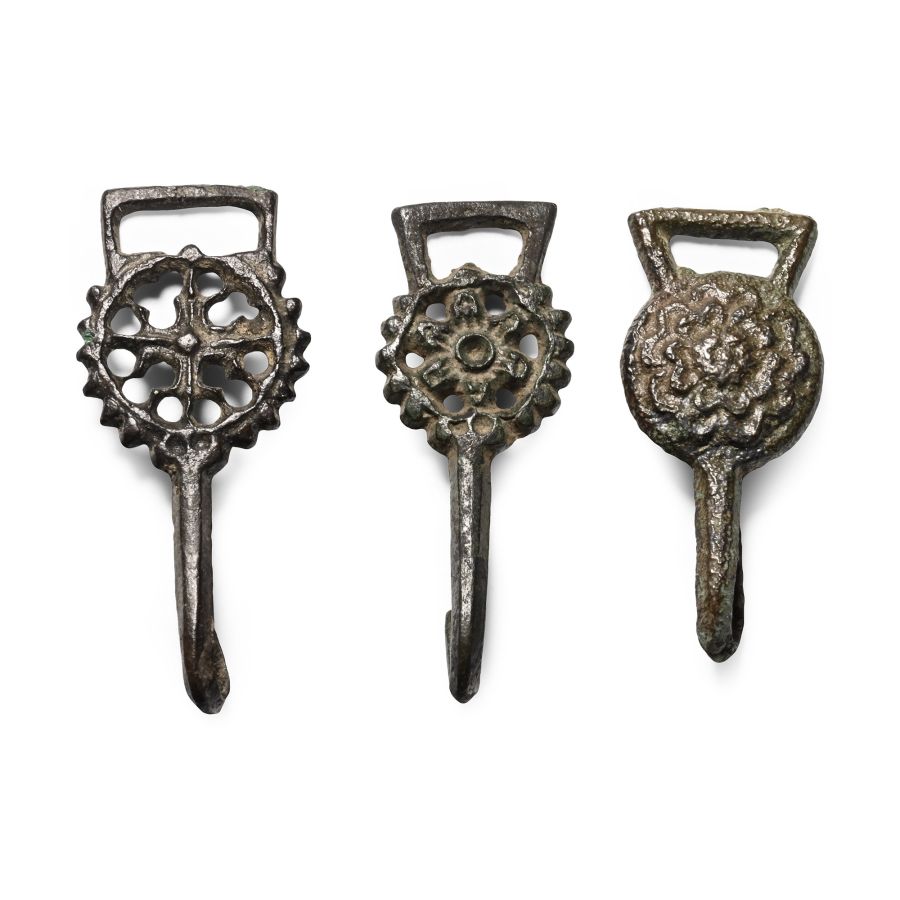
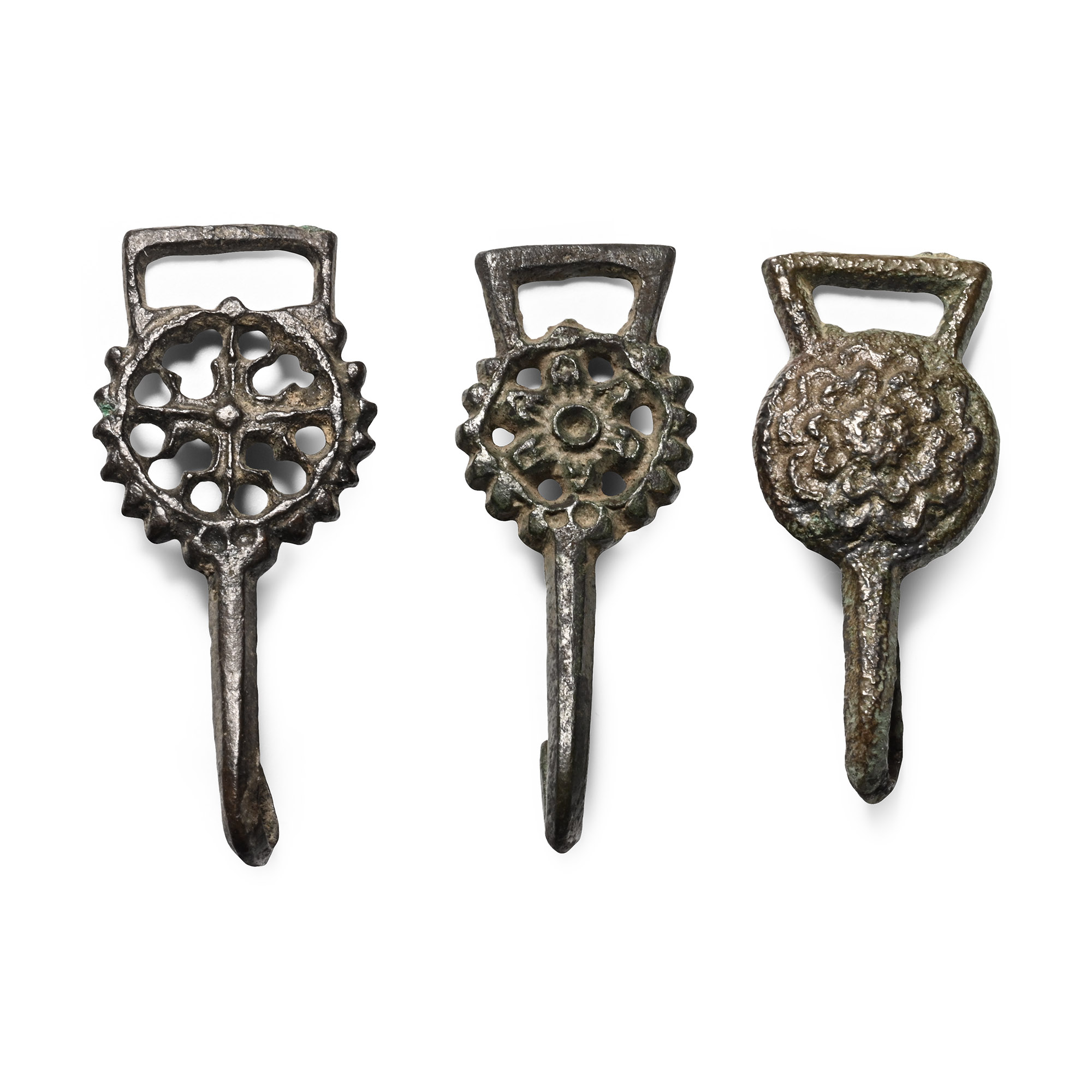
Tudor Period Bronze Hook Fastener Group
CIRCA 16TH CENTURY A.D.
1 3/8 - 1 1/2 in. (7.52 grams total, 34-39 mm).
Comprising: an openwork fastener with a cross motif; a fastener with a Tudor rose; an openwork fastener with a six-petalled flower. [3, No Reserve]
ProvenanceFrom the private collection of Graham Slater (1927-2024), Cambridge, UK; formed 1980s-1990s.
CONDITIONTimeLine Auctions follows a vetting process to ensure the authenticity and legality of all items, reinforcing our commitment to integrity and responsible trading. Each antiquity, antique, and coin lot undergoes thorough examination by a vetting committee of at least ten external specialists, professional trade association members, scientists, and archaeologists: Our Vetting Process
AUCTIONS:
TimeLine is a leading auction house specialising in antiquities, ancient art, collectables, natural history, coins, medals, and books. Our auctions offer museums, collectors, historians, and enthusiasts the opportunity to acquire unique and historically significant pieces.
LOT 2134
Tudor Period Bronze Hook Fastener Group
Estimate £20 - 30€23 - 35 (for guidance only)$27 - 41 (for guidance only)
Opening Bid
£5 (EUR 6; USD 7) +BP*
-
Romano-Egyptian Style Fayum Portrait of a Woman
20th century A.D.Estimate: £400 - 600 (‡+bp*)
Opening Bid: £5
Portrait of a young woman, her head turned slightly to the right, with an oval face, thin almond-shaped eyes, and a large mouth with full lips; her curly hair arranged above her forehead in a series of rich curls; her clothing consisting of a pink tunic visible at the neck and shoulders; encaustic on wood. 1.73 kg total, 47 x 33.8 cm including frame
Condition In good condition, the painted board has been mounted on to a piece of wood in recent history. The surface has a dirt overlay that is expected with age. Minor losses, affecting the top edge and and left proper edge. Minor losses throughout and one vertical crack runs the length of the wood grain.
Private collection of Dr Fred Olsen (1891-1986) and Mrs Florence Ellen Olsen (née Quittenton, d.1996), Guilford, Connecticut, by at least 1961. Exhibited at 'Coptic Art', The Minneapolis Institute of Art, Minneapolis, Minnesota, 5 December 1961-7 January 1962, no.L-380-2, loan number L61.711.
Fayum portraits, painted on wood or linen, applied to the mummies of the Graeco-Roman period, are one of the most wonderful legacies that the koiné of the Graeco-Roman world has left us. Due to the favourable climate enhancing the state of preservation, these encaustic paintings have left us an almost photographic testimony of the faces of the inhabitants of Roman Egypt. -
Georgian Gold Ring with Renaissance Cameo of a Muse
16th-18th century A.D.Estimate: £3,000 - 4,000 (+bp*)
Opening Bid: £1,500
Comprising a D-section hoop and a large fluted bezel set with a cameo depicting a female profile bust, her hair pulled to a chignon at the nape of her neck, with two loose strands elegantly resting on her shoulder. 11.70 grams, 27.74 mm overall, 18.38 mm internal diameter (approximate size British P, USA 7 1/2, Europe 16.23, Japan 15)
Acquired on the European art market. This lot has been checked against the Interpol Database of stolen works of art and is accompanied by search certificate number no.13319-257965.
This refined bust captures the timeless elegance of ancient iconography: delicate profile turned to the left, hair held by a chignon and diadem allowing the locks to escape and forming braids. The cameo is Italian and dates to the 16th century, the ring is 18th century. -
Marble Fountain Sculpture of a Putto Wrestling a Fish
Baroque, 17th century A.D.Estimate: £4,000 - 6,000 (‡+bp*)
Bids: 1 | Current Bid: £5
Standing on an angular base resting his left knee on the open jaws of a fish, his left arm holding the jaws open, the body and tail held upright be the raised right hand (partly absent); with heavy sulphured patina. 20.75 kg, 48 cm
Acquired prior to 1970. From the estate of a Swiss gentleman, Ticino. Private collection, Zurich, Switzerland. This lot has been checked against the Interpol Database of stolen works of art and is accompanied by a search certificate number no.12790-240308.
In ancient Roman art and architecture, fountains were often decorated with sculptures of young boys or putti holding fish. These sculptures were known as 'putti with fish' or 'boy with fish' and were a popular motif in the decoration of fountains. The young boy or putto was shown holding a fish or a shell, which would spout water into the fountain basin below. The fish was a particularly popular motif because it symbolised abundance, fertility, and prosperity, which were all important values in ancient Roman society. Overall, the putti with fish sculptures are a notable example of the art and architecture of ancient Rome and have continued to be an enduring symbol of beauty, abundance, and prosperity throughout the centuries. Archaeological excavations in Pompeii have revealed many examples of sculptures of putti with fish. The putti with fish sculptures from Pompeii were usually made of bronze, marble, or terracotta. They were often placed in the centre of the fountain, surrounded by other decorative elements such as flowers, plants, and other sculptures. Many of these putti with fish sculptures are now on display in the National Archaeological Museum of Naples. The museum also houses a famous mosaic of a putto with a fish, which was discovered in the House of the Faun in Pompeii. The putti with fish sculptures from Pompeii and those in the Naples Museum provide valuable insights into the art and culture of ancient Rome. They demonstrate the importance of beauty and abundance in ancient Roman society and offer a glimpse into the everyday life of the people who lived in Pompeii over two thousand years ago. In the 17th and 18th centuries these sculptures were imitated and used to decorate the fountains of royal palaces and palaces.