
Loading, please wait...
LOT 1459
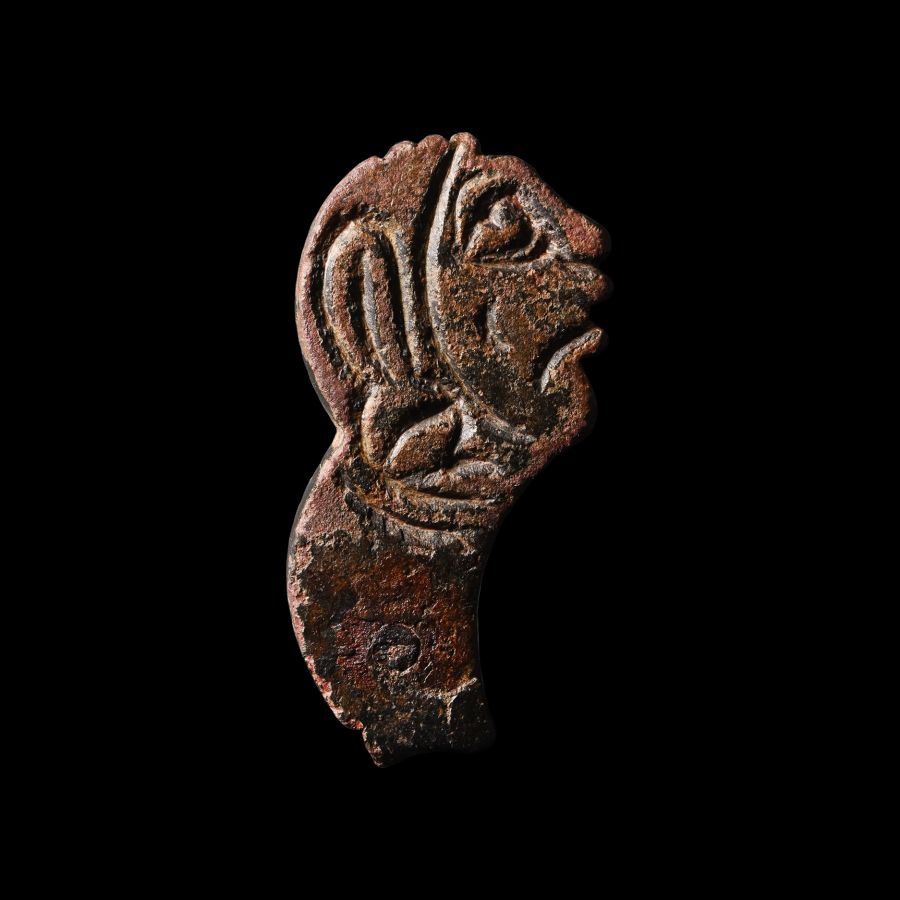
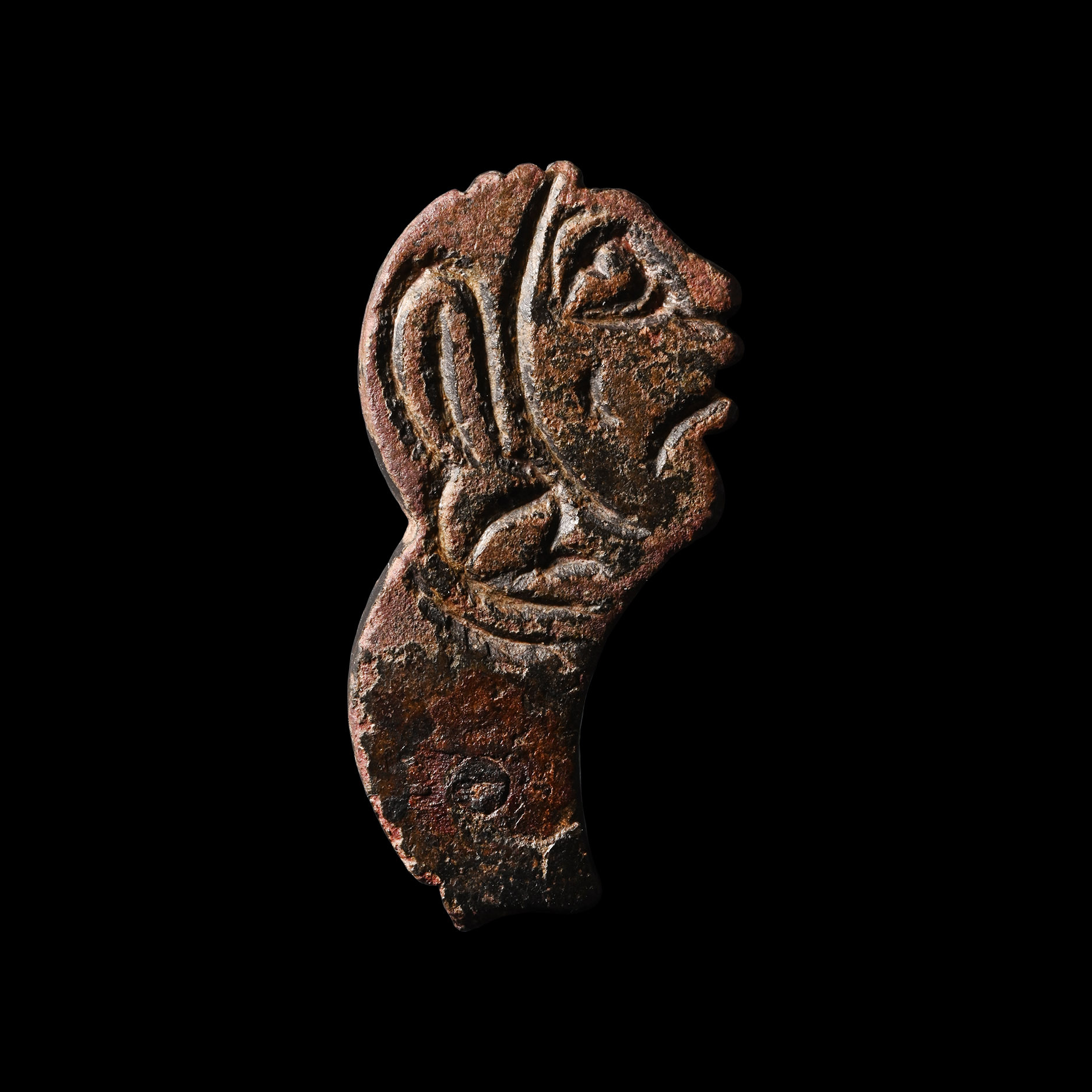
Tudor Figural Chafing Dish Mount
16TH CENTURY A.D.
1 1/4 in. (11.1 grams, 33 mm).
A bifacial anthropomorphic copper-alloy chafing dish mount, comprising a flat plate in the shape of a man's head and torso in profile, incised on both sides outlining stylised facial features and a hood or cap. [No Reserve]
ProvenanceFound near Brenzett, Kent, UK.
Property of a Kent gentleman.
Accompanied by a copy of the British Museum's Portable Antiquities Scheme (PAS) report no. KENT-561C41.
Cf. Bailey, G., Detector Finds 4, pp.58-59, for similar.
FootnotesThe PAS report dates this item to 1575-1650. Such supports were used in sets of three on chafing dishes. Scholars believe they were produced in Germany, Denmark and the Low Countries from 1575 onwards, remaining in use in poorer households until the middle of the 18th century A.D. Such a find is rare in England.
CONDITIONTimeLine Auctions follows a vetting process to ensure the authenticity and legality of all items, reinforcing our commitment to integrity and responsible trading. Each antiquity, antique, and coin lot undergoes thorough examination by a vetting committee of at least ten external specialists, professional trade association members, scientists, and archaeologists: Our Vetting Process
AUCTIONS:
TimeLine is a leading auction house specialising in antiquities, ancient art, collectables, natural history, coins, medals, and books. Our auctions offer museums, collectors, historians, and enthusiasts the opportunity to acquire unique and historically significant pieces.
-
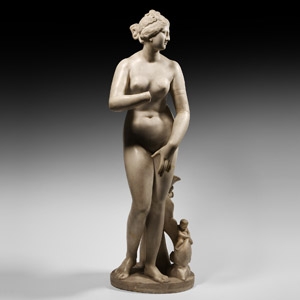
Statue of Venus of the Dolphin
19th century A.D.Sold for (Inc. bp): £1,300
A white marble statue of Venus of the Dolphin, modelled naturalistically in the round, nude, posed to preserve her modesty, two putti riding the dolphin; set on an oval base; after a Roman copy of a Hellenistic original; some damage and old repairs. 24.7 kg, 77 cm high
French collection, 1960s-early 2000s. From an important Paris gallery, France. with Ader Auction, Paris, France, 24th November 2017, lot 218.
The Venus of the Dolphin is a carrera marble statue dating from the 4th century B.C. which inspired copies dating from the Roman period, some of which survive and are housed in the Prado Museum, Madrid and the Capitoline Museum in Rome and elsewhere. -
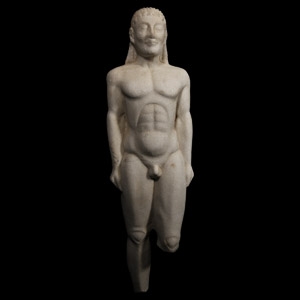
Marble Archaic Kouros Statue
20th century A.D.Sold for (Inc. bp): £1,690
A Greek style marble archaic kouros statue carved with braided hair held by a diadem, arms held straight at the sides, legs in advancing pose. 16.5 kg, 71 cm high
French collection, 1960s-early 2000s. From an important Paris gallery, France.
The kouros (free-standing nude male youth) first appeared in ancient Greece in the Archaic Greek period; kouros figures have been found across the Greek-speaking world, concentrated mainly in sanctuaries of Apollo. The term means ‘male youth, particularly one of noble rank’; when a pubescent boy came of age in ancient Greece, he was known as a kouros, at which point he could participate in the initiation feast of the brotherhood. The god Apollo was known as the greatest kouros. Typically life-sized, these figures were produced in marble, but have also been found in limestone, wood, bronze and terracotta. The female counterpart is the kore. -
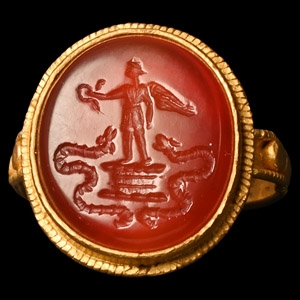
Victorian Gold Ring with Victory Gemstone
19th-20th century A.D. or earlierEstimate: £600 - 800 (+bp*)
Opening Bid: £300
A gold finger ring with beaded wire to the rim of the hoop and applied pellets, ellipsoid bezel with beaded wire border, inset carnelian cloison with figure of Victory on a plinth between rearing snakes. 3.54 grams, 20.07 mm overall, 15.50 mm internal diameter (approximate size British I, USA 4 1/4, Europe 7.44, Japan 7)
English private collection.
