
Loading, please wait...


LOT 2019
Tudor Bone Apple Corer
CIRCA 16TH CENTURY A.D.
6 in. (30.2 grams, 15.1 cm).
Hollowed-out mammal bone, cut to form a U-shaped corer, inked collector's note 'Moore Lane', on the underside. [No Reserve]
ProvenanceFrom the private collection of Graham Slater (1927-2024), Cambridge, UK; formed 1980s-1990s.
CONDITIONTimeLine Auctions follows a vetting process to ensure the authenticity and legality of all items, reinforcing our commitment to integrity and responsible trading. Each antiquity, antique, and coin lot undergoes thorough examination by a vetting committee of at least ten external specialists, professional trade association members, scientists, and archaeologists: Our Vetting Process
AUCTIONS:
TimeLine is a leading auction house specialising in antiquities, ancient art, collectables, natural history, coins, medals, and books. Our auctions offer museums, collectors, historians, and enthusiasts the opportunity to acquire unique and historically significant pieces.
-

Stuart Period Silver Seal Matrix with 'Hurrell Family' Heraldic Shield with Crossbows
England, 17th century A.D.Sold for (Inc. bp): £208
A silver chessman-type seal matrix with pierced trefoil head; central heraldic heater shield with three crossbows. 8.58 grams, 26 mm
Private collection, Europe. Acquired on the English art market.
The surnames associated with this crest are: Hurell, Hurle or Hurrell. -
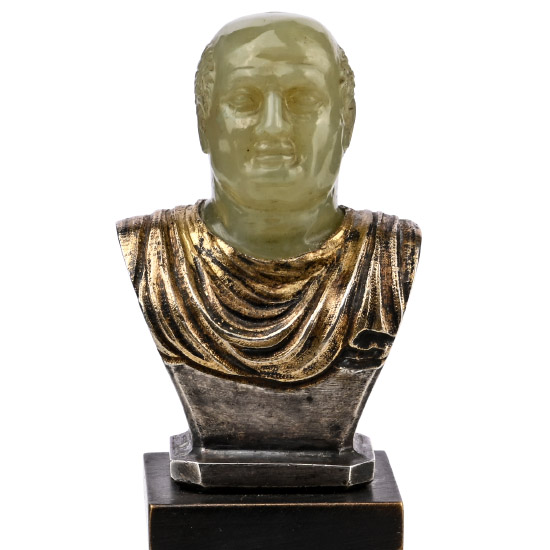
Chalcedony and Silver-Gilt Bust of the Emperor Vespasian
Italy, 17th-18th century A.D.Estimate: £1,500 - 2,000 (+bp*)
Opening Bid: £750
The head, carved from pale green chalcedony, polished to a smooth lustre and with a drilled aperture at the crown, the hair in tight curls around the nape and crown; the silver-gilt torso dressed in a draped toga carefully chased with deep folds and traces of gilding across the high points; mounted on a later patinated bronze column stand in the neoclassical manner. 208 grams total, 10.9 cm high including stand
Acquired on the European art market.
This small-scale portrait evokes the Roman tradition of imperial portraiture and the early modern fascination with the ancient world. From the seventeenth century onwards, artists and collectors revived classical subjects through hardstone and gilt-metal compositions, often intended for display in Kunstkammer or Grand Tour contexts. The combination of a reused ancient or earlier element with a later mount was a practice typical of the Renaissance and Baroque periods, reflecting the period’s reverence for antiquity and its imaginative recontextualisation of ancient forms. -
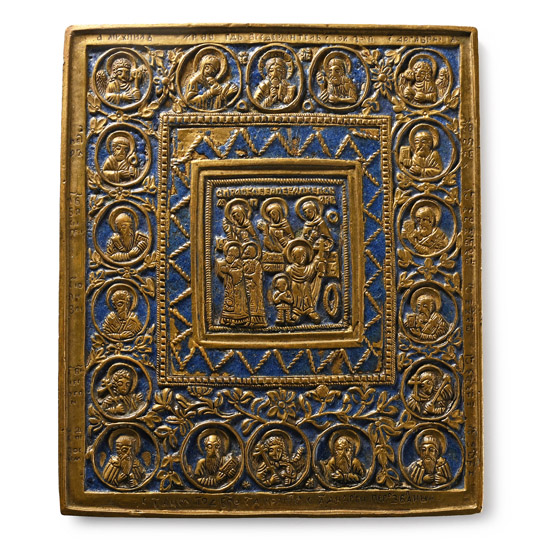
Russian Orthodox Enamelled Bronze Travel Icon with Saint Julitta, Cyricus and Deesis
19th century A.D.Sold for (Inc. bp): £234
With blue enamel and framed by a raised border; Saint Julitta and her son, Cyricus, Saint Gregory the Theologian and Saint John the Chrysostom standing beside them at the centre; three half-length figures above: St. Paraskeva (right), Eudokia, and Barbara (left); OCS inscriptions identifying the saints framing the scene; on the top a deesis, with Christ Pantokrator at the centre, flanked by Saint Mary and Saint John the Precursor; at the top left corner Archangel Michael, on the top right corner the Archangel Gabriel; beneath Saint Gabriel, in vertical order, Saint Paul, Saint Gregory the Theologian, Saint Nicholas of Myra, Saint Demetrios; beneath Saint Michael, in vertical order, Saint Peter, Saint Basil the Great, Saint John Chrysostomos and Saint George; in the last row, nearby Saint Andrew, at the centre, the Archangel Raphael, with sword and cross. 360 grams, 14 cm
Acquired from Chris Martin-Zakheim, Iconastas, 5 Piccadilly Arcade, London SW1. From the private collection of a West London, UK, gentleman, formed since the early 2000s.
This icon was intended for private devotion, often carried by pilgrims and Orthodox believers for spiritual protection. St. Julyttas and her son Cyricus (Ки́рик и Иули́тта), among the most venerated figures in Russian tradition, are depicted in the centre, surrounded by other saints, a symbol of the communion of the righteous in front of the Divine Deesis.
