
Loading, please wait...

LOT 2065
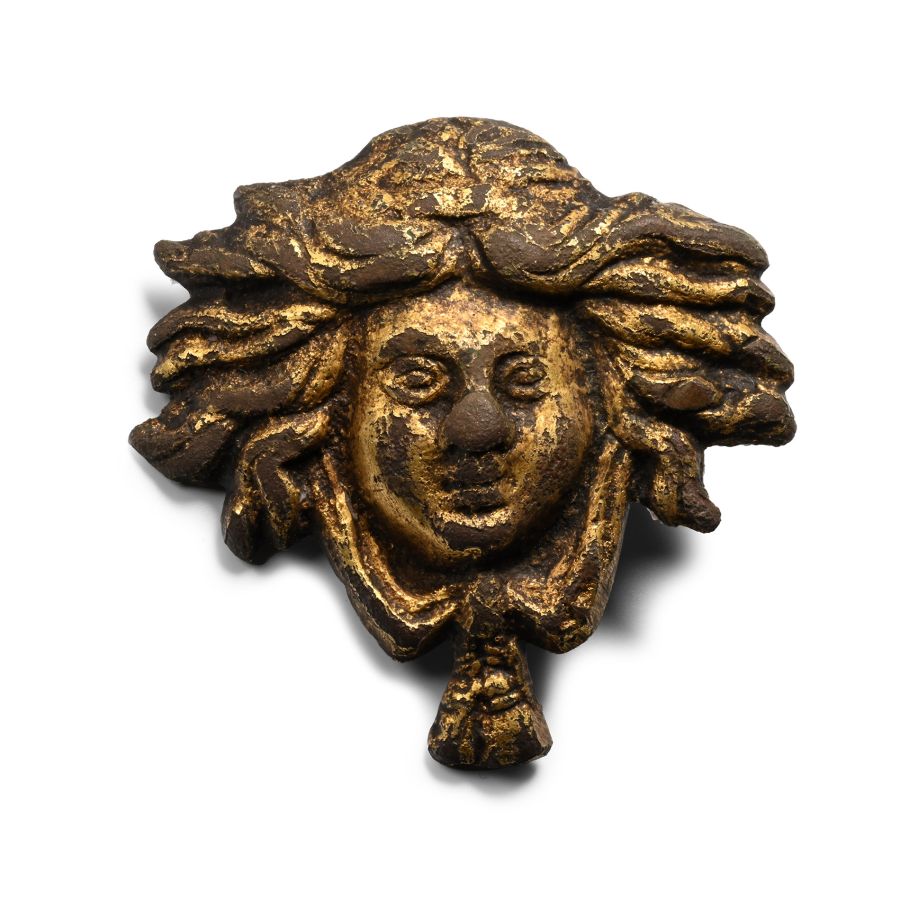
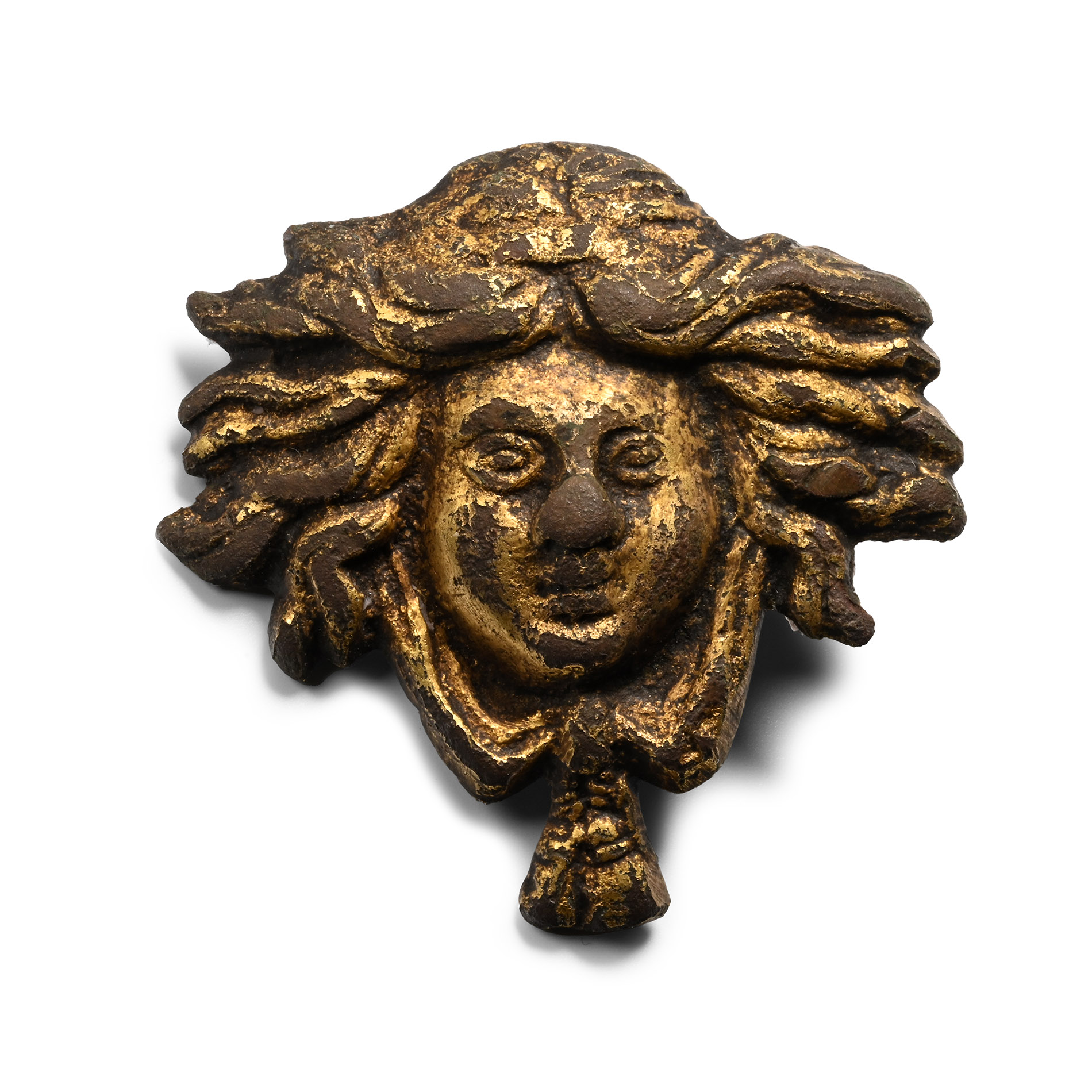
Tudor Age Gilt Bronze Head Mount
16TH-17TH CENTURY A.D.
2 in. (35.8 grams, 50 mm).
Modelled as the face of a woman with flowing hair, a sash wrapped around the head and the ends tied beneath the chin, possibly representing Medusa; stud to the reverse. [No Reserve]
ProvenanceEx North American private collection, 1970s-1990s.
This lot is accompanied by an illustrated lot declaration signed by the Head of the Antiquities Department, Dr Raffaele D’Amato.
TimeLine Auctions follows a vetting process to ensure the authenticity and legality of all items, reinforcing our commitment to integrity and responsible trading. Each antiquity, antique, and coin lot undergoes thorough examination by a vetting committee of at least ten external specialists, professional trade association members, scientists, and archaeologists: Our Vetting Process
AUCTIONS:
TimeLine is a leading auction house specialising in antiquities, ancient art, collectables, natural history, coins, medals, and books. Our auctions offer museums, collectors, historians, and enthusiasts the opportunity to acquire unique and historically significant pieces.
-
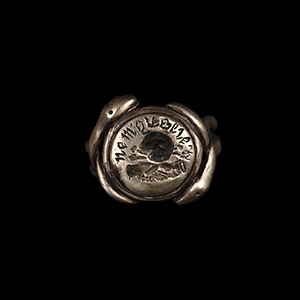
Georgian Silver Memento Mori Skull and Crossed Bones Ring
18th-19th century A.D.Sold for (Inc. bp): £1,820
The hoop formed as two snakes each with head and tail on the discoid bezel; skull and crossed long-bones above clasped hands and legend 'Ne M' Oubliez' (Forget Me Not). 14.30 grams, 27.27 mm overall, 18.09 mm internal diameter (approximate size British P 1/2, USA 7 3/4, Europe 16.86, Japan 16)
Private collection, Arundel, West Sussex, UK, 1980s. This lot is accompanied by an illustrated lot declaration signed by the Head of the Antiquities Department, Dr Raffaele D’Amato. -
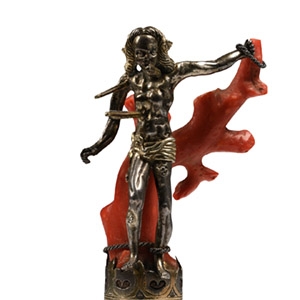
Renaissance Devotional Aid Depicting Saint Sebastian Tied to a Coral Branch
Southern Germany, circa 1500-1520 A.D., adapted by Jacob Frick of Constance, circa 1590 A.D.Sold for (Inc. bp): £2,860
Comprising a parcel-gilt raised discoid base with fluted hexafoil developing to a central column with braided collar and openwork crown socket; inset portion of natural coral branch; figure of St Sebastian modelled in the round with three arrows piercing his shoulders and chest and the stub of a fourth in his shin, portrayed with gilt loincloth and centre-parted hair, braided wire bonds to the left wrist and one ankle' old collector's numbers 'V.590.3H1 7' and '18688' to underside. 190 grams, 12.4 cm
F.K.A. Huelsmann, Hamburg. with Christie's, Geneva, 13 May 1981, no.7. Private collection, South Germany. with Hargesheimer & Gunther, 22 September 2017, no.1307. This lot has been checked against the Interpol Database of stolen works of art and is accompanied by search certificate number no.12507-230673. This lot has been cleared against the Art Loss Register database, and is accompanied by an illustrated lot declaration signed by the Head of the Antiquities Department, Dr Raffaele D’Amato.
This lot will require a CITES licence when exported outside the UK. -
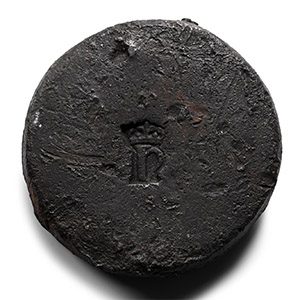
Tudor Henry VIII Lead One Pound Town Weight
16th century A.D.Sold for (Inc. bp): £208
Discoid with an impressed crowned 'H' to one side. 456 grams, 67 mm
Found from spoil from the Thames Foreshore at Billingsgate in the 1980s. Property of an Essex collector. Ex Capital Gains Exhibition at the Museum of London. This lot is accompanied by an illustrated lot declaration signed by the Head of the Antiquities Department, Dr Raffaele D’Amato.
