
Loading, please wait...


LOT 0071
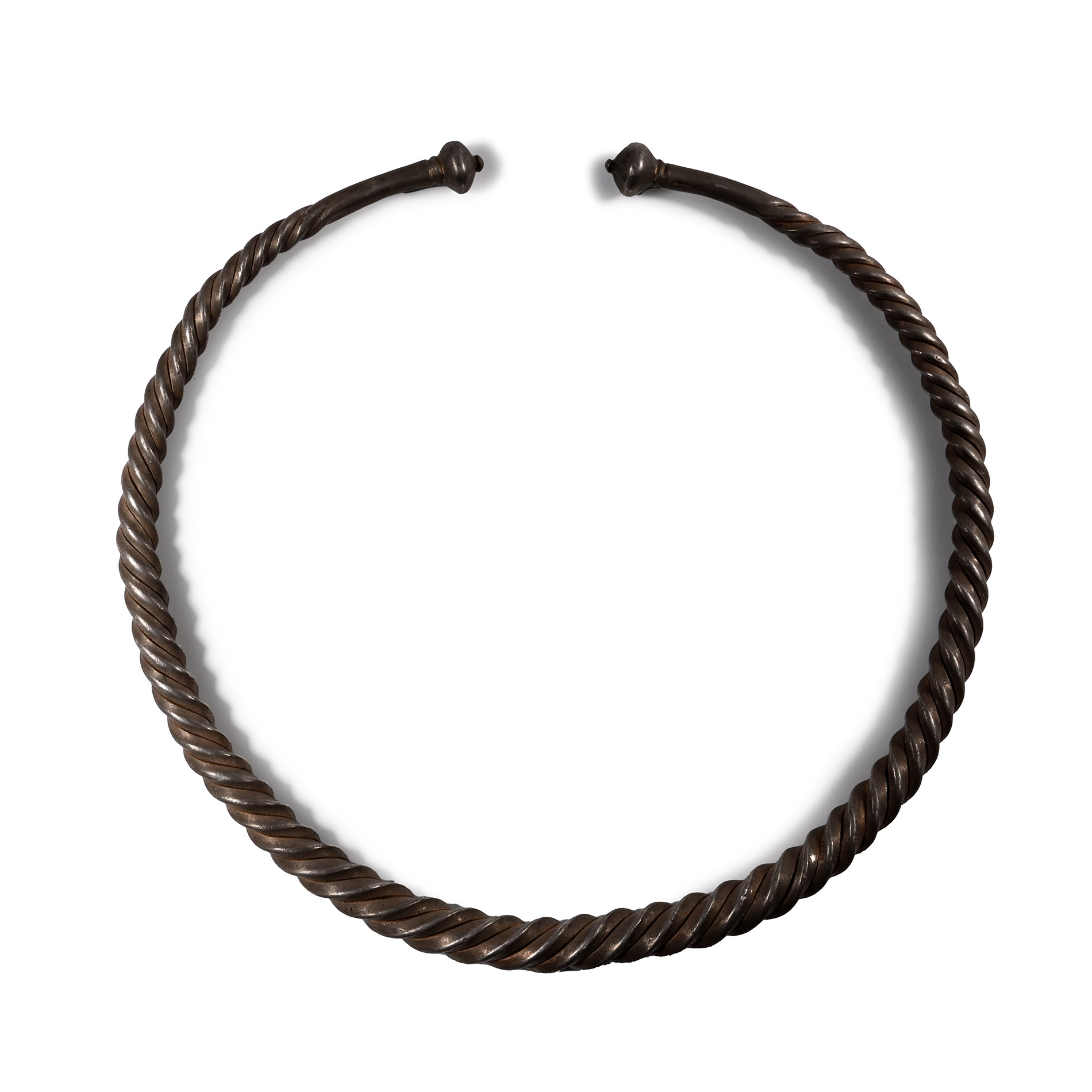
Thracian Twisted Silver Torc
4TH-2ND CENTURY B.C.
6 in. (157 grams, 15 cm).
Formed of twisted rods, each square in section, tapering towards the hammered finials, each with an onion-knop terminal.
Provenancewith Christie's, New York, 5 June 1998, no.209.
Private collection, Europe.
Accompanied by an academic report by Dr Raffaele D'Amato.
Accompanied by copies of the relevant Christie's catalogue pages.
This lot has been checked against the Interpol Database of stolen works of art and is accompanied by a search certificate number no.12381-226710.
See Hoddinott, R.F., The Thracians, London, 1981; Marazov, I. (ed.), Ancient Gold: The Wealth of the Thracians. Treasures from the Republic of Bulgaria, New York, 1997.
CONDITIONTimeLine Auctions follows a vetting process to ensure the authenticity and legality of all items, reinforcing our commitment to integrity and responsible trading. Each antiquity, antique, and coin lot undergoes thorough examination by a vetting committee of at least ten external specialists, professional trade association members, scientists, and archaeologists: Our Vetting Process
AUCTIONS:
TimeLine is a leading auction house specialising in antiquities, ancient art, collectables, natural history, coins, medals, and books. Our auctions offer museums, collectors, historians, and enthusiasts the opportunity to acquire unique and historically significant pieces.
LOT 0071
Thracian Twisted Silver Torc
Estimate £2,000 - 3,000€2,320 - 3,480 (for guidance only)$2,700 - 4,050 (for guidance only)
-
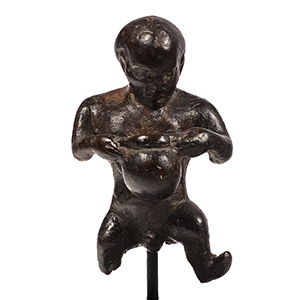
Hellenistic or Roman Bronze Statuette of a Grotesque Holding a Jar
Alexandria, 1st century B.C.-3rd century A.D.Sold for (Inc. bp): £156
Modelled standing nude in a contorted pose with legs spread, holding a jar or bag to his chest; mounted on a custom-made stand. 73.7 grams total, 68 mm including stand
From a collection acquired on the UK art market from various auction houses and collections mostly before 2000. From an important Cambridgeshire estate; thence by descent.
Such figures are often described as ‘grotesques’, yet typically constituted overstated representations of people with dwarfism. Such individuals are invariably shown with exaggerated features such as pot bellies, hunched backs, bald heads, large phalli and angry facial expressions. -
Greek Bronze Human-Headed Female Dancer
4th-3rd century B.C.Sold for (Inc. bp): £46
Comprising a narrow hoop and lentoid bezel, intaglio image of a siren in flight. 1.33 grams, 21.71 mm overall, 19.09 mm internal diameter (approximate size British Q, USA 8, Europe 17.49, Japan 16)
Ex German art market, 2000s. Acquired from an EU collector living in London. From the collection of Surrey, UK, gentleman. -
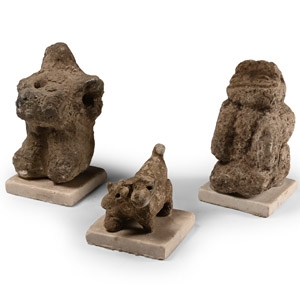
Cypriot and Other Idol Group
1st millennium B.C. and laterSold for (Inc. bp): £52
Including a two-headed dog, a crouching female and a kneeling figure with vertical piercing; each mounted on a ceramic base. 480 grams total, 52-91 mm including stand
From a collection acquired on the UK art market from various auction houses and collections mostly before 2000. From an important Cambridgeshire estate; thence by descent.
