
Loading, please wait...
_900x900.jpg "Thracian Gold Clad Ribbed Torc with Decorated Terminals")
_200x200.jpg "Thracian Gold Clad Ribbed Torc with Decorated Terminals")
_900x900.jpg "Thracian Gold Clad Ribbed Torc with Decorated Terminals")
_200x200.jpg "Thracian Gold Clad Ribbed Torc with Decorated Terminals")
.jpg "Thracian Gold Clad Ribbed Torc with Decorated Terminals")
.jpg "Thracian Gold Clad Ribbed Torc with Decorated Terminals")
LOT 0083
Thracian Gold Clad Ribbed Torc with Decorated Terminals
4TH-3RD CENTURY B.C.
11 3/8 in. (467 grams, 29 cm).
Penannular in form with round-section shank and flat tongue-shaped terminals; the shank formed as a series of transverse rings modelled to represent granulation; the outer face of each terminal formed with punched detailing to the border and transverse final bars, two rows of punched annulets separated by a median gusset; some modern polishing.
ProvenanceSwiss private collection, 1987.
Private collection, London.
This lot has been checked against the Interpol Database of stolen works of art and is accompanied by a search certificate number no.12859-241328.
This lot has been cleared against the Art Loss Register database, and is accompanied by an illustrated lot declaration signed by the Head of the Antiquities Department, Dr Raffaele D'Amato.
See Hellmuth, A., Da Esti A Ovest: Le Tombe Principesche degli Sciti, in Bonora, G.L. and Marzatico, F., Ori dei Cavalieri delle Steppe, Milan, 2007, p.175, pl.13.
CONDITIONTimeLine Auctions follows a vetting process to ensure the authenticity and legality of all items, reinforcing our commitment to integrity and responsible trading. Each antiquity, antique, and coin lot undergoes thorough examination by a vetting committee of at least ten external specialists, professional trade association members, scientists, and archaeologists: Our Vetting Process
AUCTIONS:
TimeLine is a leading auction house specialising in antiquities, ancient art, collectables, natural history, coins, medals, and books. Our auctions offer museums, collectors, historians, and enthusiasts the opportunity to acquire unique and historically significant pieces.
LOT 0083
Thracian Gold Clad Ribbed Torc with Decorated Terminals
Sold for (Inc. bp): £13,000
-
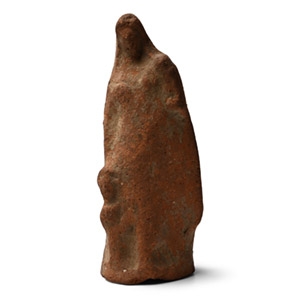
Graeco-Roman Terracotta Veiled Votive Figure
2nd-1st century B.C.Sold for (Inc. bp): £72
Tanagra-type robed female figure with child; vent to reverse, hollow underside. 190 grams, 13.6 cm
Acquired on the UK art market in the 1990s. From the Dr Ince collection, N.W. London, UK. This lot is accompanied by an illustrated lot declaration signed by the Head of the Antiquities Department, Dr Raffaele D'Amato. -
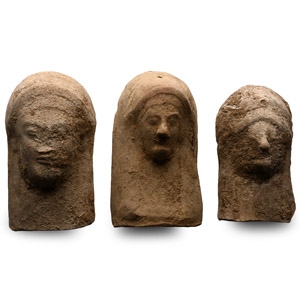
Greek Terracotta Female Protome Group
Early 5th century B.C.Sold for (Inc. bp): £260
Each tongue-shaped in plan and hollow to the reverse, female bust in high-relief with palla head-covering. 271 grams total, 9.4-11.2 cm
with H.A.C., Basel, prior 1999. This lot is accompanied by an illustrated lot declaration signed by the Head of the Antiquities Department, Dr Raffaele D'Amato. -
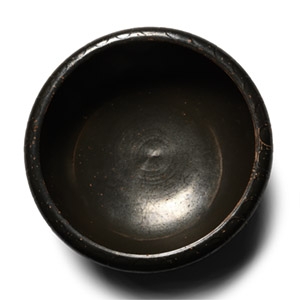
Greek Black-Glazed Terracotta Bowl with Stamped Decoration
Circa 330 B.C.Sold for (Inc. bp): £182
Flat bowl on a ring-base, convex rim decorated with a flat-profiled tongue-leaf frieze and fine groove beneath. 183 grams, 12.2 cm
with Galerie Gilgamesh, prior 2003. Accompanied by a copy of an Art Loss Register certificate no.S00035402. This lot is accompanied by an illustrated lot declaration signed by the Head of the Antiquities Department, Dr Raffaele D’Amato. This lot is accompanied by an illustrated lot declaration signed by the Head of the Antiquities Department, Dr Raffaele D'Amato.
