
.jpg "Thrace, Bisanthe AE 13mm.")
LOT 3125
Thrace, Bisanthe AE 13mm. 3rd century BC.
Veiled head of Demeter to right, wreathed with grain / BI within grain wreath, ΣΑΝ below. Schönert-Geiss 38-41; HGC 3.2, 1367 (ΣΑΝ not mentioned). Near Very Fine. Very rare.(2.06gr, 13mm, 12h.).
ProvenanceAcquired on the European coin market.
Property of a Kent, UK, gentleman.
TimeLine Auctions follows a vetting process to ensure the authenticity and legality of all items, reinforcing our commitment to integrity and responsible trading. Each antiquity, antique, and coin lot undergoes thorough examination by a vetting committee of at least ten external specialists, professional trade association members, scientists, and archaeologists: Our Vetting Process
AUCTIONS:
TimeLine is a leading auction house specialising in antiquities, ancient art, collectables, natural history, coins, medals, and books. Our auctions offer museums, collectors, historians, and enthusiasts the opportunity to acquire unique and historically significant pieces.
-
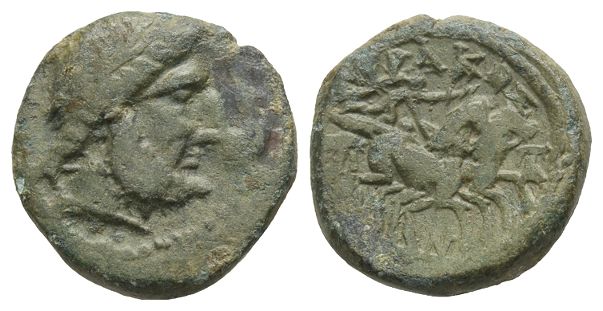
Sicily, Syracuse AE 19mm. Roman rule, after 212 BC.
Sold for (Inc. bp): £20
Laureate head of Zeus to right / Victory driving biga to right; [ΣYP]AKOΣI[Ω]N around. CNS 229; cf. SNG ANS 1072-5. 6.43gr, 19mm, 12h.
Very Fine.
Acquired on the UK art market. From the collection of Mr Carlos Bahamonde, Manchester, UK. -
.jpg)
Lesbos, Eresos AE 9mm. Circa 300-200 BC.
Sold for (Inc. bp): £46
Head of Hermes to left, wearing petasus / EPE, grain ear. Cf. HGC 6, 880. 0.63gr, 9mm, 9h.
Near Very Fine. Very rare.
Acquired on the European coin market. Property of a Kent, UK, gentleman. -
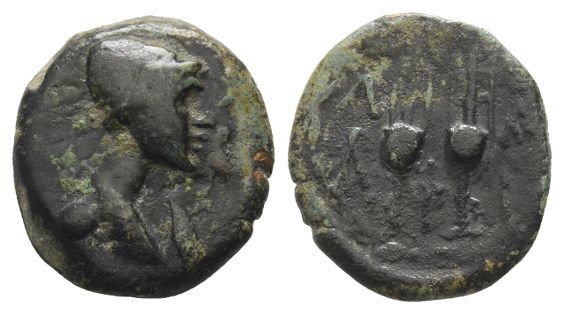
Laconia, Lakedaimon (Sparta) AE 17mm. Circa 48-35 BC. ΑΦΙ- (Aphi-), magistrate.
Sold for (Inc. bp): £111
Jugate heads of the Dioskouroi to right / Λ-A, two amphorae; Α-Φ-Ι in fields. BCD Peloponnesos II 2349; Grunauer group XV, series 9; HGC 5, 629. 3.63gr, 17mm, 12h.
Near Very Fine. Rare.
Acquired on the European coin market. Property of a Kent, UK, gentleman.
