
Loading, please wait...
LOT 0137
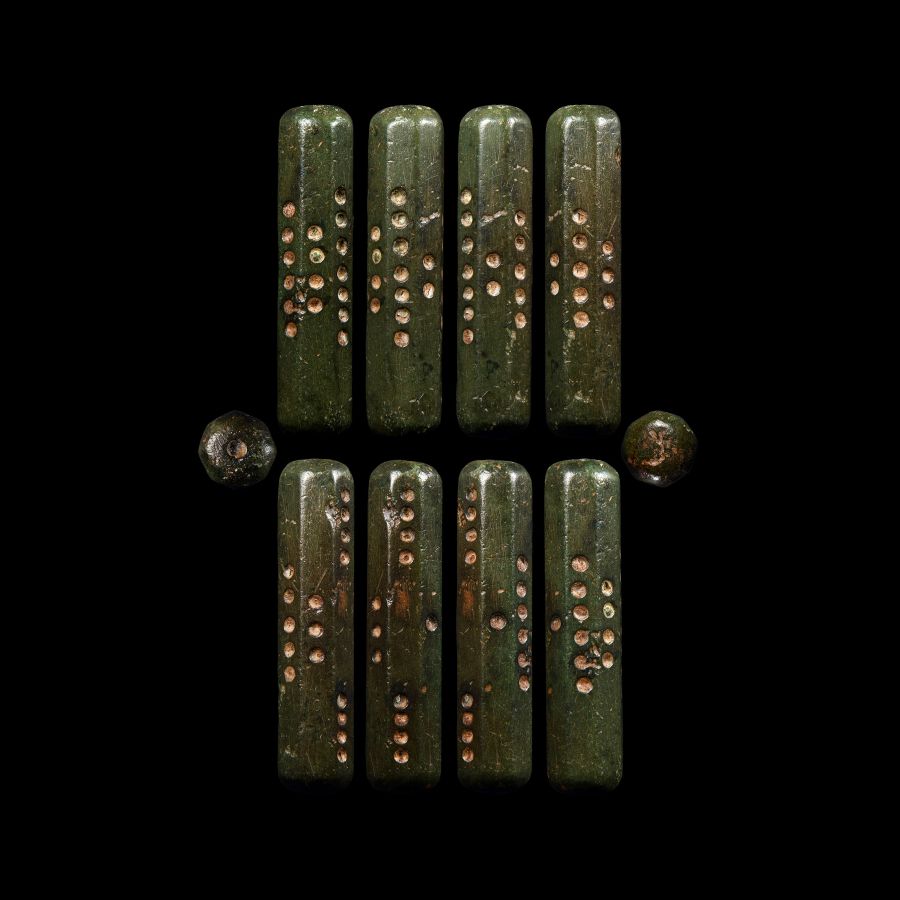
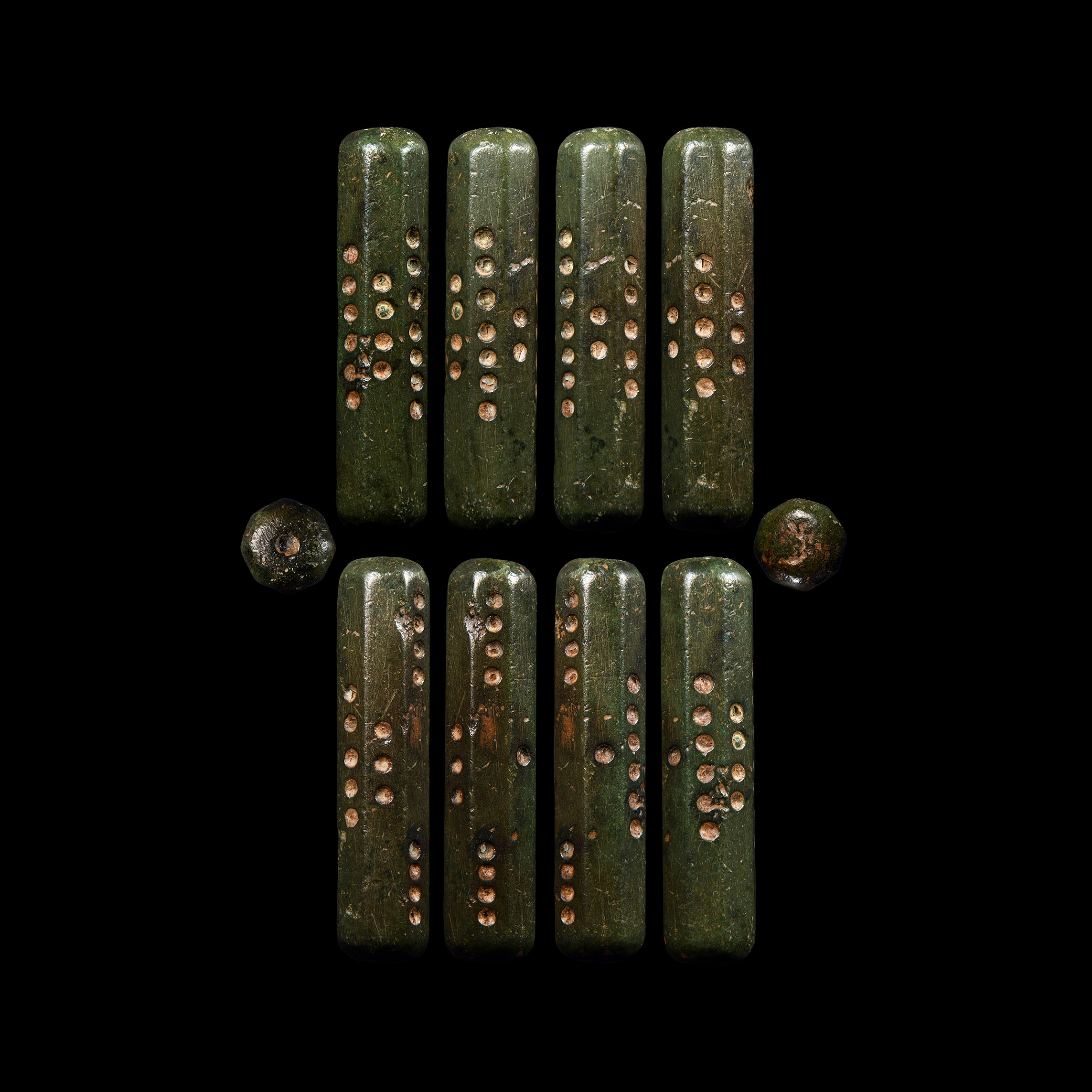
'The Uttoxeter' Roman Octagonal Rolling Dice
1ST-4TH CENTURY A.D.
2 1/8 in. (58 grams, 54 mm).
An octagonal bronze 'Stabwuerfel' rolling dice with rounded terminals, drilled dot numbering rotating the rod clockwise: 1; 4-4; 3; 5; 2; 7; 4; 6; an additional single dimple to the end face of one terminal; all numbers are drilled at the centre of the rod with the exception of the number 8, which is split into two groups of 4, located at either end.
ProvenanceFound whilst searching with a metal detector rear North Uttoxeter, East Staffordshire, UK, on Saturday 11th March 2017, by Martin Colclough.
Accompanied by a copy of the British Museum's Portable Antiquities Scheme (PAS) report no. LANCUM-E6101C where it states: 'Stabwuerfel (germ. rod dice) are very rare in this country and this is the first one recorded on this database...This die will be marked a Find of Note for the area...and has been designated: Potential for inclusion in Britannia.'
Cf. The British Museum, museum number 1871,0910.2, for a similar hexagonal bone example.
FootnotesThe PAS report describes this find of note as being 'in extremely good condition'. The dots may once have had an enamel fill.
CONDITIONTimeLine Auctions follows a vetting process to ensure the authenticity and legality of all items, reinforcing our commitment to integrity and responsible trading. Each antiquity, antique, and coin lot undergoes thorough examination by a vetting committee of at least ten external specialists, professional trade association members, scientists, and archaeologists: Our Vetting Process
AUCTIONS:
TimeLine is a leading auction house specialising in antiquities, ancient art, collectables, natural history, coins, medals, and books. Our auctions offer museums, collectors, historians, and enthusiasts the opportunity to acquire unique and historically significant pieces.
-
.jpg)
Roman 'Thames' Samian Ware Stamped Fragment Group
Circa 2nd century A.D.Sold for (Inc. bp): £143
A group of seven stamped Samian ware vessel bases including specimens labelled by the collector; accompanied by a copy of the collector's typed notes, identifying four of the stamps: 'g. MARCELLI I F Marcellinus Central Gaul mid 2nd century; h. ANNIO F Annius Central Gaul early 2nd century; i. NOBILIANI Nobilianus Central Gaul; j. SOLINI.OFI Solinus (officiana) Central Gaul mid 2nd century'; three non-identified stamps, possibly reading 'AEIOX.E; [ ]ERNI; MAX[]M'. 278 grams total, 3.8-10.3 cm
Found Billingsgate spoil from the Thames foreshore, London, UK. Acquired on the UK antiques market between 1974-1985. Albert Ward collection, Essex, UK. Accompanied by a copy of a typed original identification document from the Museum of London dated 29th August 1984. -
Roman Coin and Limited Edition Framed Print
3rd century A.D. and laterSold for (Inc. bp): £13
A Roman coin mounted on 22 carat gold foil, framed with an art print signed by the artist David McAllister, depicting scenes of Roman military activity; limited edition number 174/1150. 1.25 kg, 37 x 50 cm
Essex gallery, early 2000s.
David McAllister's exciting design is a 'one of a kind' work that portrays the might and riches of the Roman civilisation. This limited edition print is a celebration of the award winning artist's lifetime dedication to historical paintings of the ancient world. To enhance appreciation of this rare and historic work, each individual print is signed and numbered by the artist. -
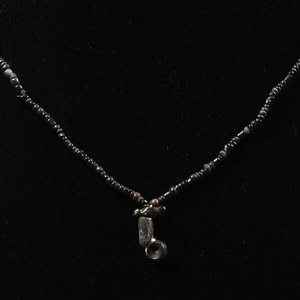
Roman and Other Bead Necklace
1st century A.D. and laterSold for (Inc. bp): £39
A restrung necklace composed mainly of 'black' stone and glass beads of various types and sizes, with a trio of larger pendant beads. 5.02 grams, 82 cm long
Acquired 1980-2015. Ex Abelita family collection.
