
Loading, please wait...
_900x900.jpg "'The Thetford' Roman Bronze Putto Statuette")
_200x200.jpg "'The Thetford' Roman Bronze Putto Statuette")
.jpg "'The Thetford' Roman Bronze Putto Statuette")
LOT 0172
'The Thetford' Roman Bronze Putto Statuette
1ST-2ND CENTURY A.D.
1 3/4 in. (26.2 grams, 43 mm).
Modelled in the round with back arched, legs extended, right arm reaching upwards; old collector's label marked 'Thetford'.
ProvenanceFound Thetford, Norfolk, UK.
LiteratureCf. Boucher, S. and Tassinari, S., Bronzes Antiques I, Inscriptions, Statuaire, Vaisselle, Paris, 1976, p.31, no.23, for similar.
CONDITIONTimeLine Auctions follows a vetting process to ensure the authenticity and legality of all items, reinforcing our commitment to integrity and responsible trading. Each antiquity, antique, and coin lot undergoes thorough examination by a vetting committee of at least ten external specialists, professional trade association members, scientists, and archaeologists: Our Vetting Process
AUCTIONS:
TimeLine is a leading auction house specialising in antiquities, ancient art, collectables, natural history, coins, medals, and books. Our auctions offer museums, collectors, historians, and enthusiasts the opportunity to acquire unique and historically significant pieces.
LOT 0172
'The Thetford' Roman Bronze Putto Statuette
Estimate £300 - 400€350 - 460 (for guidance only)$410 - 540 (for guidance only)
-
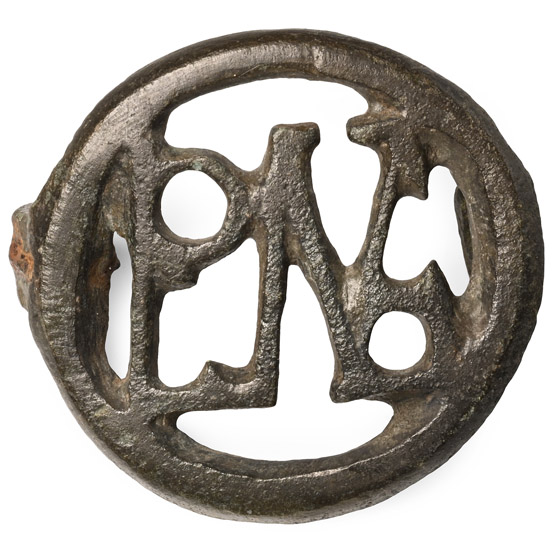
Roman Bronze ROMA Brooch
2nd-3rd century A.D.Sold for (Inc. bp): £26
Discoid body formed as an openwork monogram 'ROMA' in capitals, the M and A ligated, the O formed by the brooch frame itself; pin-lug and catch to reverse; minor losses to lettering. 14.86 grams, 35 mm
Ex German art market, 2000s. Acquired from an EU collector living in London. From the collection of a Surrey, UK, gentleman. -
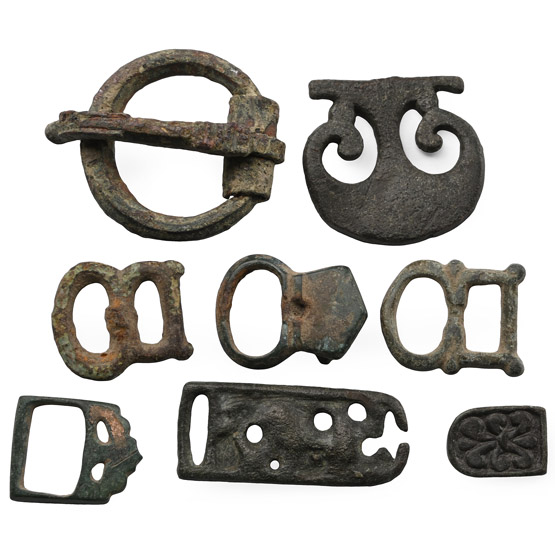
Roman to Medieval Bronze Artefact Collection
4th-16th century A.D.Sold for (Inc. bp): £59
Including a La Tène Style mount, openwork starp end with advancing lion, appliqué with lobed fleur-de-lys and other items. 69 grams total, 17-42 mm
Ex German art market, 2000s. Acquired from an EU collector living in London. From the collection of a Surrey, UK, gentleman. -
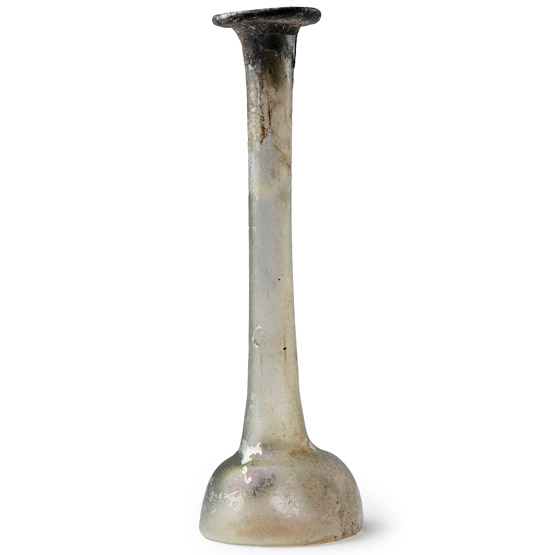
Roman Tall Glass Flask
Circa 1st-4th century A.D.Sold for (Inc. bp): £169
Comprising a squat conical body with a dimple at the base, long tubular neck with everted rolled rim. 28 grams, 15.9 cm
From a London, UK, collection of glass, 1970-2000s.
