
Loading, please wait...
_900x900.jpg "'The Tenby' Hiberno-Norse Viking Penannular Brooch")
_200x200.jpg "'The Tenby' Hiberno-Norse Viking Penannular Brooch")
.jpg "'The Tenby' Hiberno-Norse Viking Penannular Brooch")
LOT 0353
'The Tenby' Hiberno-Norse Viking Penannular Brooch
8TH-9TH CENTURY A.D.
2 1/2 in. (10.55 grams, 62 mm wide).
Comprising a round-section crescent with flared ends terminating in two curved spatulate flat panels, each with a ropework border surrounding a two-band knotwork motif; cleaned and conserved.
ProvenanceFound whilst searching with a metal detector on a beach, probably having been washed out of a Viking burial from an overlooking cliff near Tenby, Pembrokeshire, UK, on Thursday 7th April 2016 by Kelvin Maddocks.
Recorded with the Portable Antiquities Scheme (PAS) with reference number NMGW-DA579E.
Accompanied by a copy of the PAS report including a museum drawing of the object, a copy of report number NMWPA 2016.43 sent to the finder.
Accompanied by copies of the relevant Treasure Hunting Magazine pages where it has been published.
Treasure Hunting Magazine, Portable Antiquities Scheme Corner, November 2021, p.38.
CONDITIONTimeLine Auctions follows a vetting process to ensure the authenticity and legality of all items, reinforcing our commitment to integrity and responsible trading. Each antiquity, antique, and coin lot undergoes thorough examination by a vetting committee of at least ten external specialists, professional trade association members, scientists, and archaeologists: Our Vetting Process
AUCTIONS:
TimeLine is a leading auction house specialising in antiquities, ancient art, collectables, natural history, coins, medals, and books. Our auctions offer museums, collectors, historians, and enthusiasts the opportunity to acquire unique and historically significant pieces.
-
.jpg)
Viking Age Bronze Openwork Ring
9th-11th century A.D.Sold for (Inc. bp): £46
Composed of an expanded bezel decorated with circlets and triangles; part of hoop absent. 3.81 grams, 22.11 mm overall, 18.19 mm internal diameter (approximate size British N 1/2, USA 6 3/4, Europe 14.35, Japan 13)
London art market before 2000. Property of an Essex gentleman. -
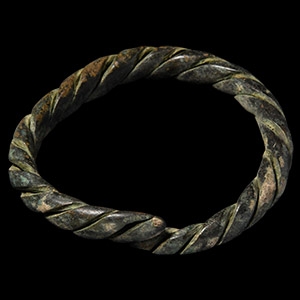
Viking Age Bronze Twisted Bracelet
9th-11th century A.D.Sold for (Inc. bp): £52
Featuring overlapping terminals, the D-section body composed of twisted bronze bars. 37.7 grams, 61 mm
London art market before 2000. Property of an Essex gentleman. -
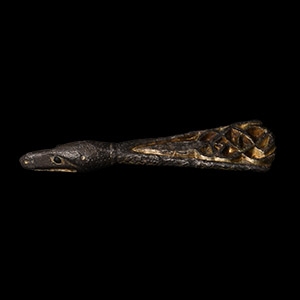
Viking Age Silver-Gilt Zoomorphic Strap End
9th-11th century A.D.Sold for (Inc. bp): £260
Comprising a slender animal head finial modelled with raised eyes, sub-triangular body with chased interlace; remains of gilding. 3.19 grams, 40 mm
From the collection of a North American gentleman, formed in the 1990s.
