
Loading, please wait...
_900x900.jpg "'The Smithsonian' Greek Terracotta Horse")
_200x200.jpg "'The Smithsonian' Greek Terracotta Horse")
.jpg "'The Smithsonian' Greek Terracotta Horse")
LOT 0096
'The Smithsonian' Greek Terracotta Horse
ITALY, 3RD-1ST CENTURY B.C.
7 5/8 in. (1.15 kg, 19.4 cm).
Modelled in the round, horse in advancing pose with one foreleg raised, flange base; old collector's number '170439' to base; old label '170[...]' and '102' to lower body; neck repaired.
ProvenancePrivate collection of Baron d’Ussés.
Acquired by F.B. Spiridon, New York, believed before 1894.
Acquired by Eleanor Magruder (1852-1906), and thence by descent to her heirs in 1906.
Accompanied by photographs of the object on display at the Smithsonian Institution and of the corresponding accession catalogue entry.
This lot has been checked against the Interpol Database of stolen works of art and is accompanied by search certificate number no.13108-248975.
On loan to the Smithsonian Institution, Washington, D.C., from 1894 to 1898, where it was published in the accession catalogue (accession no.
28776; catalogue no.170439) with Parke-Bernet Galleries, New York, 4 December 1969.
TimeLine Auctions follows a vetting process to ensure the authenticity and legality of all items, reinforcing our commitment to integrity and responsible trading. Each antiquity, antique, and coin lot undergoes thorough examination by a vetting committee of at least ten external specialists, professional trade association members, scientists, and archaeologists: Our Vetting Process
AUCTIONS:
TimeLine is a leading auction house specialising in antiquities, ancient art, collectables, natural history, coins, medals, and books. Our auctions offer museums, collectors, historians, and enthusiasts the opportunity to acquire unique and historically significant pieces.
-
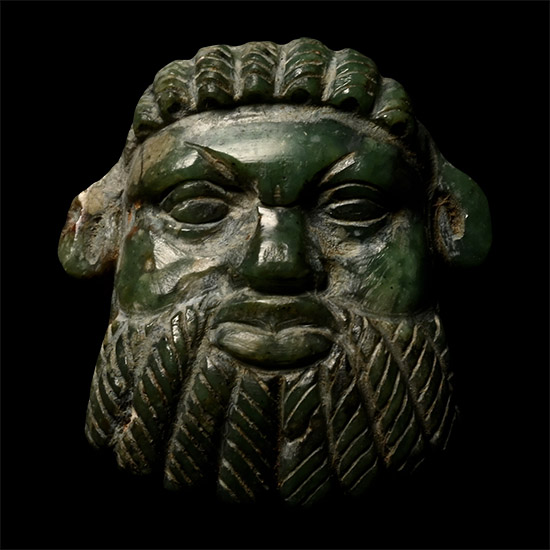
Greek Green Stone Bearded Face Amulet
400-300 B.C.Sold for (Inc. bp): £338
Finely carved head, featuring narrow eyes, a snub nose, full lips, a broad, stranded beard, and tightly curled hair rows; with a suspension loop behind the head. 4.16 grams, 20 mm
Private collection, England.
The facial features closely resemble those of Bes; the absence of Bes's characteristic plumed headdress is also evident in other amulets (Cf. Reisner, G.A., Catalogue général des antiquités égyptiennes du Musée du Caire, Nos.12528-13595, Vol. II, Amulets, Cairo, 1958, p. 16 (CG12649), pl. IV). -
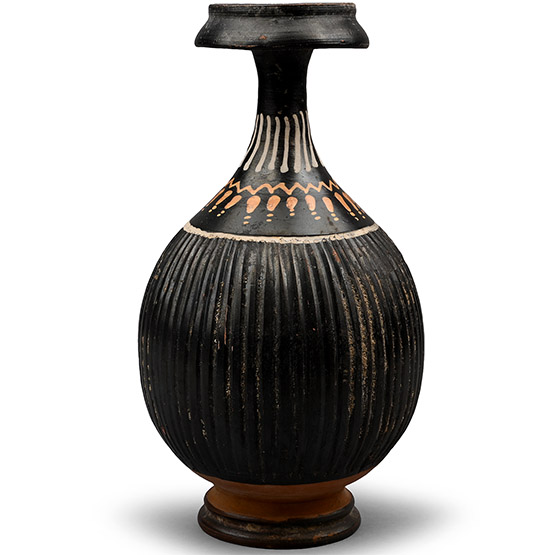
Greek Gnathian Thistle Flask
Apulian, circa 325-300 B.C.Sold for (Inc. bp): £650
Piriform in profile with flange to the flared mouth, ribbed fusiform body and socle base; painted undulation and stylised grapevine motif in ochre and white. 188 grams, 17 cm
Acquired on the art market between the late 1990s and mid-2000s. Estate of the late Barry Paul Buxton (1944–2024), Oakham, Rutland. Acquired on the UK art market, 2025. -
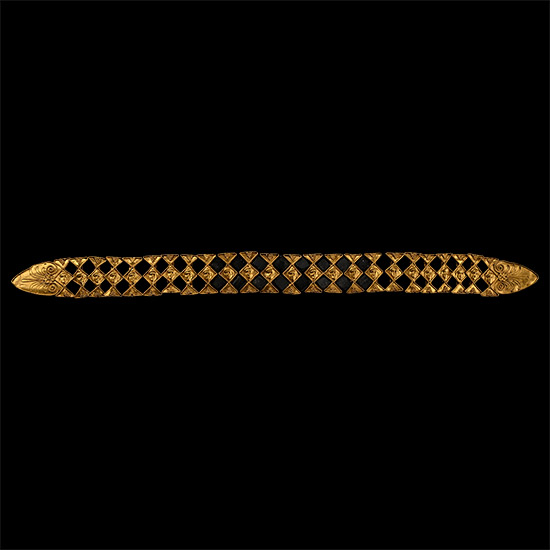
Greek Gold and Jet Diadem with Masks
Hellenistic, 3rd-2nd century B.C.Sold for (Inc. bp): £14,300
A gold necklace or diadem composed of twenty-two articulated units each in the form of a complex shields terminating in finials decorated with palmettes executed in filigree; body consists of shield-shaped jet(?) elements with a central rhomboid panel, joined above and below by triangular sections decorated with granulated triangles; the perimeter of each shield framed by a soldered beaded wire; at the centre of each rhomboid panel, an embossed appliqué mask in low relief; to the reverse of each element, two vertically aligned loops formed from narrow gold strips and intended for articulation; offered in a lined wooden display case. 22.5 grams, 21.6 cm
Ex M. Velensky collection, London, UK, 1990s. Accompanied by a copy of a four page examination report number 90/2015 by Dr habil Mikhail Treister. This lot has been checked against the Interpol Database of stolen works of art and is accompanied by search certificate number no.13104-248043.
The terminals are comparatively rare survivals, decorated with palmettes in filigree, a feature only occasionally attested among comparable assemblages from Bosporan contexts. The overall typology, decorative programme, and construction techniques closely parallel examples recovered from well-documented burials at Phanagoria, Pantikapaion, Tanais, and Tsukur-Liman. Comparable necklaces combining shield elements with embossed human heads are particularly characteristic of the 3rd-2nd centuries BC. According to the examination conducted by Dr habil. Mikhail Treister, there is nothing to challenge the authenticity of the object. The specific form, restricted geographic distribution, and close parallels suggest manufacture within a workshop of the Bosporan Kingdom, most plausibly in Phanagoria, one of its principal production centres during the Hellenistic period.
