
Loading, please wait...
LOT 0328
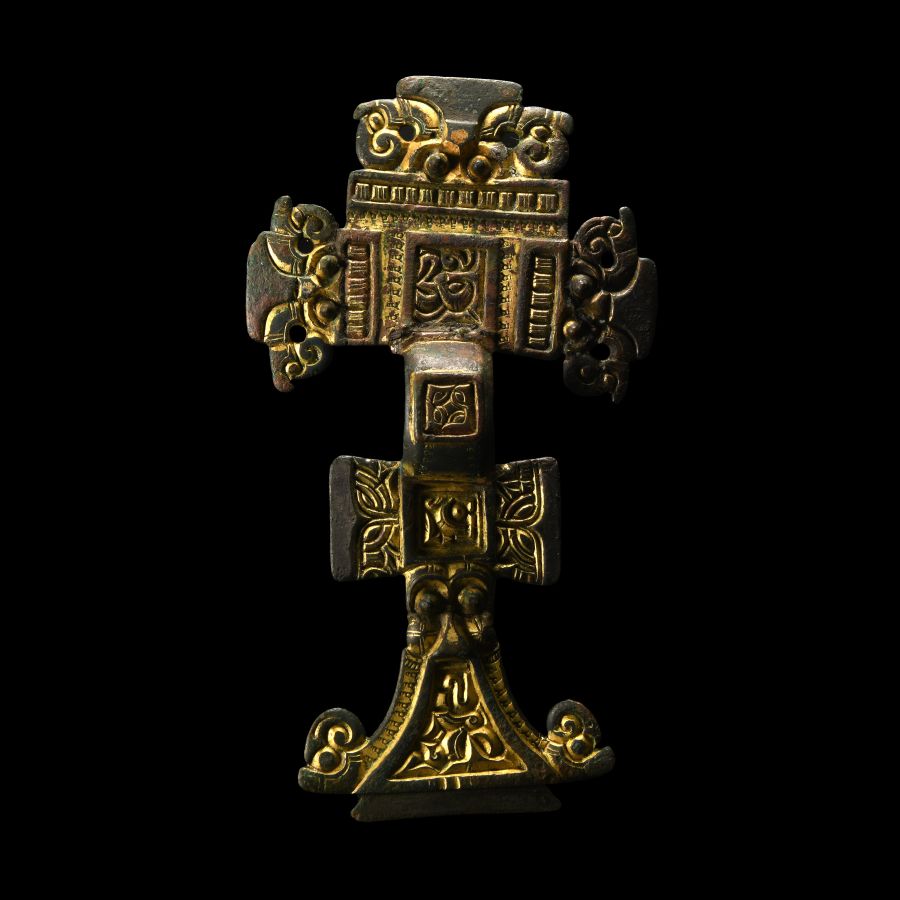
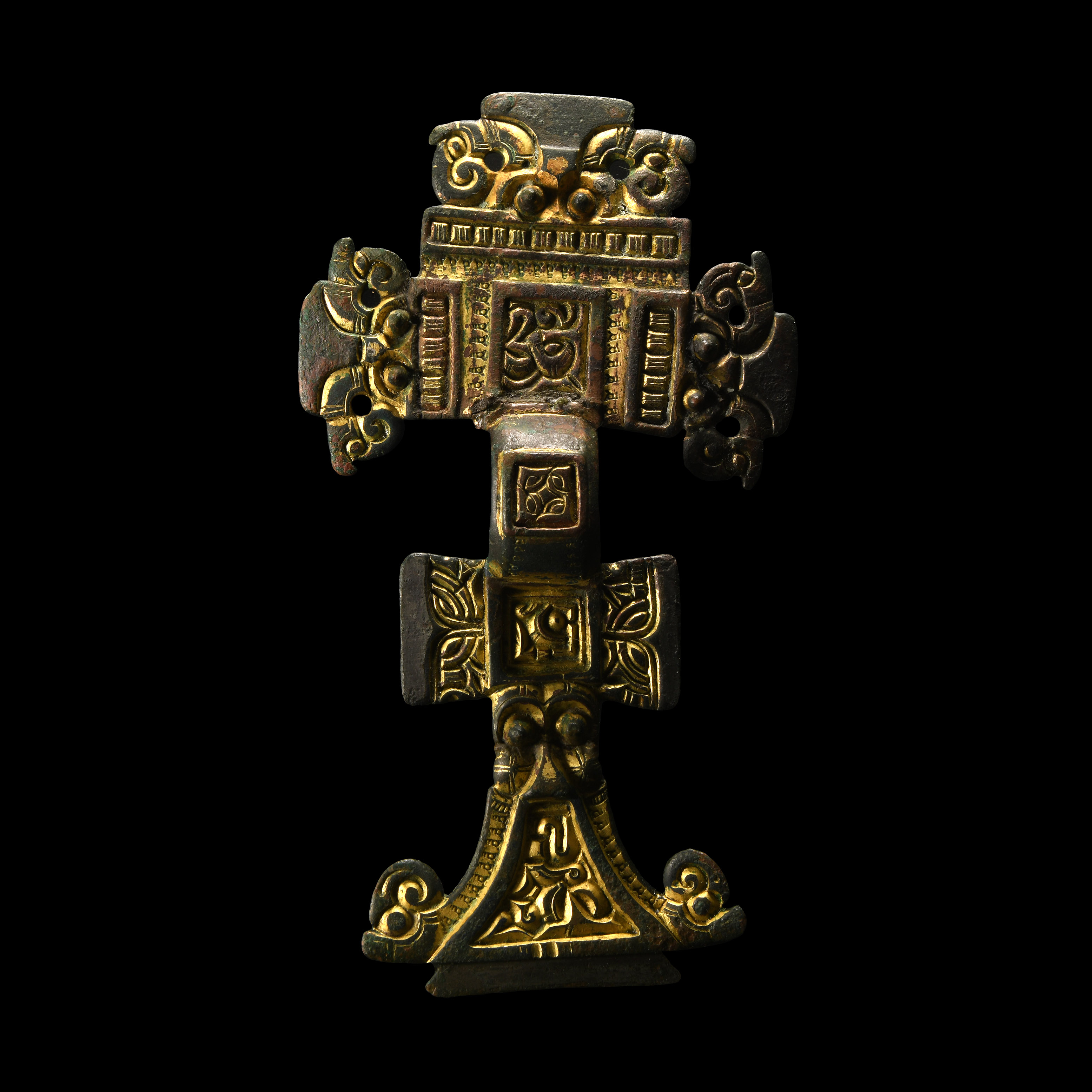
'The Scampton' Published Anglo-Saxon Gilt Bronze Florid Cruciform Brooch
6TH CENTURY A.D.
6 3/4 in. (182 grams, 17 cm).
Of Martin's Group 4 with rectangular headplate and florid face-masks to the three edges and conical eyes, deep bow with with square central panel, footplate with square lateral lappets, triangular face-mask finial with conical eyes; pin-lug and catchplate to the reverse; gilded surface abraded.
ProvenanceFound Scampton, Lincolnshire, UK.
From the private collection of Alan Harrison, circa 2000.
This lot has been checked against the Interpol Database of stolen works of art and is accompanied by search certificate no.11898-204375.
Leahy, K., The Anglo-Saxon Kingdom of Lindsey, Stroud, 2007, pl.7.
LiteratureCf. Martin, T., The Cruciform Brooch and Anglo-Saxon England, Woodbridge, 2015, p.78-9.
FootnotesThe florid type of cruciform brooch stands at the end of the series and probably dates to the middle of the 6th century according to the most recent discussion (Martin, 2015). The present example has a close parallel in the find from Duston, Northamptonshire, which Martin assigns to his Type 4.7.1, among the very last (or most fully developed) group in the seriation. The headplate, bow and footplate each have a square panel of Style I zoomorphic ornament within a thick frame; the headplate features blocks of billeting to three edges and punched triangular ornament on the frame, which also appears on the lateral edges of the finial. The conical eyes on the facing masks are an unusual and very distinctive feature which would have made casting the brooch a technical challenge. There is some evidence for silvering on the flat rectangular surfaces (T-shaped on the headplate and rectangular on the lappets and finial). The openwork masks on the headplate develop into profile bird-heads.
This brooch was recovered by a metal-detectorist in several pieces over a period of some years, and re-assembled. It was published by Leahy in his authoritative work on the Kingdom of Lindsey.
TimeLine Auctions follows a vetting process to ensure the authenticity and legality of all items, reinforcing our commitment to integrity and responsible trading. Each antiquity, antique, and coin lot undergoes thorough examination by a vetting committee of at least ten external specialists, professional trade association members, scientists, and archaeologists: Our Vetting Process
AUCTIONS:
TimeLine is a leading auction house specialising in antiquities, ancient art, collectables, natural history, coins, medals, and books. Our auctions offer museums, collectors, historians, and enthusiasts the opportunity to acquire unique and historically significant pieces.
LOT 0328
'The Scampton' Published Anglo-Saxon Gilt Bronze Florid Cruciform Brooch
Sold for (Inc. bp): £11,050
-
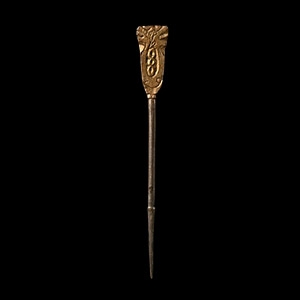
Saxon Silver-Gilt Pin with Beast Heads
8th century A.D.Estimate: £400 - 600 (‡+bp*)
Opening Bid: £200
With a flat, tongue-shaped head connected to the shaft by a rectangular collar; the shaft with a bulbous 'rib’ approximately 20 mm from the tip; the upper portion of the head with radiate detailing and a Trewhiddle Style zoomorph; recessed panel with knotwork motif below, within an elliptical panel with lateral flanches towards the base. 2.91 grams, 76 mm
Ex Lord McAlpine collection. Ex David Miller collection.
Dress pins of this period are often 'hipped', with a small bulb about two-thirds of the length of the shank in order to secure them in the weave of the fabric. The present piece is very delicate and would have been suitable only for a fine linen or silk garment of the highest quality. -
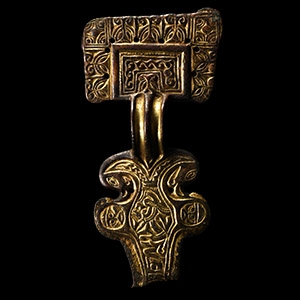
Anglo-Saxon Gilt Bronze Great Square-Headed Brooch
6th century A.D.Sold for (Inc. bp): £4,160
Of Hines's Group XIII with running scrolls on the headplate surrounded by a border of beast-masks, deep bow with raised ribs, curved horse-head lappets and lateral lobes with facing masks, median panel of Style I ornament; remains of ferrous pin to the reverse and deep catch; some silver detailing; finial absent. 77.9 grams, 11.5 cm
Found near Thetford, Norfolk, UK, circa 2010.
This brooch falls within Hines's Group XIII and shares many features with an example from Nassington, Northamptonshire. The headplate bears a raised rectangular frame (possibly silvered) separating the inner scroll motif from the outer band of animal-masks which are pierced along the inner edge; the lappets are also pierced at the point of junction with the footplate. The lateral lobes feature facing masks of a helmetted type similar to those featured on contemporary button brooches. -
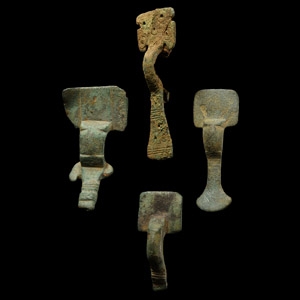
Anglo-Saxon Bronze Long Brooch Collection
Circa 6th century A.D.Sold for (Inc. bp): £111
Including one example accompanied by a Portable Antiquities Scheme record, the brooch with a rectangular head plate, arched bow and pelta-shaped foot; three additional brooches with transverse decoration. 63 grams total, 45-68 mm
Found Berkshire, UK. Accompanied by a copy of the British Museum's Portable Antiquities Scheme (PAS) report no.BERK-A98971.
