
Loading, please wait...
_900x900.jpg "'The Roxwell' Medieval Gold Signet Ring of 'King's Serjeant William Skrene'")
_200x200.jpg "'The Roxwell' Medieval Gold Signet Ring of 'King's Serjeant William Skrene'")
.jpg "'The Roxwell' Medieval Gold Signet Ring of 'King's Serjeant William Skrene'")
LOT 0392
'The Roxwell' Medieval Gold Signet Ring of 'King's Serjeant William Skrene'
14TH-15TH CENTURY A.D.
1 in. (8.01 grams, 25.00 mm overall, 20.49 mm internal diameter (approximate size British V 1/2, USA 10 3/4, Europe 24.4, Japan 23)).
Gold hoop and discoid bezel with incuse ropework border; incuse image of a bird of prey perching with wings spread and head turned; blackletter incuse and reversed inscription in an arc above the bird's head and pinions '·al : for : ye : best ·' (all for the best); repair to hoop.
ProvenanceFound while searching with a metal detector near Roxwell, Essex, UK, by Albert Robert Taylor on 4th September 2021.
Accompanied by a copy of the British Museum's Portable Antiquities Scheme (PAS) report no.ESS-CD68AE.
Accompanied by a copy of the report for H M Coroner on find of potential treasure with reference no.2022 T920.
Accompanied by a copy of a letter from the British Museum disclaiming the Crown's interest in the find.
Accompanied by a copy of the Treasure Act receipt.
Accompanied by copies of the relevant pages on an article about finding this ring in Treasure Hunting Magazine, August 2022, p.13.
'Gold Armorial Sheriff's Ring', Treasure Hunting Magazine, August 2022, p.13.
LiteratureCf. Ward, A. et al., The Ring from Antiquity to the Twentieth Century, Thames and Hudson, London, 1981, types 164, 165.
FootnotesThe ring's find location is close to an estate which was owned in the 14th century by the Skrene family and which included among their number a senior barrister and sergeant-at-law named William Skrene who was an Irish-born barrister and judge. The family name lives on to the present day at Roxwell with Skreens Park and for local road names nearby. Wiiliam spent his professional life in England, being appointed King's Serjeant and a judge of assize, as well as Chief Baron of the Irish Exchequer in 1395-7. In addition to the estate at Roxwell, he acquired various lands in Essex, including at Writtle, Great Finborough and Stanford Rivers. William died in 1419-20 and left sons and a daughter; his heir, also called William, married Alice Tyrrell, widow of Hamo Strange, and daughter of John Tyrrell, who was Speaker of the House of Commons of England for three terms.
The exact combination of motto and crest or badge has eluded researches thus far. However, the ring was found near Roxwell, Essex, and evidently belonged to a person of some wealth and status given the quantity of gold used in its manufacture and the quality of the workmanship. The style of the ring is close in appearance to a number of early 15th century examples, which began to appear with the badge and motto rather than the full armorial bearings, so it is very possible that this is the personal signet ring of William Skrene, or possibly of his sons, William or Thomas.
TimeLine Auctions follows a vetting process to ensure the authenticity and legality of all items, reinforcing our commitment to integrity and responsible trading. Each antiquity, antique, and coin lot undergoes thorough examination by a vetting committee of at least ten external specialists, professional trade association members, scientists, and archaeologists: Our Vetting Process
AUCTIONS:
TimeLine is a leading auction house specialising in antiquities, ancient art, collectables, natural history, coins, medals, and books. Our auctions offer museums, collectors, historians, and enthusiasts the opportunity to acquire unique and historically significant pieces.
LOT 0392
'The Roxwell' Medieval Gold Signet Ring of 'King's Serjeant William Skrene'
Sold for (Inc. bp): £23,400
-
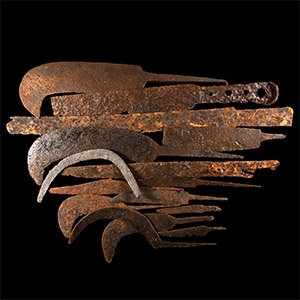
Medieval Iron Knife Blade Group
14th-16th century A.D.Sold for (Inc. bp): £39
Including cleavers, sickle blades, knives and others; mostly cleaned and conserved. 2.7 kg total, 11-51 cm
Acquired 1990s-early 2000s. East Anglian private collection. -
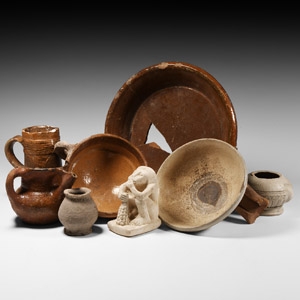
Medieval Ceramic Group
15th century A.D. and laterSold for (Inc. bp): £33
Composed of glazed and unglazed vessels including a small tankard, skillet, handled cup, spouted jar and other vessels, together with a statuette of a baboon; chipped and cracked. 3.4 kg total, 7-34 cm
Acquired 1990s-early 2000s. East Anglian private collection. -
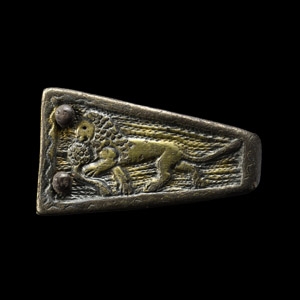
Medieval Gilt Lion Dagger Chape
13th century A.D.Estimate: £200 - 300 (+bp*)
Opening Bid: £100
With raised border and image of the lion of England and plant on a textured field; running zigzag border with points to the folded edge. 4.64 grams, 28 mm
Fine condition. Rare.
Private collection, before 1976. Thence by descent.
